
The Senses of the Fair and the Fair of the Senses in Seville, Spain
- Gabriela Vargas Cetina
- Steffan Igor Ayora Diaz
- - see biodata
The Senses of the Fair and the Fair of the Senses in Seville, Spain
Receipt: September 8, 2025
Acceptance: December 11, 2025
Abstract
In this article we propose that the April Fair in Seville, Spain, is a multisensory, synaesthetic and synesthetic experience that reaffirms Sevillian identity and highlights identity boundaries between locals and visitors, while underlining local social differences. Drawing on the work of Paul Stoller and David Sutton, as well as our fieldwork in Seville between 2017 and 2025, we describe the synaesthetic and synesthetic experience of the Feria de Abril as dimensions that invoke “the Sevillian.” We argue that the recognition of sensory experience contributes to a complex anthropological approach to the political dimension of local events.
Keywords: anthropology of the senses, April Fair, Sevilla, synaesthesia, synesthetics
senses and meaning at the feria de abril in seville, spain
This article explores Seville's April Fair as a multisensory and synesthetic experience with its own distinctive sensory aesthetics, showing how it reaffirms Sevillian identity, it highlighting boundaries between local residents and visitors, and accentuates social differences among the locals. Drawing on the work of Paul Stoller and David Sutton, as well as ethnographic fieldwork in Seville conducted between 2017 and 2025, we describe the synesthetic experience of the April Fair as a set of dimensions that invoke “the Sevillian.” We propose how attention to the sensory experience contributes to a more complex anthropological understanding of the political dimensions of local events.
Keywords: synesthesia, synaesthetics, sensory anthropology, Seville, April Fair.
Introduction: more than a party
Those were the days of the Seville Fair of 2022. We arrived in Seville from Merida, Yucatan, at the end of April. The Seville Fair attracts tourists from all over Spain, but particularly from Madrid. For this festival, Renfe, the Spanish railway company, added, as it does every year, cars and trains to bring Spanish and foreign tourists to and from Seville, taking advantage that year of the two days off that coincided with the week of the Feria: the Wednesday of the Feria, which is not a holiday in Seville every year, and the workers“ day on May 1. The hotels were charging high prices and yet they were full, as were the so-called ”tourist rental apartments," as apartments rented for short periods of time are known in Seville. We found a modest hotel in the old part of the city and were only able to occupy an apartment until the end of the Feria. During one of those days, we found ourselves in the booth of one of the Spanish political parties with a strong presence in Andalusia. The heat was intense at the beginning of May (around 40°C) and, although the booth was covered with tarpaulins, the heat in the air was felt strongly on the skin, which was barely sweaty from the dry air.
At midday, the streets of the Feria area were crowded with a large number of fairgoers, and in the political party's booth, the music of songs “por sevillanas” could be heard, played on an electric sound system. At the veladores, as the one-legged tables set up on terraces are called, and at tables inside the booths, men and women drank cañas (medium-sized glasses) of local beer, rebujitos (manzanilla wine mixed with lemon soda) and glasses of manzanilla wine and sherry, while girls and boys consumed soda pop. Many men, despite the heat, wore vests and dress jackets and the women, in large numbers, wore the Sevillian clothes known in Spain and abroad as traje de flamenca (flamenco dress). Among the tables and on platforms in some booths, both children and women and some men danced to the sound of the songs by Sevillanas. At the bar tapas were sold that local visitors and tourists recognize as “typical” Sevillian “tapeo”, consisting of small portions of various dishes: potato omelettes, shrimp salad, Russian salad, Iberian pork cheeks, seasoned potatoes, sirloin steak with whiskey, shrimp omelettes, ham croquettes and fried anchovies and sardines, among others.
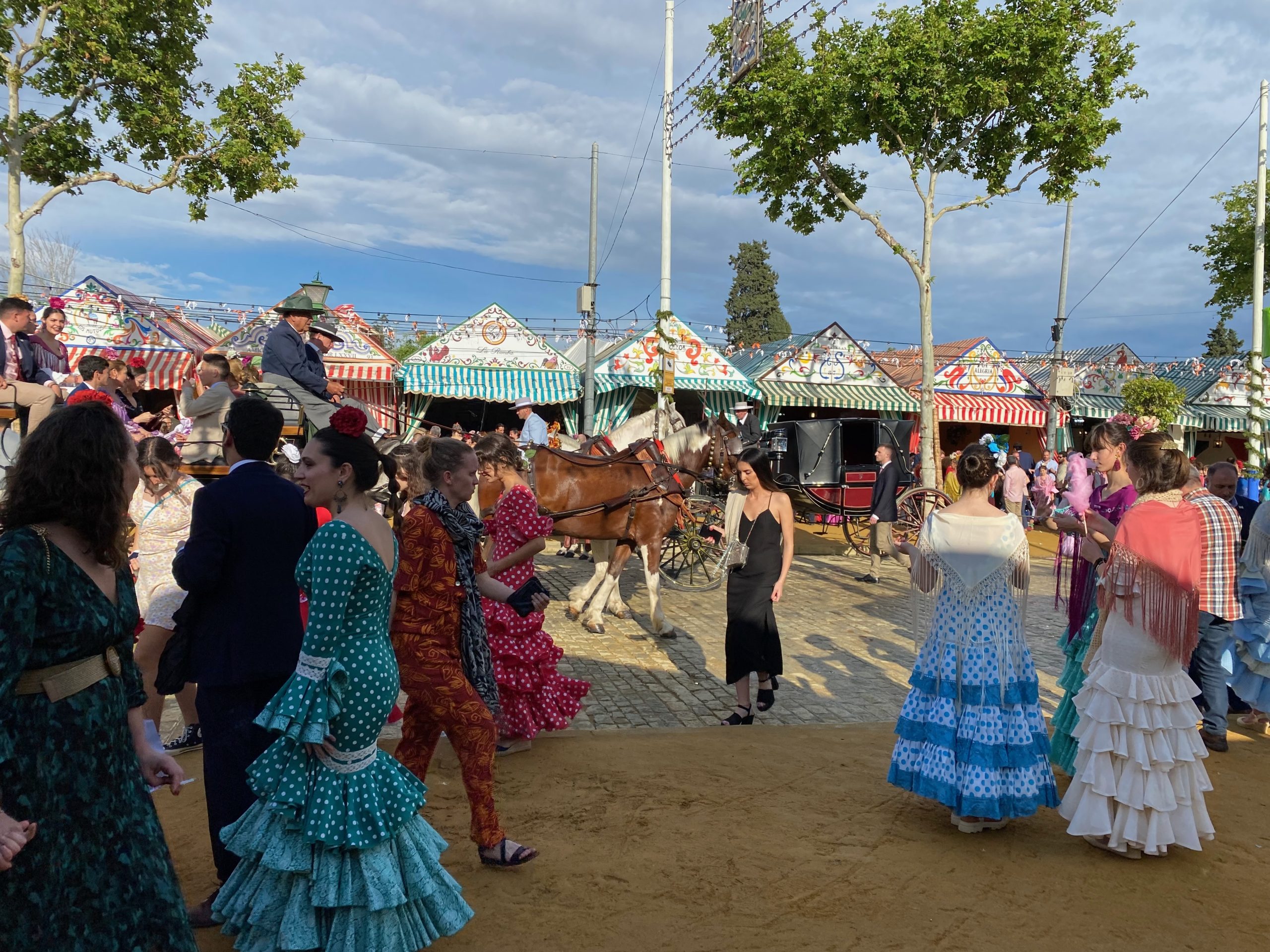
The streets, which have been named after famous bullfighters, were sunny, and the reddish-yellow sandy floor reflected the sunlight. The smell of the horses (including their urine and excrement), the sweat of the humans, and the aromas of the food being prepared and consumed in the various stalls wafted through the air (Figure 1). As the afternoon hours passed and evening came, the density of passers-by in the streets and guests in the booths increased. At this point, the alcoholic beverages consumed had an effect on some of the fairgoers, who enjoyed themselves without worrying, since “what happens at the Fair, stays at the Fair”.
The Seville Spring Fair is an annual festive event. The beginning and course of long days with family and friends is eagerly awaited. It is enjoyed on a daily basis by fairgoers, both locals and tourists. However, as we will show in this article, the Seville Fair is neither a socially, culturally nor politically neutral event. Our argument is that the synaesthetic experience of this event contributes to highlight and affirm sociocultural practices with an important political and economic component that distinguish Sevillians from each other, from other Spaniards, and from foreign “guiris” (tourists).
Bullfights are a very important element during the Feria de Abril. However, we do not consider them in this article because in Seville the bullfighting season is a festival in itself: it joins the Spring Festivities with the Autumn Festivities, as it starts on Easter Sunday, with which ends the Holy Week, and ends with the last festivities of the San Miguel Fair, in the so-called “Corrida de Miura”. This is a bullfight in which the bulls come from the Miura Livestock, specialized in fighting bulls (Real Maestranza de Caballería de Sevilla, 2024).
The religious festivities of Holy Week have often been studied together with the commercial and ludic festivities of the April Fair as part of a unique complex of Spring Festivals (Aguilar Criado, 2002; Palma Martos, García Sánchez, Palma Martos, 2008; Palma Martos, Palma Martos, Martín Navarro, 2014). However, as we show below, these festivals, which initially coincided, have been distancing themselves in two ways: on the one hand, in time, as now days are interposed between Easter and the Fair. On the other, in their meanings, since Holy Week is a period of primarily religious celebrations, while the fair is dominated by a secular, commercial and festive character (Sánchez Carrasco, 2019).
Unlike previous studies, which generally focus on the economic or marketing dimensions, in this paper we want to contribute to the study of the April Fair from the field of sensory studies. We propose that also in this dimension there are great contrasts in the individual and group experience: for Sevillians, the Feria is a collectively imagined reiteration of the sensory ways of being Sevillian. This “being Sevillian” -as described in different paragraphs of this article- includes the experience of inequalities in society, illustrated by the differential access to different types of clothing, to spaces for festivities, to the type of drinks and food, as well as to other symbolic forms of power, such as riding in carriages and/or horses within the fairgrounds (with a cost set by the city council, in 2025, of 95 euros for a one-hour ride).
The Seville Fair, then, constitutes a multisensory stimulation that integrates colors, aromas, flavors, tactile stimuli, experiences of social spaces, as well as different bodily manifestations that underline the character of a party and of being or not being from Seville. In the following sections we explore historical and ethnographic aspects of this festival as a social event in which, through the bodily senses, the collective experience of what this week of coexistence means to Sevillians is constructed.
The party and its senses
In Spain there is a widespread stereotype that Sevillians are more dedicated to partying than to work. We have even heard sevillanas and sevillanos express this opinion and compare Seville and Andalusia unfavorably with regions such as Catalonia and the Basque Country. Here we refer to the fiesta as a socially positive and important event that allows its participants to break away from the formal structures of everyday life and allows subjects the freedom to express themselves in a playful way (Brisset, 2009). The many local festivals, such as Easter Week, the Pilgrimage of the Virgen del Rocío and the Corpus celebrations, combine the religious and the ludic, and have been widely described and analyzed from anthropology (Hurtado Sánchez, 2002; Moreno Navarro, 1992; Murphy and González Faraco, 2002).
In the case we present, this ludic dimension should be seen as a set of practices that underline the Sevillian aspect of the event and of the different aesthetic and affective manifestations. These allow the Sevillians to stage the clothes, food, drinks, as well as other elements: music, dance and various exhibitions that have become signs of what is Sevillian and Andalusian. The cover and the casetas, described below, are ephemeral forms of architecture that invoke the Andalusian and Sevillian aesthetics. We do not rule out, as Salvador Rodríguez Becerra (2008) has pointed out, that this joy and sociability may, on different occasions and places, mask that the interactions and drinks consumed lead to what that author calls “debauchery” and violent situations. However, our objective is to point out the valorization of the Seville Fair as an expression of identity, playfulness and expression of social order through synaesthetic and synesthetic experiences.
From anthropology and sociology it has been argued that the fiesta is particularly important to highlight, on the one hand, the identity of local subjects and, on the other, their differences with outsiders, those who do not fully share the local identity (Homobono, 1990). One of the characteristics of the fiesta is that it takes place in public spaces and, although during part of the 20th century folklorist studies on fiestas focused on rural societies, it is now widely accepted to recognize fiestas held in urban environments, as well as their different modalities: religious, secular or political (Pujol Cruells, 2006). Since the last century, different anthropologists pointed out the importance of the festival as an urban celebration that allowed the affirmation of identity through symbols that aimed to celebrate economic practices already in decline, partly obscuring the fact that they were losing relevance in local and regional society (Konrad, 1983; Manning, 1983).
In different areas of the Mediterranean, the festival has been seen as a stage for political confrontations between factions of the people (Boissevain, 2013; Magliocco, 1993). Other aspects of festivals, underlined by Victor Turner (1974), are their ritual dimension that allows both to reproduce social structures, as well as to question them, and their magnitude as a social drama, as a stage on which they are held performances which are also aimed at the maintenance of the social structure. Turner's influence has been important and is frequently written about ritual, performances and festivals with overlapping meanings. All these themes are complementary, as they do not exclude each other: the festival is playful, it is political, it is a source and vehicle of identities (ethnic, local, regional, political, religious), and it can contain and transgress ceremonial and religious aspects.
We find it significant to analyze the fiesta as “celebration”, especially because in Seville rites and rituals are also part of the celebration. Frank Manning (1983: 4) identifies four characteristics of what he and his collaborators call “celebration”. First, it is a form of performance social and political; second, it is entertainment for enjoyment; third, it is public; and fourth, it is participatory. In theory, everyone can participate, although in practice there are different levels of participation and exclusion. These aspects are recognizable in our description and analysis of the Seville Fair. However, our emphasis, in contrast to the previous ones, will be on the role that the sensory and aesthetic experience plays in the celebration of this annual event, in its significance and in its political-identitarian dimension and effect.
The field of the anthropology of the senses, together with other fields of social and cultural studies dedicated to the subject, has already had a long development (Howes, 2022). Given the limits in length of an article, we will not attempt here to gloss all the works on the subject, but only highlight some concepts that seem relevant to the present text. An important starting point was pointed out by Paul Stoller (1997), who vindicated sensual anthropology. Stoller proposed that it is necessary to break with the Cartesian dichotomy that has separated the body from the mind. Instead of understanding them as separate, we must recognize that sensual-sensory experience and cognition, knowledge, complement each other. Consequently, we must abandon the idea that the anthropologist's vision is like an objective recording machine that captures only “truth”.
Despite an ongoing concern with multisensoryity, it is worth noting that, since its inception, this field of sociocultural studies has generally emphasized each of the senses separately. For example, Constance Classen (2012) has examined the ways in which the sense of touch is socially constructed and employed (Erin Manning, 2007). Studies on the importance of vision are numerous (Belting, 2011; Heywood and Sandywell, 2014). Aural experience has also been analyzed in its social, cultural and political dimensions (Feld, 1990; Groth and Schulze, 2020; Schulze, 2021). The same has happened with aromas, which socially and culturally have been examined as mechanisms of social inclusion and exclusion (Classen, Howes and Synnot, 1994; Larrea Killinger, 1997). Taste (flavor) is another sensory experience that is strongly marked by the political, the social and the cultural (Counihan and Højlund, 2018; Korsmeyer, 2002; Trubek, 2009). This separation corresponds, as Paul Stoller emphasized, to the modern rationalist gaze and to the establishment and validation over centuries of a hierarchy of the senses. This hierarchy has been widely reviewed and criticized. For example, Carolyn Korsmeyer (2002) has examined how, since the classical Greek philosophers, the sense of vision has received recognition as the one that brings us closest to truth, followed by hearing. It has been accepted that, since both senses operate at a distance, they allow us objective knowledge of the world. In contrast, it has been argued that touch, smell and taste are senses of proximity and, therefore, are subjective and unreliable for knowing the world. Since the emergence of the anthropology of the senses, the challenge has been to show how the senses can operate in a supplementary way and to emphasize multisensoriality as necessary for knowing the world (Calvert, Spence, & Stein, 2004).
Given this theoretical-conceptual separation, David Howes (2005) redefined the medical term “hyperesthesia” (heightened sensitivity to stimuli) to refer to the conscious and instrumental manipulation of the senses to motivate consumption in the contemporary stage of late capitalism. For example, automobile manufacturers produce designs that visually appeal, modify the sounds of the engine and music players, the scent again, as well as the textures of metal and car upholstery. This sensory manipulation has proven useful for the marketing of food and processed ingredients in which the use of colorants and other additives is done with the intention of visually stimulating desire for these objects/goods (Hisano, 2019), as well as with the use of chemicals that seek to encourage consumption through scent combinations (Ramišak, 2024).
Focusing on subjects, both consumers and human groups producing cultural practices and objects, David Sutton (2010) redefined the term “synaesthesia”. Medically, synaesthesia refers to the irregular connection between senses: seeing music in colors, smelling flavors and so on (Cytowic, 2002). Sutton (2010: 218) proposes that in anthropological analysis we understand synaesthesia as a learned skill developed through practice and language. Food, he points out, is an ideal vehicle for this experience. In food we put into action all the senses: it produces a visual stimulus and transports aromas; we feel its texture, taste its flavors and hear both the sounds of its preparation and different sounds of softness or crunchiness when we cut or split it on the plate and when we chew it (Ayora Diaz, 2019, 2021). To this supplementary relationship between all the senses, together in action, Sutton (2001) adds the role of memory. Our memory of the consumption of meals provides a support for the multisensory experiences of the present.
The recognition of the importance of multisensoriality in food has motivated the search for strategies to promote among restaurateurs and chefs the vision that the success of a restaurant is based as much on the visual dimension of the plating as on the flavors of the food, the design of the space, the furniture, the “ambience”, the music, and other sensory stimuli (Spence and Piqueras-Fiszman, 2014). Although food has so far been the focus of studies on these complex synaesthetic relationships, the study of synaesthesia in relation to art has begun. It is in this context that Gordon (2020: 4) proposes that synaesthetic experience is largely synaesthetic, for example, from the relationship between the writer and his or her reader, and in the ways in which description or images appeal to other senses. However, Gordon restricts his analysis to the production and experience of art. We propose that from anthropology we can approach the synaesthetic in ways that allow us to recognize the importance of the sensory, sensual, and aesthetic conjugation and experience of the world, and, through these bodily and affective aspects, to understand how forms of social identification and exclusion are constituted.
In another text we have argued that aesthetics, as a discipline, has ceased to focus solely on great art, and there is a greater recognition of the values and practices that underpin an aesthetics of the everyday (Ayora Diaz, Vargas Cetina and Fernández Repetto, 2016). This recognition led us to use the concept of synesthesia proposed by Sutton (2010) to analyze different cultural phenomena and practices related to food, music, and the use of platforms for remote interaction in Mérida, Yucatán. Here we will focus on the Seville Fair, to show how all the synaesthetic sensory registers come together in a synaesthetic experience that affirms the Sevillian and Andalusian identity before the rest of Spain.
Methodological ExcursusThis article is based on 13 months of fieldwork in Seville, Spain. Since 2017 we have made short research stays: one month in 2017, two months in 2018, six months in 2022, two months in 2024 and two months in 2025. With the exception of the first visit, on each occasion we have remained affiliated as visiting professors at the University of Seville. During these stays we have conducted observations, participant observation, semi-structured interviews, informal conversations with Sevillians and residents of the city from other regions of Spain. During the periods when we have not lived in Seville, we have remained in contact with friends in the city through Facebook, WhatsApp, video calls, and Messenger. In addition, we have followed the events in the daily newspapers ABC de Sevilla and Seville Newspaper, as well as in news channels on YouTube and social media. We have been accepted in social media groups in which Sevillians comment on the past and present of the city. Among these conversations, Holy Week, Corpus Christi Thursday, the Spring Fair and the Flamenco Biennial are constant topics that our interlocutors describe as highly significant for local society. The topics we investigate are interconnected. Gabriela Vargas Cetina investigates the musical organizations that accompany the religious processions of Holy Week, but also rehearse and perform their music at multiple different events throughout the year. Steffan Igor Ayora Diaz examines the values and forms of representation of regional gastronomy in Seville, interviewing home cooks and chefs and restaurant owners. All our research has been self-financed, so, following Schengen rules, we have not stayed more than three consecutive months in Europe.
We draw, in part, on Paul Stoller, Phillip Vannini, Dennis Waskul and Simon Gottschalk (2012: 63), who argue that. sensuous scholarship refers to a type of research, theory and methodology that is “...".“about the senses, through the senses, and for the senses.”(italics in the original). They propose that all research techniques can be enriched by paying attention to the bodily senses; that is, there is no technique exclusive to this approach, but a sensitivity of the researcher that allows him or her to pay explicit attention to the sensory experience (Vannini, Waskul and Gottschalk, 2012: 68-69). They argue that this type of work is constituted partly by showing and telling, partly by describing, and partly by interpreting (Vannini, Waskul and Gottschalk, 2012: 74). Meanings appear to operate subjectively, but in practice they acquire meaning through dialogue between us (the researcher) and, in particular, with the inhabitants of Seville. In terms of writing, these authors propose that, if “we choose to write sensually, we should consider abandoning the typical structure of articles, such as a predictable sequence of introduction, literature review, method, analysis of the given, and conclusions, which restricts the potential of sensual writing” (Vannini, Waskul and Gottschalk, 2012: 75). They add that theoretical knowledge should be integrated into writing and not in a separate section. For them (and us), this “traditional” way of writing articles has the risk of a relapse into the Cartesian separation of the rational mind and the subjective body (Vannini, Waskul and Gottschalk, 2012: 75). Consequently, we have decided to maintain the qualitative narrative structure and to explain here, through this excursus, the reasons for our writing.
The Seville Fair: from livestock market to popular festival
The Andalusian capital is recognized regionally and nationally for its festivals. According to the contemporary definition of “fiesta” that we have obtained from people, publications and media in Seville, a fiesta would be an event that suspends the everyday, installs sets of practices of sociability, of community, and involves special activities related to those particular dates. According to Antonio Romero Abao (1991), in the past, Andalusian festivals combined the sacred and the profane. His study -based on 15th century documentary sources- records events related to the noble families of that city, from births, deaths, marriages, royal entries, to religious festivities such as Corpus Christi. In all these celebrations there was a religious dimension that was accompanied, at the same time or afterwards, by recreational activities. According to the graphic descriptions published by the Municipal Photographic Library of Seville, the main festivities of the city during the 20th century were, and still are: the Holy Week of Seville, the April Fair, the Pilgrimage of the Virgen del Rocío, Corpus Christi, the Velá of Santa Ana (an evening is celebrated in Triana around July 26, the day of this Virgin), the Virgen de los Reyes (August 15),1 the San Miguel Fair (during the fall), Christmas and the Feast of the Three Kings. Some festivals have been suspended. This is the case of the carnival, which was banned in 1937 by Franco's government and has not been revived (Aguilar, 1983).
The Seville Fair is one of the local celebrations that are regionally important. The current events have their distant roots in the agricultural and livestock fairs of the Middle Ages. It was during the 13th century that the then King of Spain, Alfonso X, The Wise, authorized the celebration of two fairs in Seville (Sánchez Carrasco, 2019), which persist: one during the spring and the second during the celebration of San Miguel, in the fall; however, it is the April Fair that receives greater recognition and a growing number of visitors. In the beginning, these were commercial fairs, important for predominantly rural populations, which provided a space for the market of large and small animals (cattle, sheep, goats and pigs) (López Martínez, 2020). These events reflected the importance of livestock in rural areas since the Middle Ages (López Martínez, 2005), but they gradually lost popularity, almost to the point of disappearing. It was in 1846 when two residents of Seville argued that it was necessary to establish dates for livestock trade fairs. Once accepted by the Seville town council, the first Spring Fair was held in 1847 (Collantes de Terán Delorme, 1981; Sánchez Carrasco 2019).
Since then, the Spring Fair, with commercial predominance, was accompanied by the construction of booths in which the families of ranchers and merchants settled for a few days. In these booths, after the daytime deals and negotiations, recreational activities were held during the night. Gradually, these activities began to take precedence in the Fairgrounds until, during the 20th century, they ended up displacing the economic activities and establishing the predominance of festivities, dancing, food and horses (Collantes de Terán Delorme, 1982). Today, authors who have written about the Seville Fair focus their descriptions on the costumes, music, carriages and booths. For many, the commercial livestock aspect of the fair has already been displaced and it is the festive and playful that dominate over the other experiences of the annual event (Collantes Terán Delorme, 1982; Sánchez Carrasco, 2019).
The Fair has gone through multiple transformations over the decades. First, focused on the animal market, it was held in the Prado de San Sebastian, sometimes occupying parts of the Maria Luisa Park and land that since the 1920s occupies the Plaza de España. However, after a beginning with few booths, installed by the merchants and their families, private booths began to appear and these have increased in number until reaching 1,057 in 2025. Currently, most of the booths belong to family groups and unions, while 31 booths belong to brotherhoods and confraternities of Seville. The casetas owned by families, brotherhoods, sisterhoods and other local groups have access only to their members and their guests. All the booths have at least one guard who watches who enters and prevents access to those who do not have access. There are 18 booths of the political parties, some unions and one of the brotherhoods (Hermandad de la Estrella), along with others installed by the municipality, the tourist office and some commercial interests, to which visitors have free access, although they must pay for their drinks and food.
The year 1972, the needs of booths exceeded the capacity of the Prado de San Sebastián and the political-administrative decision was made to move the Fair to the other side of the Guadalquivir, occupying part of the neighborhood of Los Remedios, where it began to be held from 1973 (Sánchez Carrasco, 2019: 54). To this day this is the site of the so-called Real de la Feria or grounds where it is held; as reported in the. ABC de Sevilla (2025), during 2025 the mayor of Seville decreed to build 250 additional casetas by 2026. For this reason, the land will be expanded, as there are waiting lists of families and groups of friends who have been paying annual fees for thirty or more years in the hope of obtaining authorization to have one of these booths.
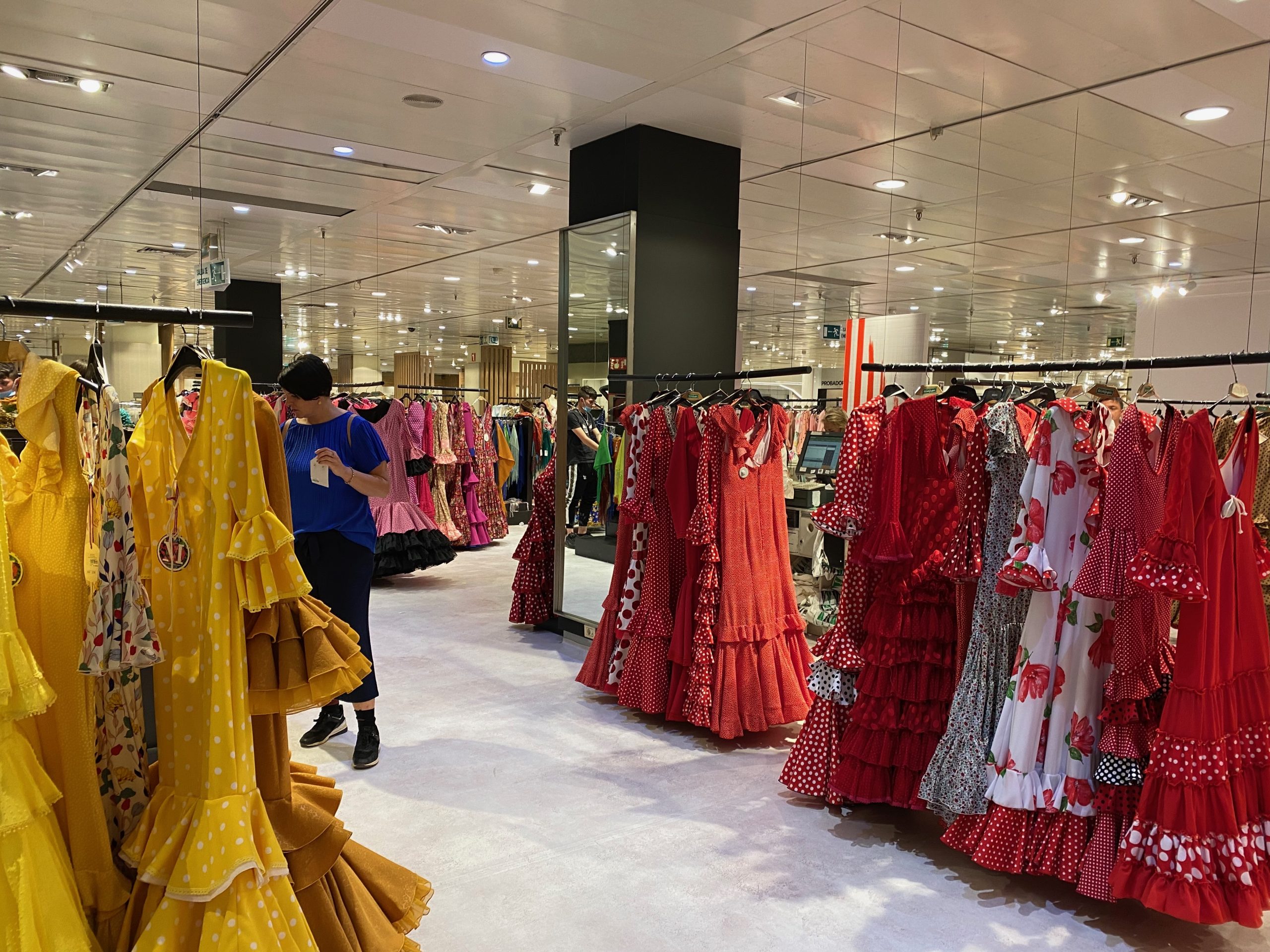
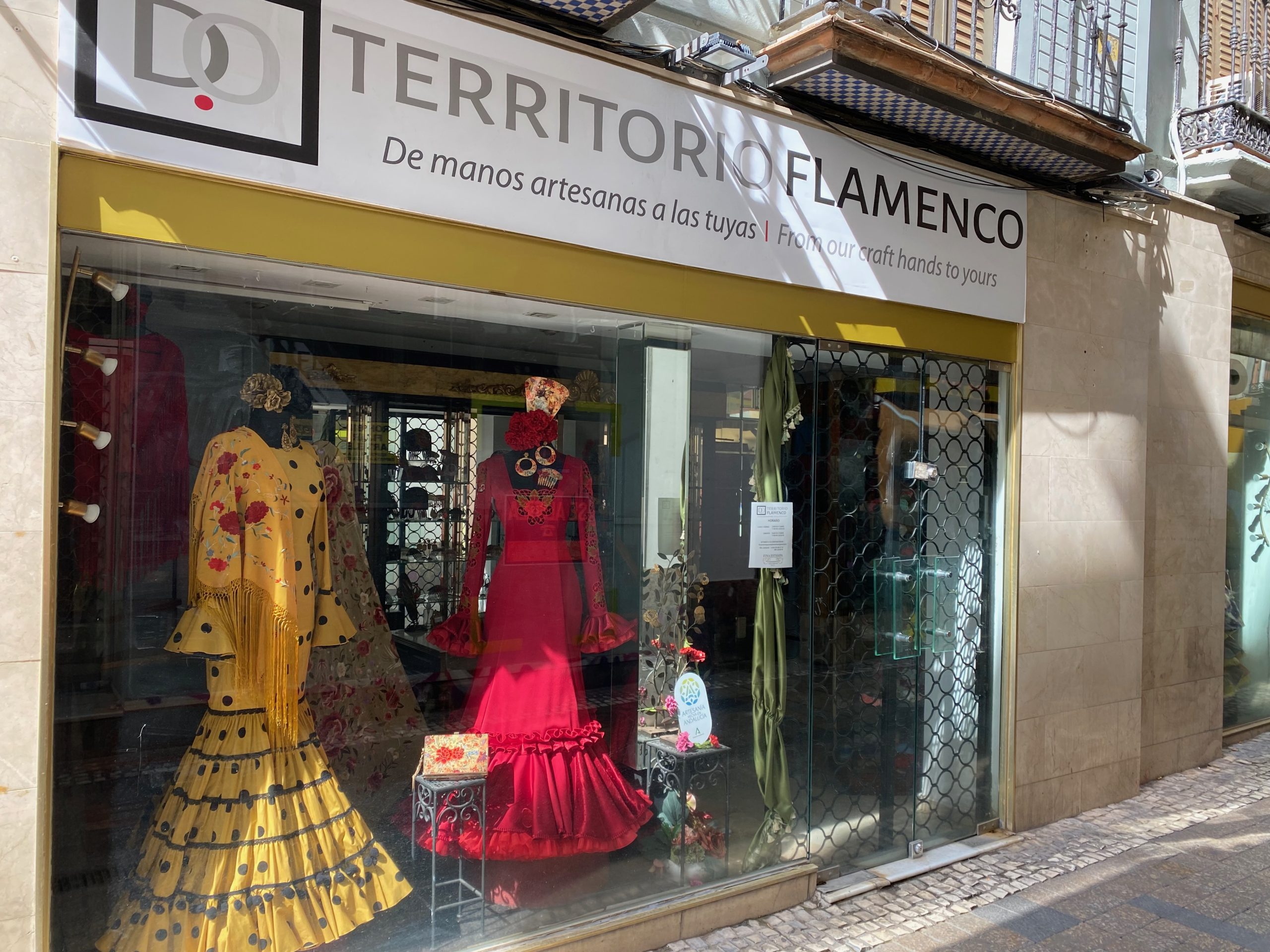
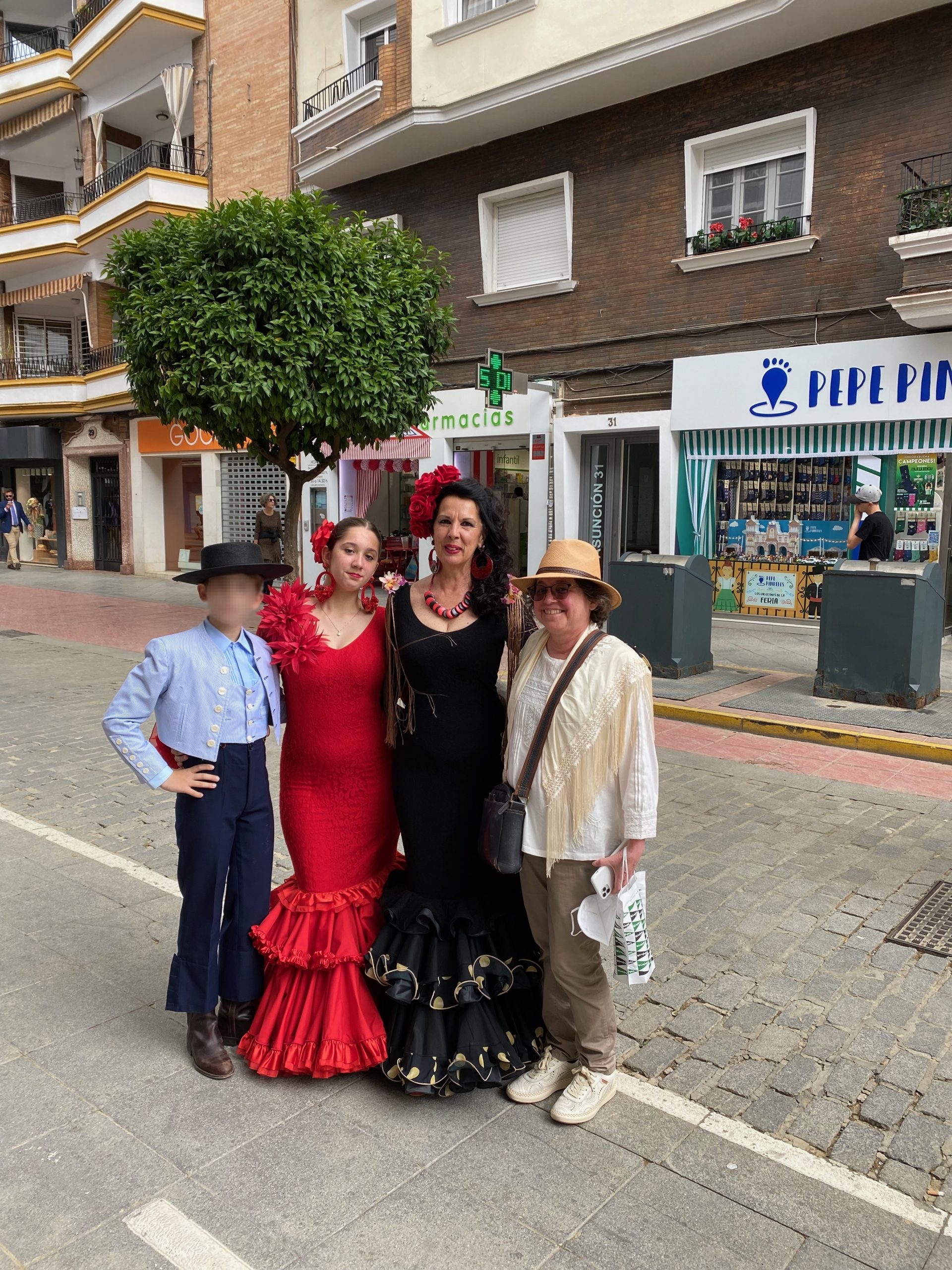
From the distribution of the “casetas” it is clear that not all and not all Sevillians enjoy this festival in the same way. If one does not have an invitation to a private booth, one must seek rest, food and fun in the public booths. Almost from the beginning, a "street of hell" has been included, where mechanical games are installed and circus shows are performed. This street has occasionally been the scene of violent acts, prostitution and in general situations that Sevillians judge as contrary to public morals. The need for an invitation to access the casetas of Sevillian families also applies to the growing number of tourists who come to Seville to enjoy the Feria. If a visiting woman wants to feel part of the atmosphere, she has to consider that dressing up as a flamenca involves a large expenditure of money (we have seen stores and specialized stores where the price range of dresses goes from a few hundred to around a thousand euros) (Figures 2 and 3). The fashions of these dresses change frequently, and for Sevillanas it is important to reflect these fashions in the streets and booths of the Feria. Men who want to join in must dress in suits, at least with a jacket and tie. Even if women are dressed in flamenco dress and men in suits and ties, visitors are not guaranteed access to the private casetas without an invitation.
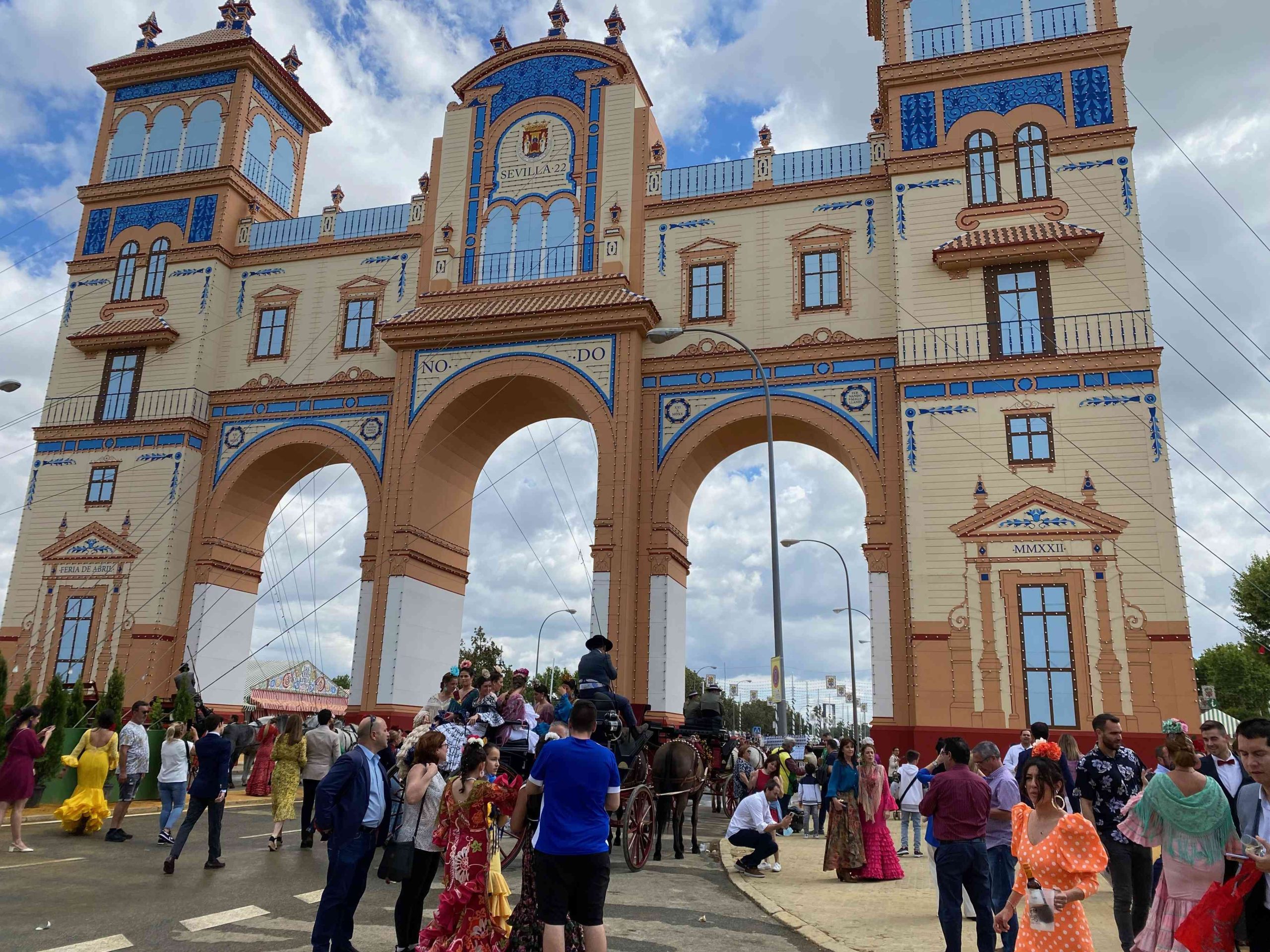
The Fair begins with the night of the lighting and the “pescaíto”. Since 1937, it became mandatory for the city council to call a competition to design and build a “portada”: a complex of ephemeral architecture that is placed at the entrance. This cover evokes Sevillian buildings and churches, as well as pavilions of the international exhibition of 1929. Since the beginning of the 20th century, the portadas have taken advantage of and displayed a symbol of modernity: electricity. The covers incorporate thousands of electric bulbs; the night before the start of the fair, thousands of people come to witness (along with the television media) the lighting of the lights, including the cover and the streets where the booths are located. In 2022, the façade displayed 25,000 LED lights. This event, celebrated locally, is followed by a private dinner, known as the “pescaíto”, in which the partners (casetas owners) gather to eat fried fish. According to a newspaper report, this activity has been in existence for about 55 years, when once the casetas were finished, their owners entertained the workers with fried fish (Acevedo and Sanmartín, 2025). Gradually, this celebration was adopted by the owners of the casetas and has become the social act that follows the lighting of the front lighting and precedes the first day of the Seville Fair.
A transformation that has been dynamic throughout the more than one hundred years is its timing and duration. In the beginning it coincided with days of the Holy Week, even its posters announced both festivities at the same time. Little by little they have been distanced in the calendar. The Fair at the beginning lasted three days, but, when the focus was the livestock market, it was extended for weather reasons. Thus, in 2016, after a survey conducted by the Socialist Party, it was agreed to extend it to eight days. In 2025, after a popular consultation carried out with the support of the Popular Party and Vox, it was returned to the “original” format of five days (Flores, 2025). However, days more, days less, the Fair continues to attract visitors from Madrid, Portugal and other European regions, as well as international tourists from other continents. During 2022, after two years suspended due to the Sars-Cov-2 pandemic, we attracted more than two million visitors and, since then, the numbers have increased. In 2025, despite the city council cutting the days of the event to five, it was reported that there were more than three million visitors (Del Pino, 2022; Daza, 2025).
Let's go to the Fair: synaesthesia and synaesthetics of an annual festival
Going to the Fair and enjoying it is a multisensory and aesthetic experience. We believe it is possible to qualify it as synaesthetic and synaesthetic, since, on the one hand, it involves all the senses and, on the other hand, each sense is accompanied by sensual experiences and aesthetic evaluations that have an intersubjective character. In the following, based on our experience and interlocution with local people and visitors, we describe these sensual-sensory and aesthetic modalities of and for the senses.
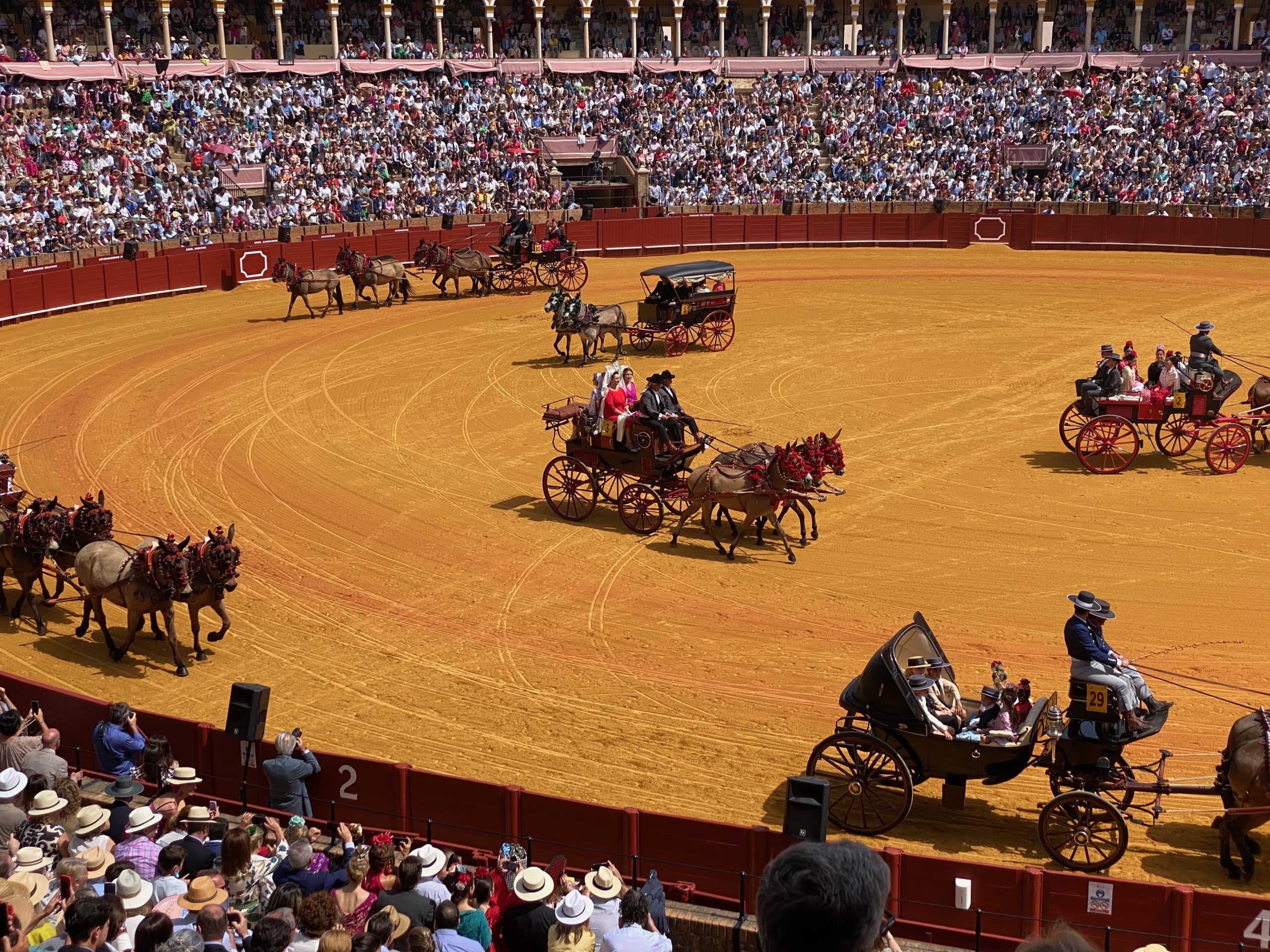
The day before the Fair, the “enganches” event takes place. During that day, ranchers, agricultural entrepreneurs and wine producers claim the mercantile inheritance of the celebrations. From the night before we observed private carriages traveling through the streets, heading towards the Arenal neighborhood, in the vicinity of the Maestranza Bullring. Early in the morning we could see different carriages lining up, which, according to a Sevillian explained to us, are originals from the end of the century or the beginning of the 20th century (new carriages are not allowed, only “classics”). Among the carriages belonging to Andalusian businessmen, there were others from Portugal and Italy. The owners and their families, women and children rode in them. The women were dressed as flamencas and the men, with regional costumes in gray tones and black hats. After parading through the streets, they went to the bullring where, in turns, different carriages competed against each other (Figure 4). Although most of the carriages were led by men, there were also several led by women. The heat was intense. The arena was filling up until it was completely occupied. In the bleachers, especially those receiving sun, we saw the public waving hand fans constantly. The women, dressed as flamencas, and the men in suits, took their seats in the bleachers. As the afternoon progressed, in the heat, we could see how the sun bleachers began to be vacated. As we left the bullring we noticed that the nearby bars were packed with patrons consuming local beer and the restaurants were full, with empty tables displaying “reserved” signs. We headed towards the Plaza de San Francisco, as it is surrounded by a large number of restaurants and bars. When we arrived, most of the tables were occupied, but we managed to find a table in a tapas bar to have a beer and eat grilled hake in green sauce and grilled squid (small squid). That night was the night of the lighting and the “pescaíto”.
The next day the Fair began for the general public. Dressed in light, casual, cotton clothing, we walked three kilometers from our hotel to the Fairgrounds. Since the Fair was held that year two weeks after the end of Holy Week, we still found that in the streets near the cathedral there was wax from the candles stuck to the ground, which felt sticky in the heat. We walked across the Plaza de San Francisco and along the Avenida de la Constitución, passing by iconic buildings of the city: the town hall, the cathedral and the Archivo General de Indias, until we reached the Puerta de Jerez; from there we crossed over the Guadalquivir by the San Telmo bridge. We arrived at the Plaza de Cuba. We felt the strong heat and were beginning to sweat, so before continuing our way to the Real de la Feria we entered an air-conditioned bar. There we were offered sherry wines and similar drinks, and found that they had available a Spanish vermouth (vermouth, in Seville), distilled with Jamaica flowers (Hibiscus sabdariffa). We ordered one for each of us and were served with ice and a slice of sweet orange in each glass. Sitting on high chairs next to the bar we contemplated its ruby red color, enjoyed its sweet and sour taste, as well as the cold temperature of the drink. The air conditioning and the darkness of the room allowed us to cool our skin and helped dry the little sweat in the low humidity local climate. Despite the heat, we found that there were more customers sitting outside at the terrace tables than inside the bar. After cooling off, we continued on our way to the Los Remedios neighborhood, where the Real de la Feria grounds are located. That day we had been invited to a couple of casetas of Sevillian friends.
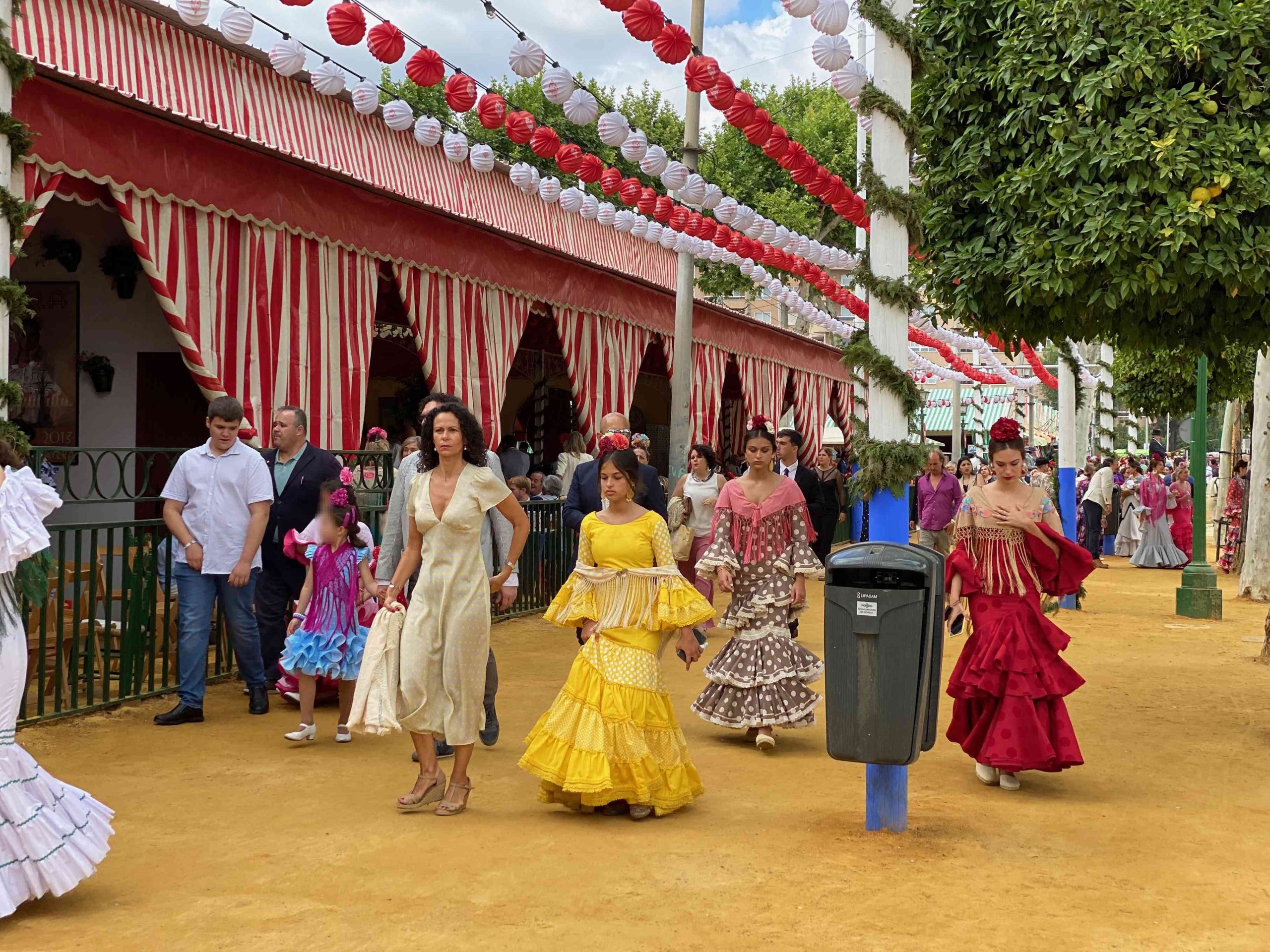
As we made our way to the site, we looked for the shady side of the street. As we passed by, we encountered couples and families walking with the same destination. Many women were dressed in their tight-fitting, brightly colored flamenco dresses (Figure 5). Some dresses had polka dots, but many others were plain colored. Women, young and old, went in groups, in families or with couples. Some were looking at their cell phones or communicating on them (Figure 6). Men walked down the street well dressed in suits and leather shoes. We saw, including two of our friends, that some were riding bicycles, the women with their dresses tucked to one side. Our friends had explained to us that local etiquette dictates that men go to the Feria well-dressed and with a tie, but it is not an inflexible rule and, as we are not Sevillians but guiris, We could dress as casually as we wanted. Of course, some sevillanos and sevillanas were scandalized by the breaking of some rules of etiquette. This is the case of a bearded man dressed in a flamenco dress or a guy dressed as a penitent. The latter caused a greater scandal by offending brotherhoods and brotherhoods that only allow penitent dress during Holy Week, but never in the grounds and days of the Fair.
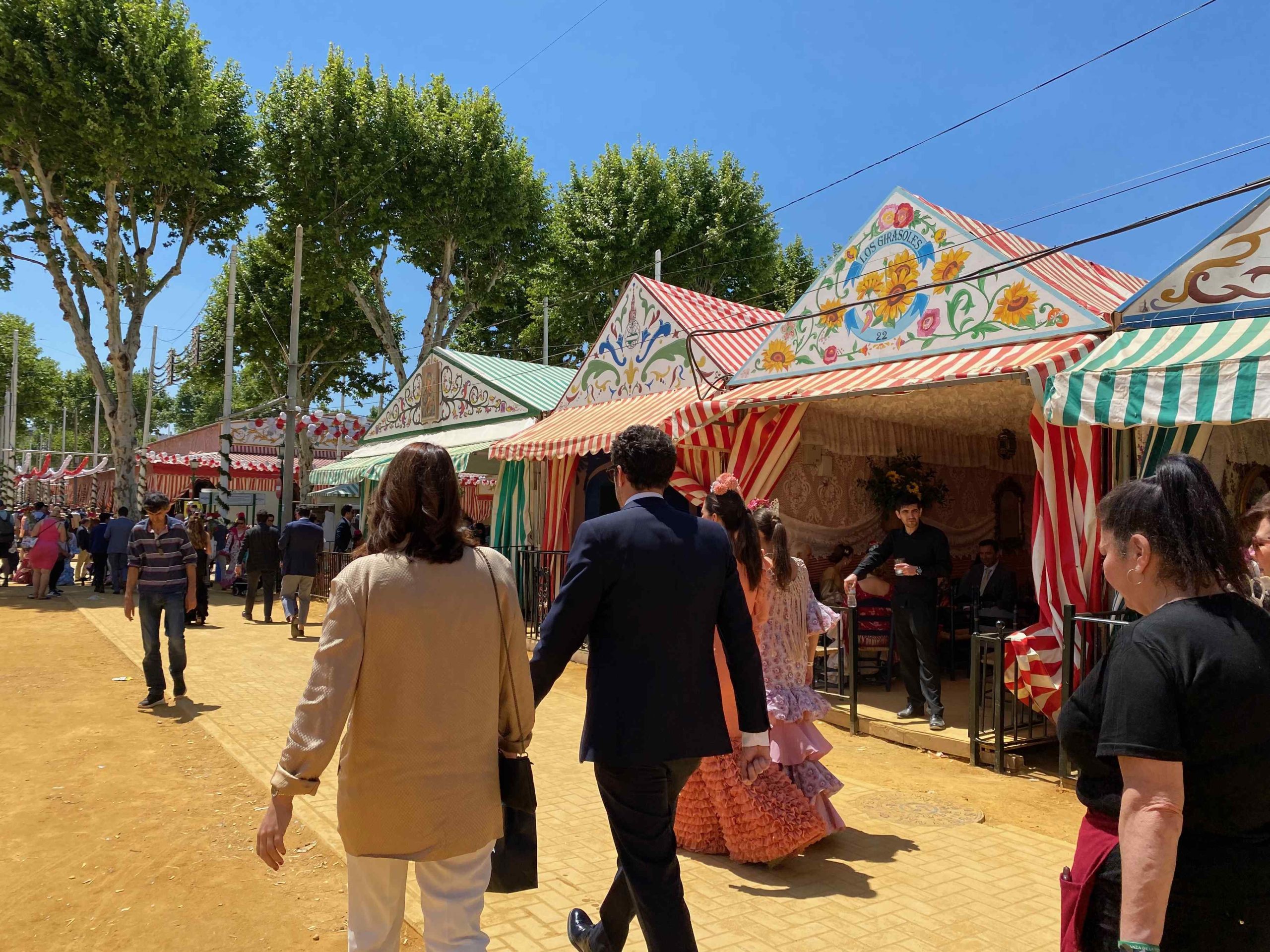
Walking from the Plaza de Cuba, on Monte Carmelo Street, among numerous fairgrounds, we arrive at the Portada. As we noted earlier, every year the city council organizes a competition for the design of this cover and its construction, a work of ephemeral architecture. In 2022, we found a cover designed in homage to the Alfonso XIII hotel (Figure 7). It had been designed and built for the 2020 Fair, but in view of its cancellation, it was built again in 2021. However, again, the covid pandemic did not allow the celebration of the Fair. Finally, in 2022 it could be built and its sight caused joy among the fairgoers (Benítez, 2022). Upon arrival, we find that all the streets of the Feria are named after famous bullfighters. Many of them were or are from Seville, others were or are foreigners who performed gloriously in the bullfights that accompany the Feria, and still others died when they were impaled by the bulls they fought. Along the sides of the streets, rows of trees provided little shade. We walked on the reddish-yellow sand with most of the fairgoers (Figure 8), although some people from ranching families, we were told, rode on horseback or in carriages (Figures 9 and 10).
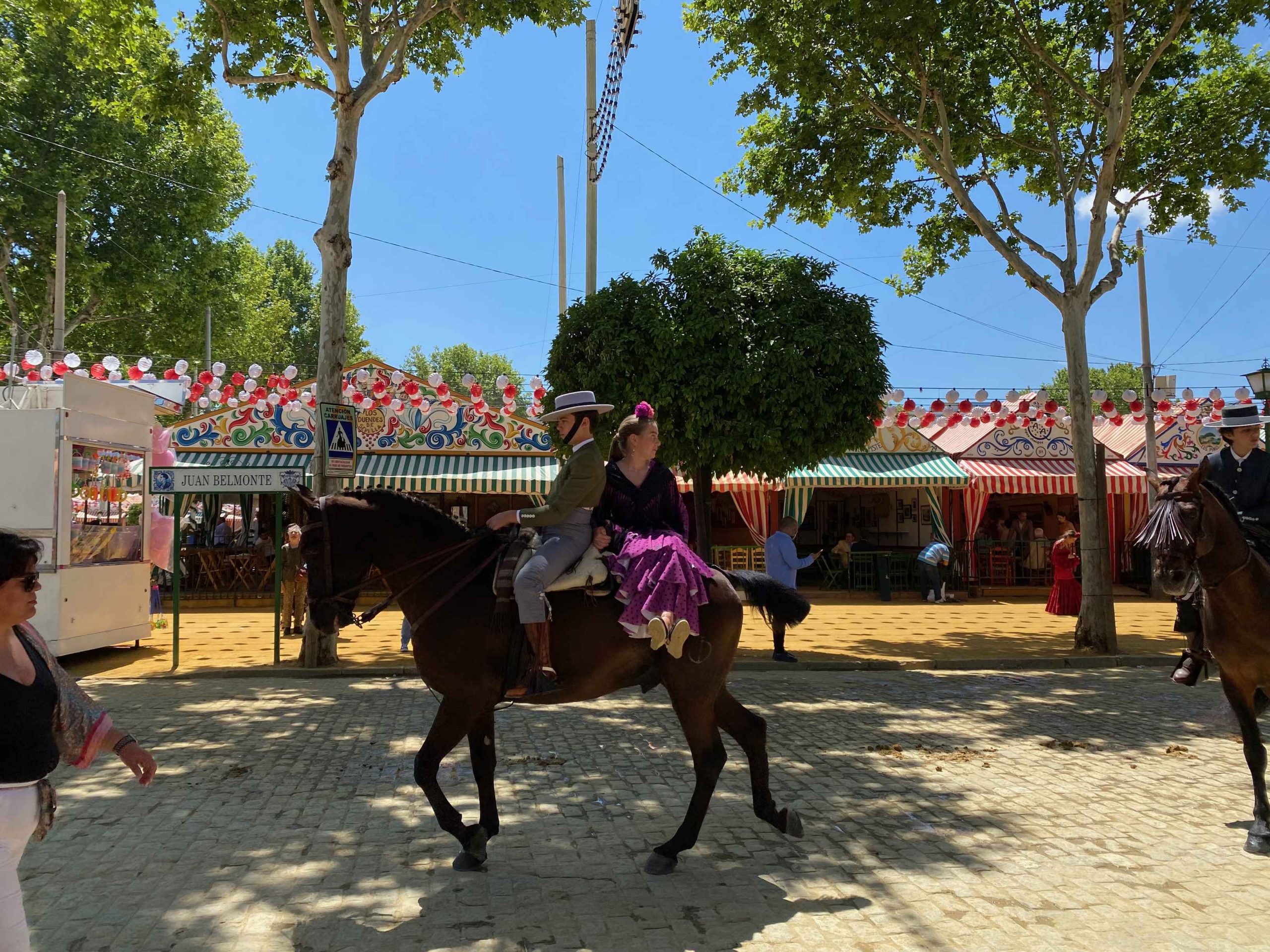
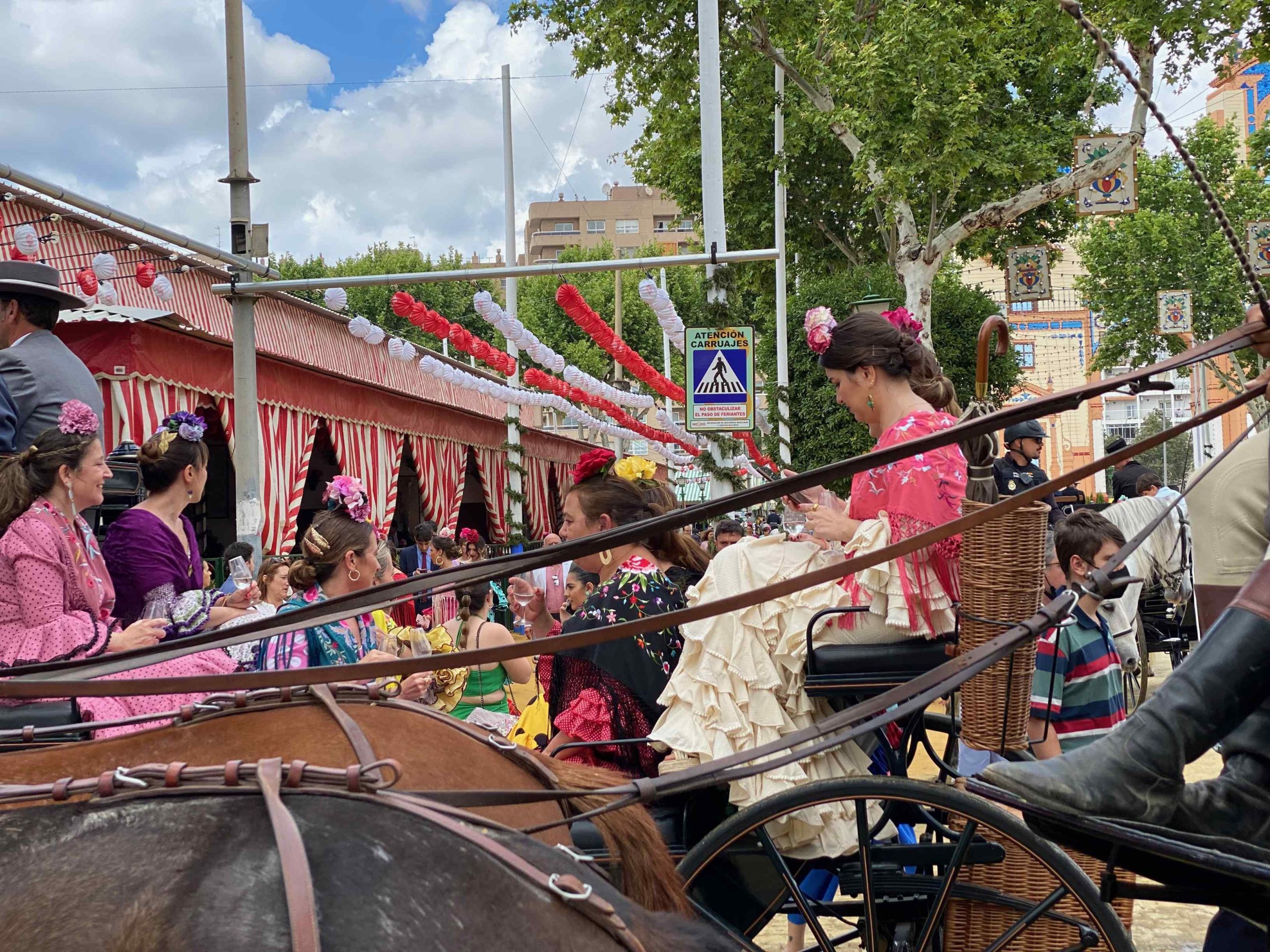
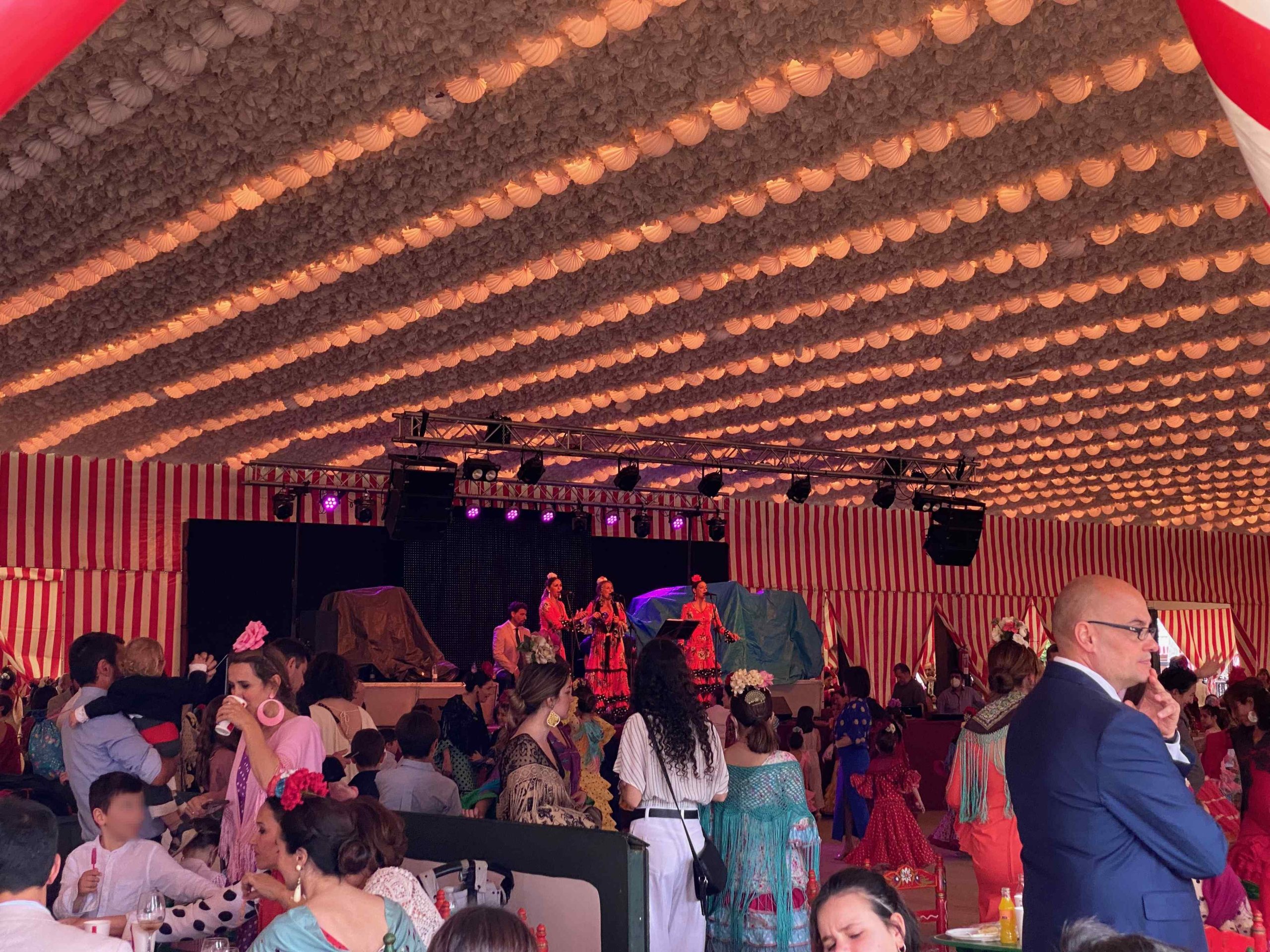
Music emerged from some of the casetas. The accepted music these days is that of “por sevillanas”, a musical style with singing derived from flamenco palos that became popular since the beginning of the 20th century (Carrasco, 2022; Perozo Limones, 2017). There are some large casetas: associations, unions or fraternities have acquired the license for several modules for their casetas and cover a large space that would otherwise house two or more small casetas. However, even these must still respect the aesthetic conventions of decoration and construction. Each year, stages are set up where musical groups play and sing live sevillanas, while the fairgoers dance in the space set aside for this purpose (Figures 11 and 12). In the public, political party or town hall booths, the music, which is of the same genre, is played from recordings and on small stages where both adults and girls dressed as flamencas and boys dance sevillanas (Figure 13). Thus, when walking through the streets of the Feria, this musical genre is heard repeatedly.
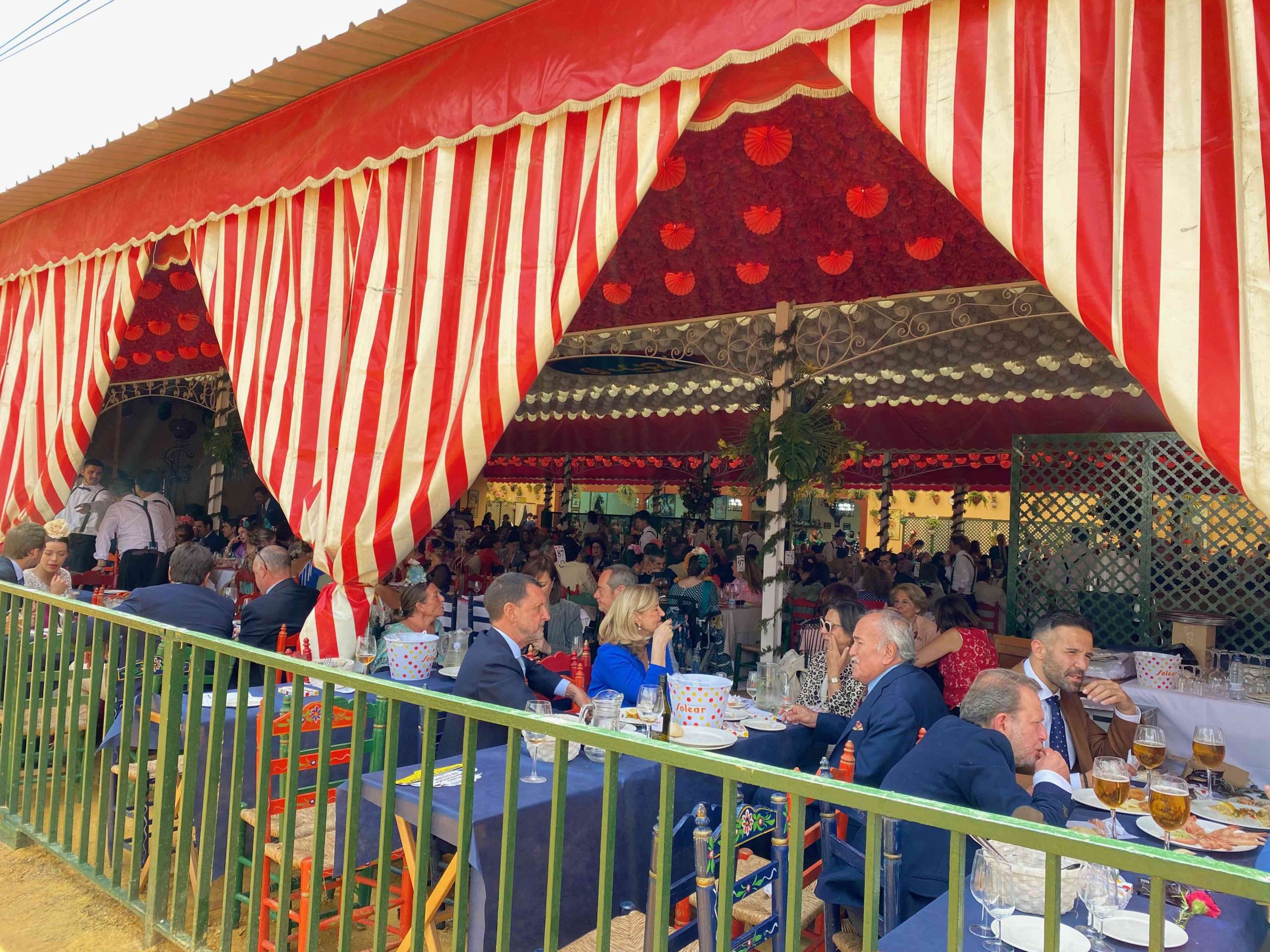
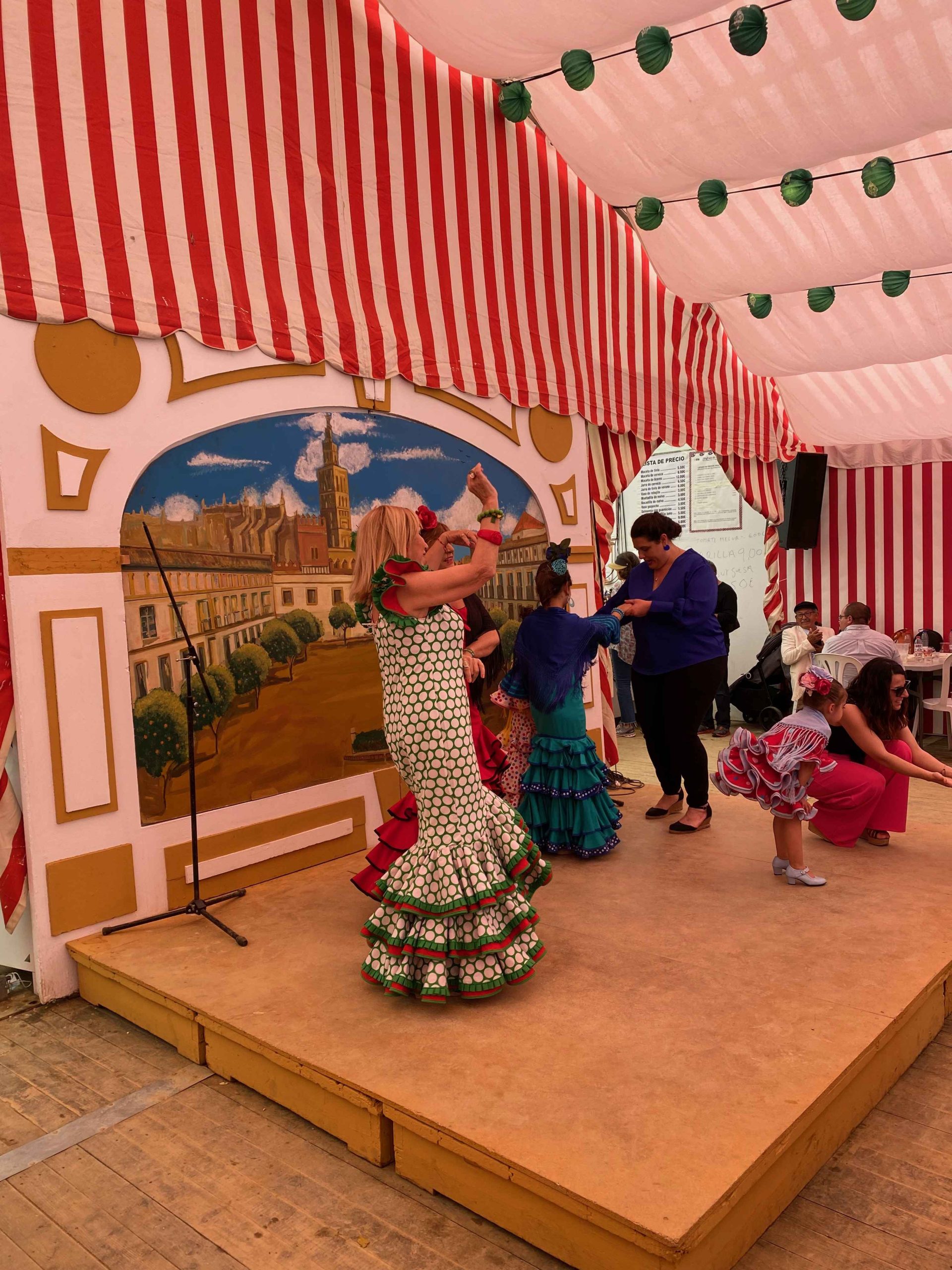
In addition to the music, songs and joyful voices celebrating, the smell of different foods emanated from the booths. The public booths we visited had a bar with a menu of food.2 printed and available by hand or had it attached to the wall, while the kitchen communicated with the bar through a window (Figure 14). The private casetas, generally belonging to groups of families who take turns to enjoy them, have a smaller kitchen behind the bar where waiters serve the guests (Figure 15). The menu of the town hall stand included gluten-free products: meat with tomato, ratatouille with tomato, meatballs in sauce, sausages in wine, menudo with chickpeas, stewed hake loin, potato omelet, sirloin steak with whiskey, spinach with chickpeas; as dressings they offered potatoes with aioli or potatoes with oil, salt and sometimes spices, roasted peppers and carrots with dressing. Among the drinks they listed gluten-free beer, beer, soft drinks (bottled sodas), juices and smoothies, tinto de verano (wine with lemon soda), half bottles of manzanilla and fino (types of sherry wines), rebujito pitcher (manzanilla or fino wines mixed with a soft drink), Rioja or Ribera del Duero wines, red wine glasses, bottles of white and rosé wine, white wine glasses, cubalibre, rum-whisky, whisky and rum-reserve combinations, non-alcoholic liquors and bottles of water. The menu, posted on the wall, advertised discounts for customers over 65 years of age. These foods and beverages were the most common in these public booths, although in one we found shrimp salad, tuna salad (lettuce with shrimp or tuna); in another, we found fried anchovies, steamed shrimp and other options (Figure 16).
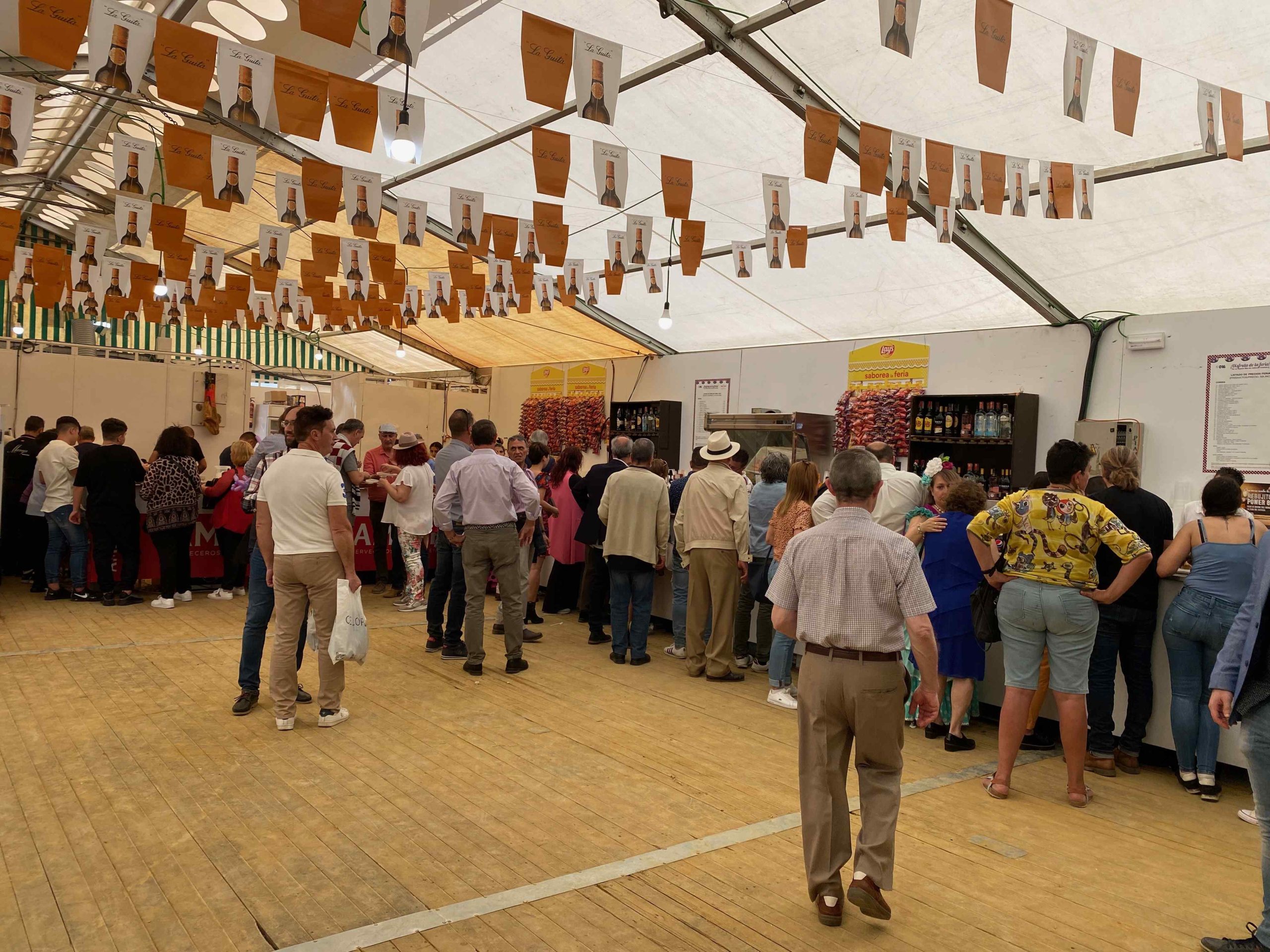
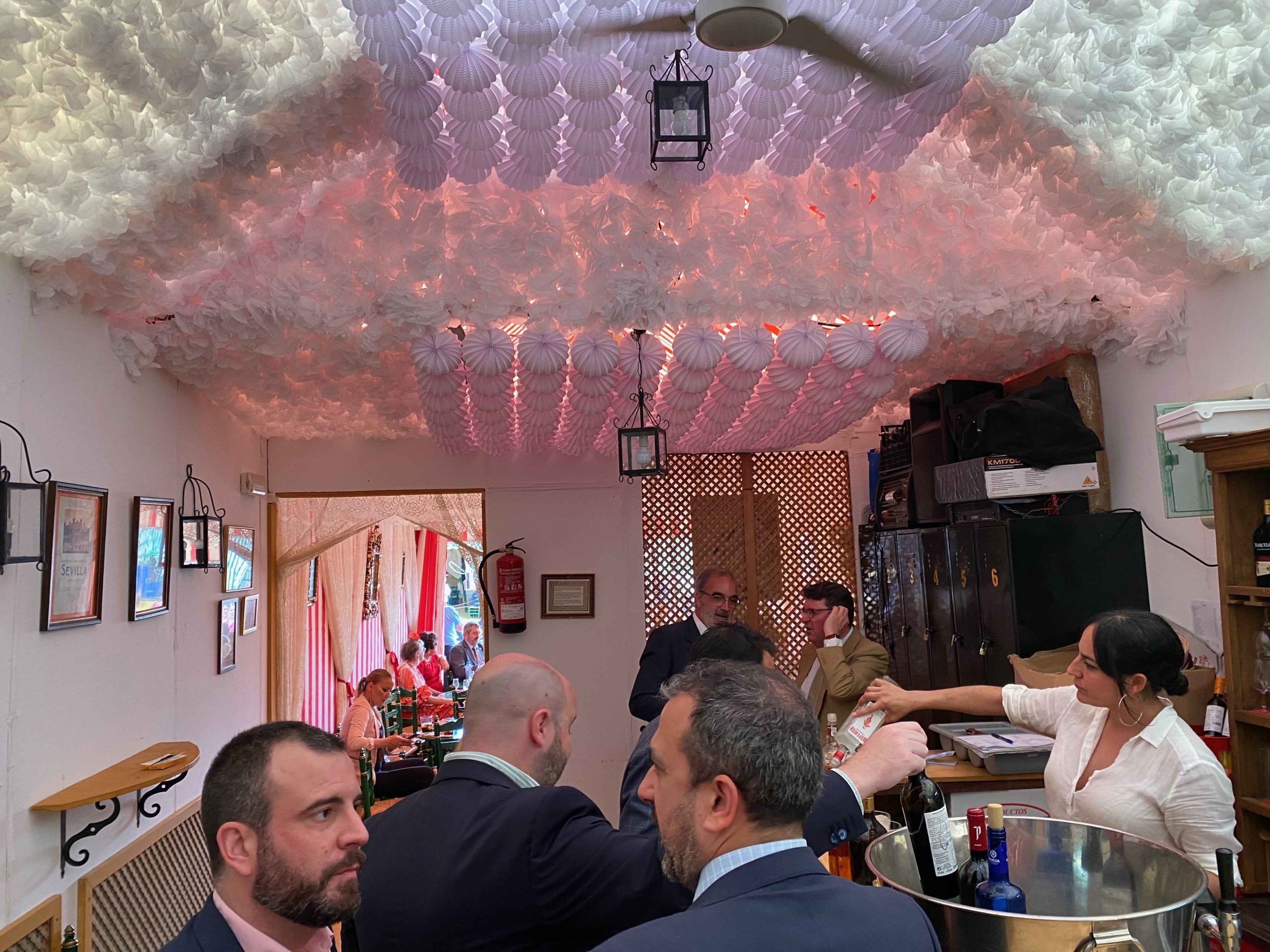
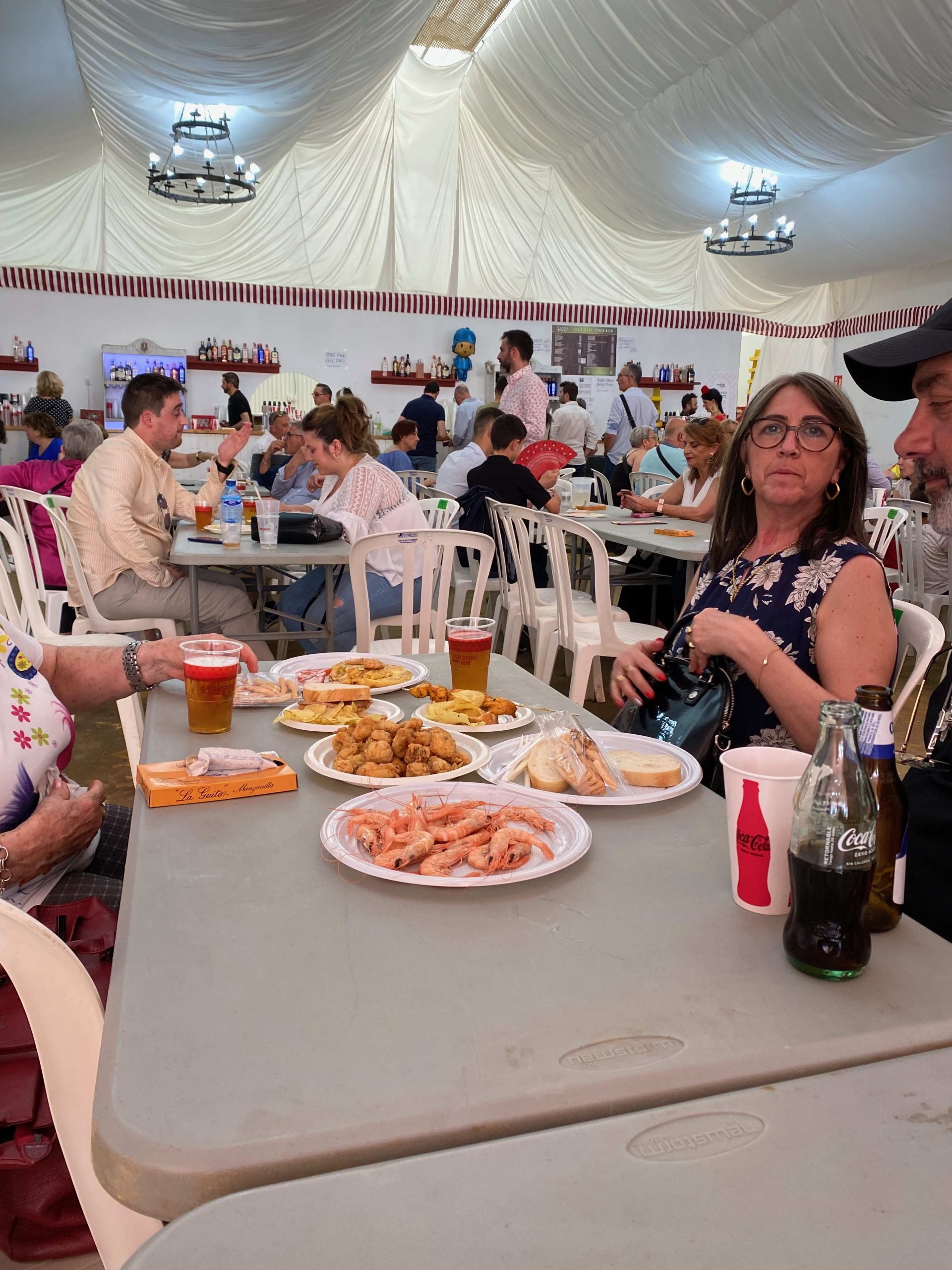
When we arrived on the first day of the Fair at our friends' booth, they had already made progress in the consumption of good quality fino and manzanilla wines. Although the caseta was selling drinks of higher consumption and lower price, our friends had brought manzanilla and finos (wines) from high quality wineries in the areas of Cadiz and Jerez de la Frontera, who generously shared them with us. This stand had on its menu Iberian cheeks of pork in Pedro Ximénez (pork cheeks in sweet sherry wine), thinly sliced Iberian ham (in very thin slices), potato omelette, Russian salad and tomato salad, among other options. Although they were for sale in the booth kitchen, as guests of the families we were not allowed to pay for our consumption. The food was well prepared and good quality ingredients could be tasted. Between meals, our friends, as well as their friends with whom they share the caseta, played recordings of por sevillanas and danced to this music (Figure 17).3 As the temperature rose, pitchers of rebujito circulated around the tables, relieving the heat and brightening up the party. That same day we visited the booth of other friends. We did not stay there, but they shared with us beer and tortilla de patatas. There were wines such as fino and manzanilla (white sherry), rebujitos and Sevillian tapas.
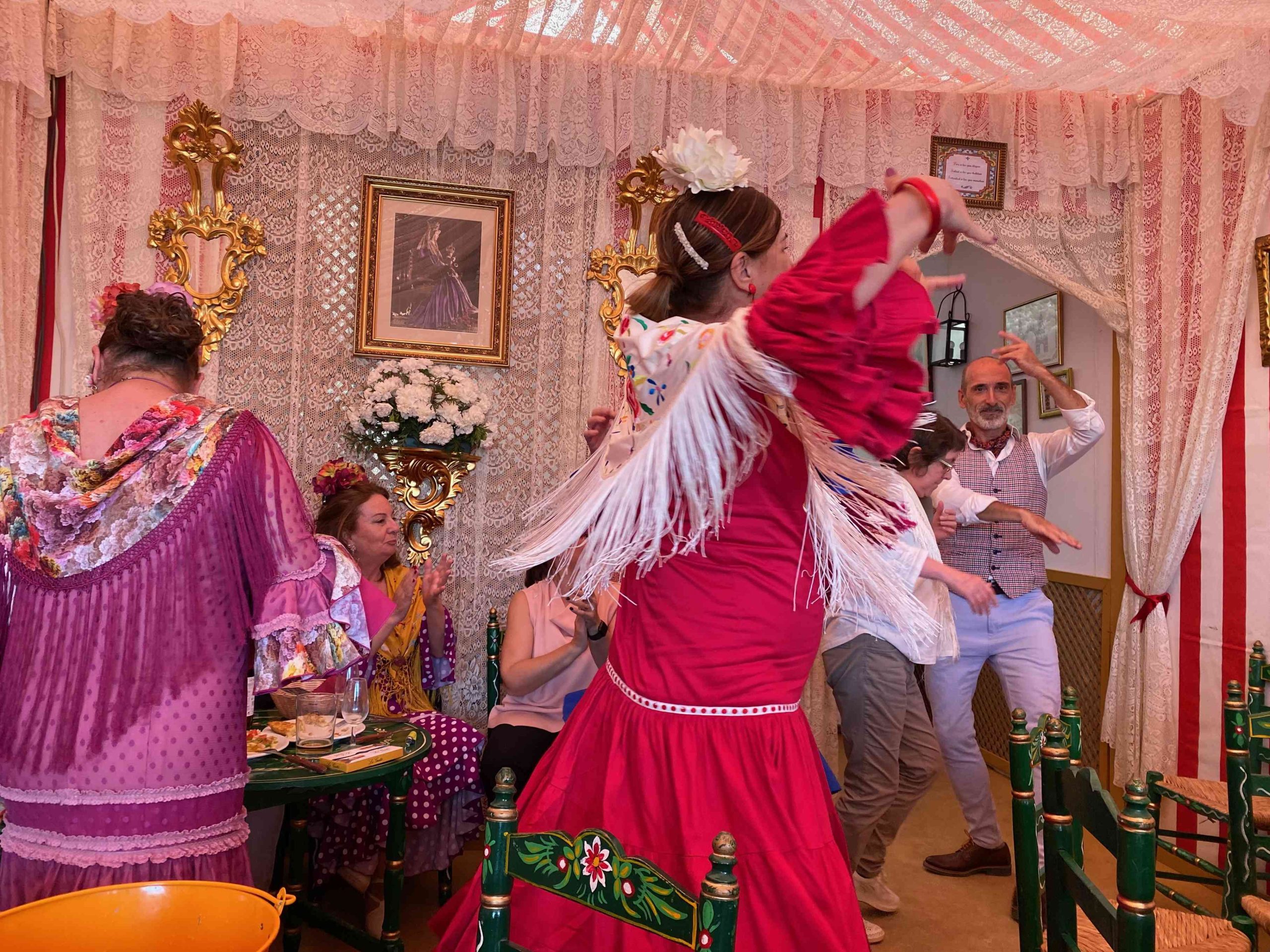
Although this is a popular festival among Sevillians, not everyone can access private booths and must be content to be in the public booths. This is true for the local population and for tourists. Those who have a booth must agree on who will enjoy the space and at what times. Among our hosts, one of the couples was in the booth all week at specific times of the day and the other used it only two days. On other days and at other times, the booth is used by the other members and by their adult sons and daughters to receive their friends.
After enjoying the day with our friends, two of them informed us that they were heading to the beach. They had had enough of the Feria. Like many, this couple of booth members were glad that the duration of the Fair would be shortened from 2025.
We learned that many merchants and business people who have their offices or establishments in the city retain their memberships in some family booth group because at the Fair they get, and through it, maintain much of their clientele. On the other hand, although families of cattle ranchers and other agricultural entrepreneurs have booths for themselves, business related to the field is conducted in other spaces, without having the livestock present. Livestock businessmen and businesswomen explained to us that to do business they use cell phones to show photographs and video recordings of their animals and the conditions in which they keep them and, thus, arrange sale and purchase prices. Every year, for a couple of days, several restaurants located on Bonifaz, Albareda and Gral. Polavieja streets are fully occupied and booked by these ranchers, their families and customers (Figures 18 and 19). We had the opportunity to chat one afternoon with some of them while consuming beers, manzanillas, rebujitos and tapas at tables set up on the street; they explained that they took advantage of these spaces outside the Fairgrounds to socialize among themselves and conduct their business.
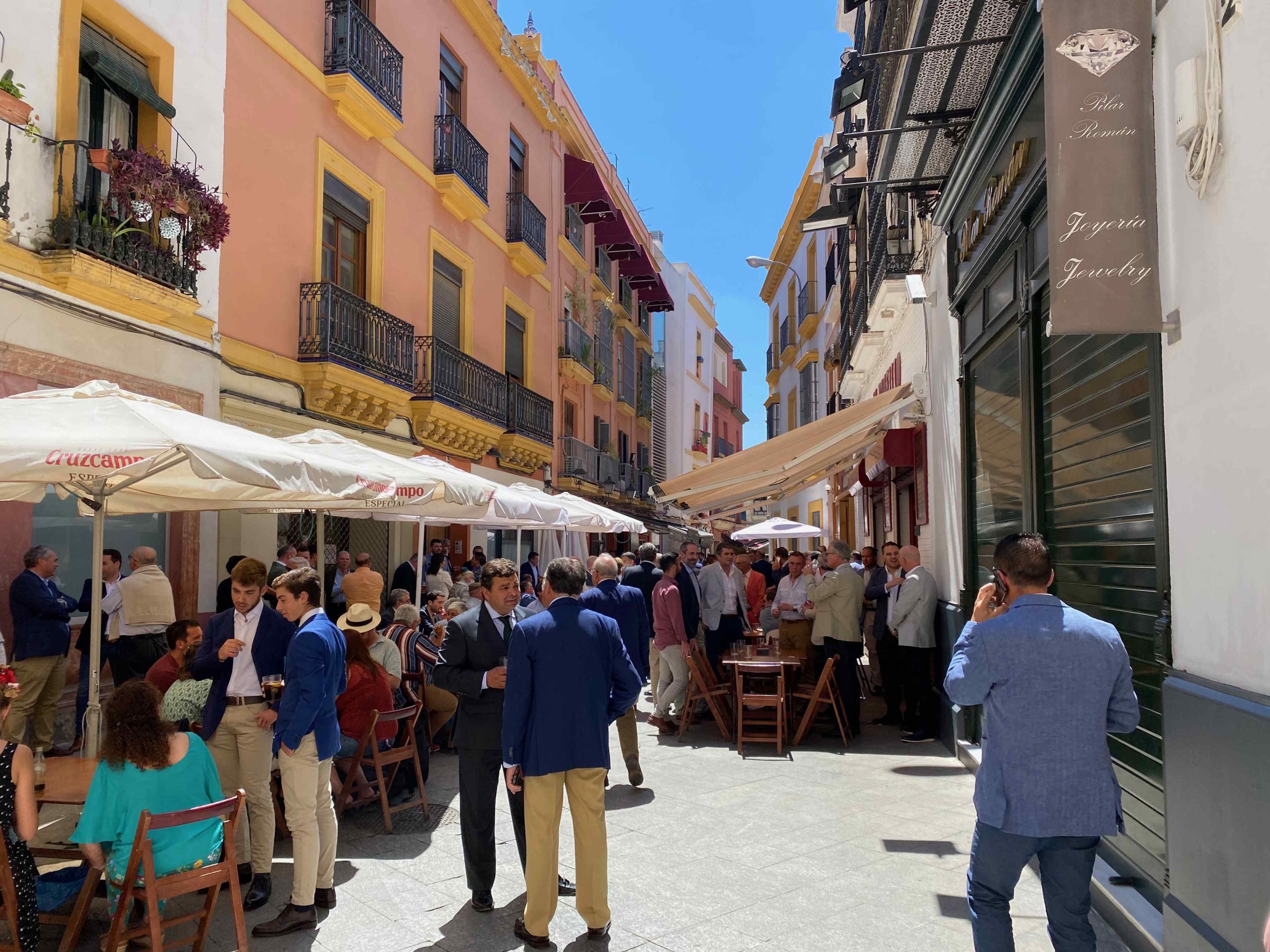
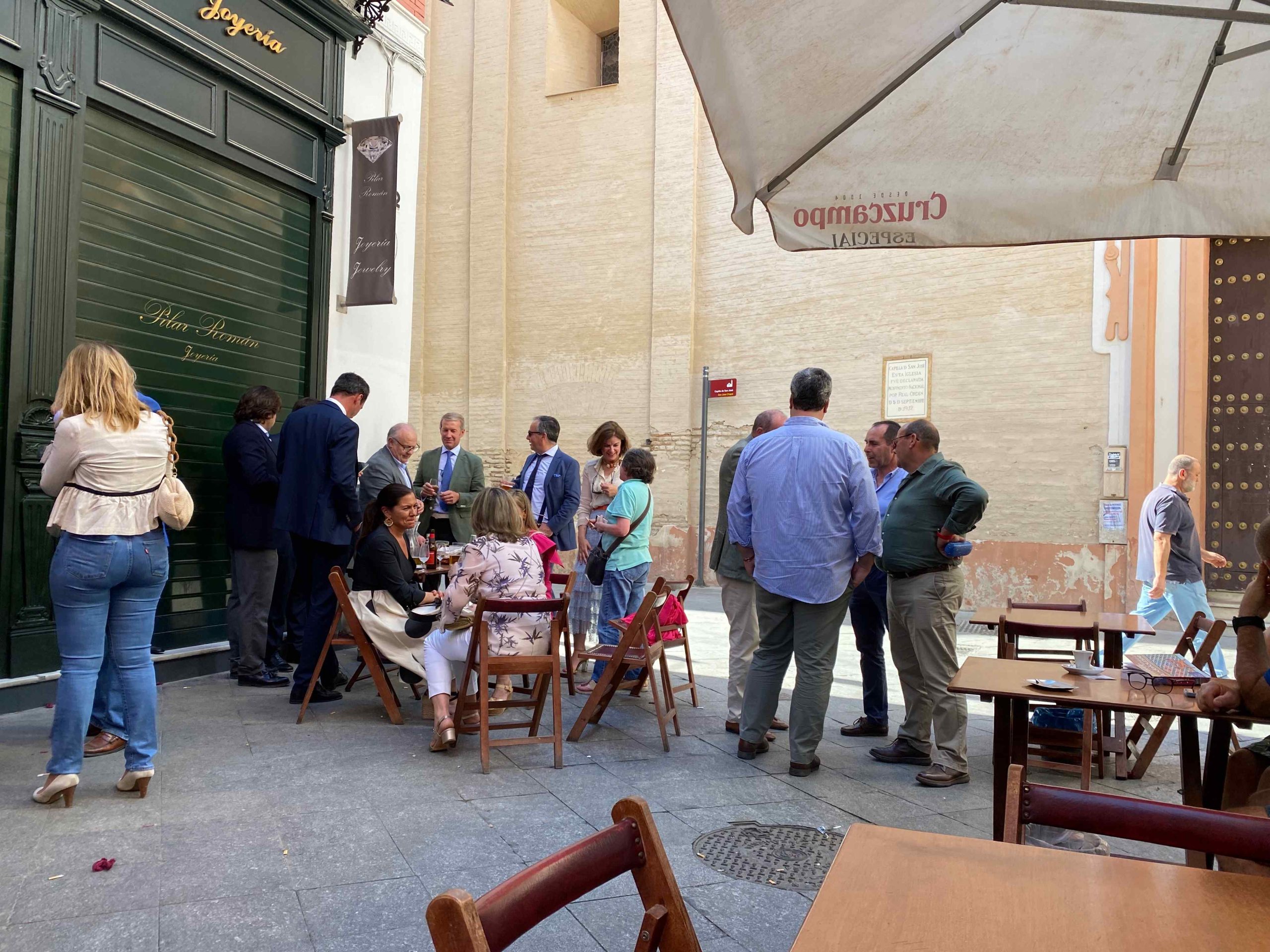
The senses in celebration and Sevillian identity
We propose that studying different events ethnographically, highlighting the role that the senses play in social experiences, brings us closer to meanings that lie beneath the surface of observation. It is not only about the sensory experience as an anthropologist, but also about the dialogical relationship between the researcher and the social subjects. in situ. This shared sensory dimension allows us to recognize the socio-structural differences that place some subjects inside and outside the event. There is a “being Sevillian” that is invoked on these occasions and that in the festive context hides, or at least blurs, the social differences. There is an observable bodily knowledge: knowing how to dress as a Sevillian, knowing what is the fashionable dress of the year, knowing and singing and dancing the "por sevillanas" and knowing how to move the body properly, in a recognizable way as a Sevillian. There are identifiable flavors in the tapas, food and drinks that are shared in the casetas, there is a walking through the streets of the Feria that underlines the Sevillianness of the andante, there is a caló in the verbal interactions that is shared by the Sevillians. In addition, the differential access to spaces, whether more private or more public, marks the difference between own (sevillanos/as) and strangers. All these corporal and objectual manifestations tend to highlight, but also to hide, the local socioeconomic differences and the cultural distance with the visitors.
Sevillians take advantage of fiestas, and celebrations in general, to socialize. In this collective action, they affirm their belonging to the local society. Again, none of the local fiestas is horizontal or egalitarian, but the social imagination holds that everyone can participate equally.4 The Feria is one of these significant annual events for the Sevillian identity, although the participation of those who have or do not have a private booth and those who are invited or not to participate are very unequal. The caseta has been designed as an extension of the Sevillian house and decorated as such. As in a house, not everyone has access to it, only the owners and their guests. As in the houses, the “owners” hire those who provide services there, in this case, waiters, baristas and guards, and sometimes also professional musicians and dancers. The celebration of local identity, therefore, is also a celebration of the differences between local and non-local people, as well as between the different ranks and differences present in Sevillian social life.
The Feria, in any case, becomes the occasion to stimulate all the senses with signs and meanings of local identity (Figure 20). The senses contribute to the synesthetic construction of the Sevillian identity: the colors of the flamenco dresses tight to the body, the mantillas and brooches, the make-up, the suits of jacket, tie and hat, as well as the riding suits, visually affirm “the Sevillian”. These also constitute a synesthetic experience: the different bodily senses construct an aesthetic experience. The ephemeral architecture of the Feria's façade and the casetas marks different historical events or celebrates local monuments. The casetas cannot be decorated in a way that is alien to the aesthetics of Seville. The decoration, curtains and portraits hanging on the walls in each caseta invoke the local Sevillian and regional Andalusian. The named streets celebrating locally important bullfighters are traversed by carriages and horses with men in gray suits and women in flamenco dresses of the upper class cattle ranchers. The music is dominated by por sevillanas songs; the dancers show that they know how to dance, know how to move the body and hands according to the conventions of flamenco dancing, highlighting the Sevillian culture.
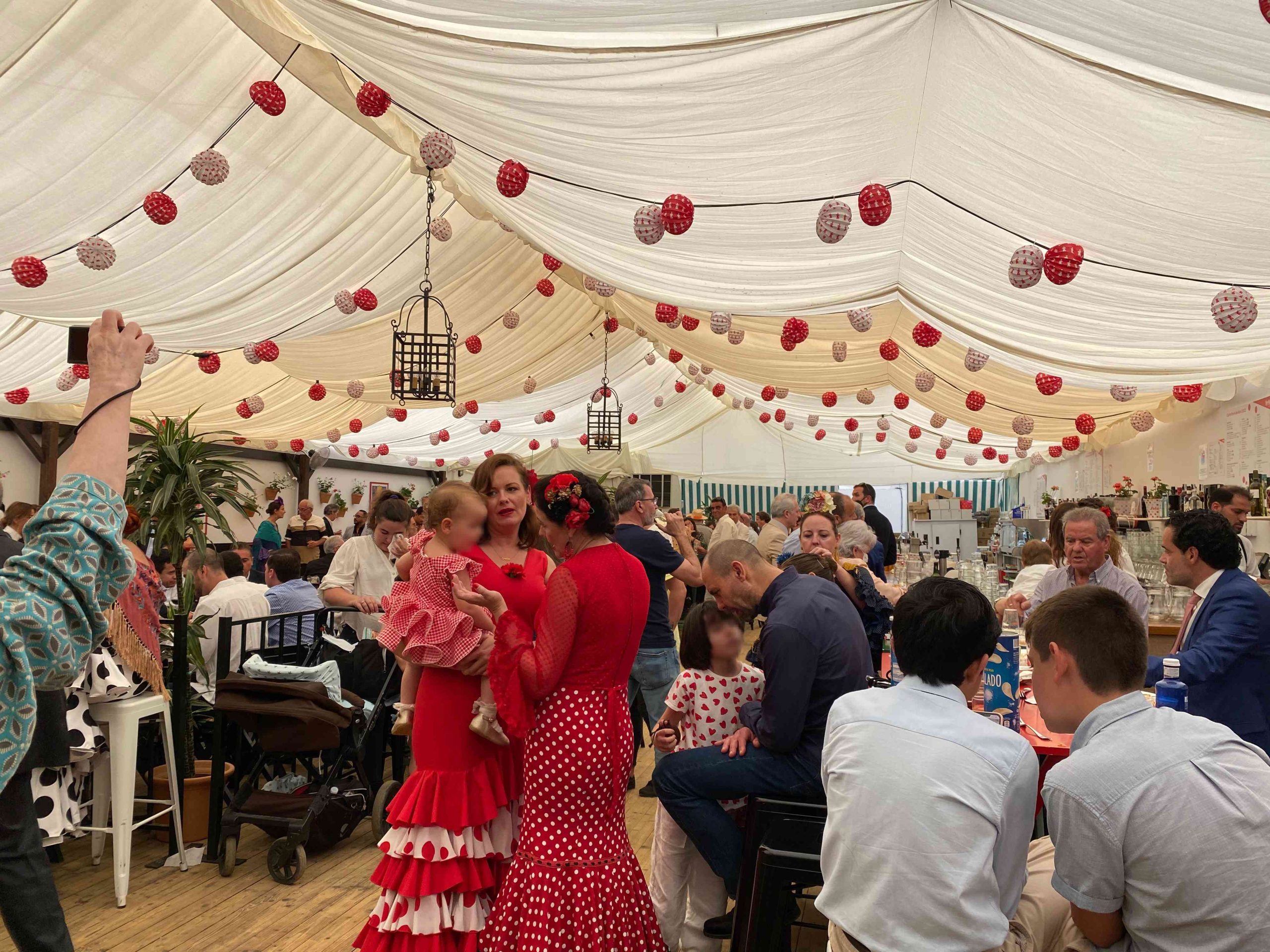
To these tactile, visual and aural stimuli are added the aroma of prepared food, perfumes and body sweat, but also the smell of urine and horse droppings, which together constitute the aromas of the Fair (even without breeders and livestock, these aromas evoke the memory of the “original” Fair). The taste and freshness of rebujitos, chilled manzanilla and fino are added to the icy sensations of the beer, which provide relief from the strong heat. The flavors of tortilla de patatas, carrillada, jamón ibérico and other dishes identified as “sevillanos”, the heat, the sweat and the sun (or, often during the Feria, the rain) stimulate all the senses in ways that Sevillians claim for themselves as sustaining local identity. This claim translates into the widely expressed request to limit the days of the Feria, as it is widely perceived that tourism is alienating Seville's inhabitants from “their” fiesta.
It is the case that the senses provide a synesthetic and synesthetic construction of the Fair in which the memory of past fairs confirms the local importance of the celebration. The very deployment of sensory stimuli becomes synesthetic: an aesthetic figuration of what is or is not “Sevillian” of the Fair is produced. Just as a penitent during that celebration is an image out of place, the flamenco dress is saved for very special occasions that prominently include the days of the Feria, when the new model of the year is usually premiered. Recordings of por sevillanas songs can be played any day of the year, but in Seville they are associated with specific celebrations, one of which is the Feria. The rebujito is a Feria drink, although it could be made any day of the week. Thus, as a whole, all these manifestations and aesthetic-sensory perceptions become the Feria, although none, by itself, is the Feria.
We can suspect that the Fair will continue to change. Despite the reduction of days, in 2025 it received three million visitors, one million more than in 2022, when we had the opportunity to experience this celebration in the flesh and to realize its importance as a synaesthetic and synesthetic experience for the imagination of what it is to be or not to be “from Seville”. In this sense, we propose that, in order to develop an anthropology of the senses, it is not enough to conduct interviews: it is essential to recover the anthropological professional practice of participatory and performative observation, where possible. This allows us to share the experience, in our own bodies and with our bodily senses, of the experiences of local subjects during these celebrations. This sensoriality supplements anthropological tools such as informal conversations, interviews and time-tracking, and allows us to approach the sensual, aesthetic and sensorial dimension of local subjects.
Addendum
In these days when we were preparing the article for publication, we learned, through electronic newspapers and Facebook groups, that a group of businessmen from Madrid is organizing a fair that they want to call “Madrilucía” (Madrid/Andalusia). This event, with a duration of one month -five days each week-, would seek to “modernize” the Seville Fair. Among its proposals are the option of renting flamenco dresses for users to feel like Sevillians; a kitchen service that will supply food to the booths, as well as bathrooms every three booths to avoid long lines. In addition, the streets would not have the clay and yellowish soil that exists in Seville, but artificial grass, in order to protect the flamenco dresses and men's suits.
The response on social networks, especially on Facebook, has been that Sevillians expect the event to be held during the same dates as the Seville Fair, so as to reduce the number of tourists that in recent years have crowded the Andalusian city. However, many also scoff at the proposal, as they consider it to be only a simulation of the cultural event so significant for Sevillians. It is clear that for them this party would not reach the “authenticity” of the experience that the Seville Fair has for the inhabitants of this city.
It will be important to follow the trajectory of this Madrid event which, in addition, would coincide with the festivities of St. Isidore, a relevant figure for the people of Madrid, but not for the people of Seville who have the Virgen del Rocio, the Macarena, the Señor del Gran Poder and other representations of the sacred that mark the Sevillian and Andalusian saints' days.
Bibliography
ABC de Sevilla (2025). “La Feria de Abril de Sevilla contará con casi 250 casetas más en 2026”. Disponible en: https://www.abc.es/sevilla/feria-abril/feria-abril-sevilla-contara-250-casetas-2026-20250505101830-nts.html
Acevedo, Laura y Mercedes Sanmartín (2025). “El verdadero origen de la cena del ‘pescaíto’ en la Feria de Abril”, La Crónica de Sevilla. Disponible en: https://lacronicadesevilla.es/index.php/2025/04/30/el-verdadero-origen-de-la-cena-del-pescaito-en-la-feria-de-abril/
Aguilar, José (1983). Los carnavales y la murga sevillana de los años 30. Sevilla: Publicaciones del Gobierno Sevillano.
Aguilar Criado, Encarnación (2002). “La economía de la fiesta”, en José Hurtado Sánchez (ed.). Nuevos aspectos de la religiosidad sevillana: fiesta, imagen, sociedad. Sevilla: Ayuntamiento de Sevilla, pp. 199-232.
Ayora Diaz, Steffan Igor (2019). “Introduction: Matters of Taste: The Politics of Food and Identity in Mexican Cuisines”, en Steffan Igor Ayora Diaz (ed.). Taste, Politics and Identities in Mexican Food. Londres: Bloomsbury Academic, pp. 1-18.
— (2021). “Food, Taste, and Identity in the Global Arena”, en Steffan Igor Ayora Diaz (ed.). The Cultural Politics of Food, Taste, and Identity. A Global Perspective. Londres: Bloomsbury Academic, pp. 15-30.
— Gabriela Vargas Cetina y Francisco Fernández Repetto (2016). Cocina, música y comunicación. Tecnologías y estética en el Yucatán contemporáneo. Mérida: Ediciones de la Universidad Autónoma de Yucatán.
Belting, Hans (2011). An Anthropology of Images. Picture, Medium, Body. Princeton: Princeton University Press.
Benítez, Mercedes (2022). “La portada que se ha montado dos veces y que ha llevado tres años de espera”, ABC Sevilla, sección “Feria de Abril”. Disponible en: https://www.abc.es/sevilla/feria-abril/sevi-feria-abril-sevilla-2022-portada-montado-veces-y-llevaba-tres-anos-espera-202205010822_noticia.html?ref=https%3A%2F%2Fwww.abc.es%2Fsevilla%2Fferia-abril%2Fsevi-feria-abril-sevilla-2022-portada-montado-veces-y-llevaba-tres-anos-espera-202205010822_noticia.html
Boissevain, Jeremy (2013). Factions, Friends and Feasts. Anthropological Perspectives on the Mediterranean. Nueva York: Berghahn.
Brisset, Demetrio E. (2009). “Investigar las fiestas”, Gazeta de Antropología, 25(1). Recuperado de: http://hdl.handle.net/10481/6852
Calvert, Gemma A., Charles Spence y Barry E. Stein (eds.) (2004). The Handbook of Multisensory Processes. Cambridge: MIT Press.
Carrasco, Martha (2022). “El origen del baile por sevillanas”, ABC de Sevilla, Sección Feria de Abril. Disponible en: https://www.abc.es/sevilla/feria-abril/sevi-feria-abril-sevilla-2022-origen-baile-sevillanas-202204251246_noticia.html?msclkid=06d1e17ac6d711ec9825007df193adeb
Classen, Constance (2012). The Deepest Sense. A Cultural History of Touch. Urbana: University of Illinois Press.
— David Howes y Anthony Synnott (1994). Aroma. A Cultural History of Smell. Londres: Routledge.
Collantes de Terán Delorme, Francisco (1981). Crónicas de la Feria (1847-1916). Sevilla: Publicaciones del Ayuntamiento Sevillano.
— (1982). Crónicas de la Feria (1917-1956). Sevilla: Publicaciones del Ayuntamiento Sevillano.
Counihan, Carole y Susanne Højlund (eds.) (2018). Making Taste Public. Ethnographies of Food and the Senses. Londres: Bloomsbury Academic.
Cytowic, Richard E. (2002). Synestesia. A Union of the Senses. Cambridge: MIT Press.
Daza, Mario (2025, 19 de abril). “La Feria de Sevilla se cierra con tres millones de visitantes y avala el nuevo formato: ‘El debate está Zanjado’”, abc Sevilla. Disponible en: https://www.abc.es/sevilla/ciudad/feria-sevilla-cierra-tres-millones-visitantes-avala-2025 0512132151-nts.html
Del Pino, Chus (2022). “La Feria de Sevilla bate récord de afluencia durante el puente de mayo”, La Vanguardia. Disponible en: https://www.lavanguardia.com/local/sevilla/20220503/8239798/feria-sevilla-bate-record-afluencia-primer-semana.html
Feld, Steven (1990 [1982]). Sound and Sentiment. Birds, Weeping, Poetics, and Song in Kaluli Experience. Durham: Duke University Press.
Flores, Victoria (2025, 17 de agosto). “El formato de la Feria divide a los sevillanos en el Real un año después del referéndum”, El Correo de Andalucía. Disponible en: https://www.elcorreoweb.es/sevilla/2025/05/08/formato-feria-divide-sevillanos-real-117162248.html
Fototeca Municipal de Sevilla (2003). Historia gráfica de las fiestas de Sevilla. Sevilla: Ayuntamiento de Sevilla.
Gordon, Paul (2020). Synaesthetics: Art as Synaesthesia. Londres: Bloomsbury Academic.
Heywood, Ian y Barry Sandywell (eds.) (2014). The Handbook of Visual Culture. Londres: Bloomsbury Academic.
Hisano, Ai (2019). Visualizing Taste. How Business Changed the Look of What You Eat. Cambridge: Harvard University Press.
Homobono Martínez, José Ignacio (1990). “Fiesta, tradición e identidad local”, Cuadernos de Etnología y Etnografía de Navarra, vol. 55, pp. 43-58.
Howes, David (2005). “hyperesthesia, or the Sensual Logic of Late Capitalism”, en David Howes (ed.). Empire of the Senses. The Sensual Culture Reader, Oxford: Berg, pp. 281-303.
— (2022). The Sensory Studies Manifesto. Tracking the Sensorial Revolution in the Arts and Human Sciences. Toronto: University of Toronto Press.
Hurtado Sánchez, José (ed.) (2002). Nuevos aspectos de la religiosidad sevillana: fiesta, imagen, sociedad. Sevilla: Ayuntamiento de Sevilla.
Konrad, Herman (1983). “Barren Bulls and Charging Cows: Cowboy Celebrations in Copan and Calgary”, en Frank E. Manning (ed.). The Celebration of Society. Perspectives on Contemporary Cultural Performance. Bowling Green: Bowling Green University Popular Press, pp. 145-164.
Korsmeyer, Carolyn (2002). Making Sense of Taste. Food and Philosophy. Ithaca: Cornell University Press.
Krogh Groth, Sanne y Holger Schulze (eds.) (2020). The Bloomsbury Handbook of Art and Sound. Londres: Bloomsbury Academic.
Larrea Killinger, Cristina (1997). La cultura de los olores. Una aproximación a la antropología de los sentidos. Quito: Abya-Yala.
Limones, Ana Rosa (2017). “La escuela sevillana de baile flamenco y su relación con la Escuela Bolera”, Revista del Centro de Investigación Flamenco Telethusa, vol. 10(12), pp. 5-10. Disponible en: 10.23754/telethusa.101203.2017
López Martínez, Antonio Luis (2005) “Una élite rural. Los grandes ganaderos andaluces, siglo xiv-xx”, Hispania, vol. lxv/3, núm. 22, pp. 1023-1042.
— (2020). Las ferias de ganado en Andalucía occidental y Extremadura, 1830-1958. Sevilla: Universidad de Sevilla.
Magliocco, Sabina (1993). The Two Madonnas. The Politics of Festival in a Sardinian Community. Nueva York: Peter Lang.
Manning, Erin (2007). Politics of Touch. Sense, Movement, Sovereignty. Minneapolis: University of Minnesota Press.
Manning, Frank E. (1983). “Cosmos and Chaos: Celebration in the Modern World”, en Frank E. Manning (ed.). The Celebration of Society. Perspectives on Contemporary Cultural Performance. Bowling Green: Bowling Green University Popular Press, pp. 3-30.
Moreno Navarro, Isidoro (1992). La Semana Santa de Sevilla: conformación, mixtificación y significaciones. Sevilla: Universidad de Sevilla.
Murphy, Michael D. y J. Carlos González Faraco (coords.) (2002). El Rocío. Análisis culturales e históricos. Huelva: Diputación de Huelva.
Palma Martos, Luis, Antonio García Sánchez y María Luisa Palma Martos (2008). “Una propuesta metodológica para la evaluación del impacto económico de las Fiestas de Primavera en la Ciudad de Sevilla”, Cuadernos de Economía de la Cultura, núm. 9, pp. 97-39.
— María Luisa Palma Martos y José Luis Martín Navarro (2014). “La integración entre cultura y economía. El caso de las Fiestas de Primavera de Sevilla”. Estudios de Economía Aplicada, vol. 32(1), pp. 287-308.
Pujol Cruells, Adrià (2006). “Ciudad, fiesta y poder en el mundo contemporáneo”, LiminaR. Estudios Sociales y Humanísticos, vol. 4(2), pp. 36-49.
Ramišak, Mojca (2024). The Anthropology of Smell. Cham: Springer.
Real Maestranza de Caballería de Sevilla (2024). “La Temporada”. Disponible en: https://www.realmaestranza.com/real-plaza-de-toros/la-temporada/
Rodríguez Becerra, Salvador (2008). “Las fiestas en Andalucía. Perspectivas históricas y antropológicas”, Actas de las xii Jornadas sobre historia de Marchena. Las fiestas en la historia de Marchena. Marchena: Ayuntamiento de Marchena, pp. 11-26.
Romero Abao, Antonio del Rocío (1991). “Las fiestas de Sevilla en el siglo xv”, Las fiestas de Sevilla en el siglo xv. Otros estudios. Madrid: Deimos, pp. 12-178.
Sánchez Carrasco, Antonio (2019). La Feria de Abril. Sevilla: Almuzara.
Schulze, Holger (ed.) (2021). The Bloomsbury Handbook of the Anthropology of Sound. Londres: Bloomsbury Academic.
Spence, Charles y Betina Piqueras-Fiszman (2014). The Perfect Meal. The Multisensory Science of Food and Dining. Oxford: Wiley Blackwell.
Stoller, Paul (1997). Sensuous Scholarship. Filadelfia: University of Pennsylvania Press.
Sutton, David E. (2001). In Remembrance of Repasts. An Anthropology of Food and Memory. Oxford: Berg.
— (2010). Food and the Senses, Annual Review of Anthropology, vol. 39, pp. 209-223.
Treshorras, Pepe (2025). “Pasacalles, gigantes, cabezudos y cucañas: la Velá de las Nieves que se celebraba en agosto”, ABC Sevilla, edición en línea. Disponible en: https://www.abc.es/sevilla/pasionensevilla/noticias-semana-santa-sevilla/hermandad-nieves-vela-agosto-sevilla-20250815225841-nts.html
Trubek, Amy (2009). The Taste of Place. A Cultural Journey into Terroir. Berkeley: University of California Press.
Turner, Victor (1974). Dramas, Fields, and Metaphors. Symbolic Action in Human Society. Ithaca: Cornell University Press.
Vannini, Phillip, Dennis Waskul y Simon Gottschalk (2012). The Senses in Self, Society, and Culture. A Sociology of the Senses. Nueva York: Routledge.
Gabriela Vargas Cetina D. in Anthropology (McGill University, 1994). Professor-researcher C at the Universidad Autónoma de Yucatán. Member of the snii level iii. She has conducted fieldwork in Yucatan with peasant families, with musicians and music producers, in indigenous reserves in Canada, with sheep and goat shepherds in Sardinia, Italy, with women artisans in Chiapas, and with musicians and band directors in Seville, Spain. He has published the monograph The Beautiful Politics of Music. Trova in Yucatán, Mexico (Tuscaloosa: University of Alabama Press, 2017). She has served as president of The Society for Latin American and Caribbean Anthropology (2004-2008), secretary of the American Anthropological Association (2021-2024), and vice president of The International Association of American Studies (2021-Present). She was a Fellow of the Society for the Humanities at Cornell University (2006-2007).
Steffan Igor Ayora Diaz D. in Anthropology (McGill University, 1993). He is a full professor-researcher C, retired from the Universidad Autónoma de Yucatán. Member of the snii level ii. He has conducted fieldwork with sheep and goat herders in Sardinia, Italy; with local doctors in the highlands of Chiapas; with cooks and chefs in Yucatan; and with cooks, cooks, chefs and restaurant owners in Seville, Spain. He is the author of Globalization, knowledge and power: local physicians and their struggles for recognition in Chiapas (México: uady/Plaza y Valdés, 2002) and Foodscapes, Foodfields and Identities in Yucatán (Oxford: Berghahn, 2012) and editor of. The Cultural Politics of Food, Taste and Identity (London: Bloomsbury, 2021). He was president of The Society for Latin American and Caribbean Anthropology (2011-2014), British Council Fellow in Goldsmiths College, London (1995) and Fellow of The Society for the Humanities at Cornell University (2006-2007).
Institutions



 EN
EN  ES
ES  FR
FR  PT
PT