
The Shameless Cuir Cult: Ritual recreations based on performance
- Hilda María Cristina Mazariegos Herrera
- - see biodata
The Shameless Cuir Cult: Ritual recreations based on performance
Receipt: November 9, 2024
Acceptance: May 13, 2025
Abstract
The aim of this essay is to give an account of one of the ways in which feminist and lgbtq+ believers, who belong to or were socialized in different religious-spiritual traditions, primarily evangelical, re-symbolize the sacred and the political through the performance in the framework of what the group Theology Without Shame calls Cuir Cult. It addresses issues such as female ancestry, trans baptisms, criticism of ecosieg and sexual freedom, in a context of growing anti-feminist and anti-gender conservatism.
Keywords: trans baptism, Cuir Cult, LGBTQ+, performance, scoundrel
cult cuir without shameritual re-creations through queer performance
This essay examines one of the ways in which feminist and lgbtq+ believers, who belong to or were brought up in diverse religious and spiritual traditions -primarily evangelical traditions- re-symbolize the sacred and the political through performance in the context of what the collective Teología Sin Vergüenza terms. Cuir Cult (Queer Worship). It engages themes such as female ancestry, transgender baptisms, critique of so-called conversion “therapies,” and sexual freedom in a context of intensifying anti-feminist and anti-gender conservatism.
Keywords: Culto Cuir, shameless, shameless, lgbtq+, performance, transgender baptisms.
Introduction
Teología Sin Vergüenza is a collective of women and lgbtq+ people from different Latin American countries, as well as migrants of Latin and African descent living in the United States. Most of its members were socialized in Protestant-Evangelical and Catholic religious traditions.
Theology Without Shame is about to celebrate its fourth anniversary as part of the international organization Soulforce, which has been working for about 26 years in the analysis and activism against violence exercised from religious spaces, through the Center for the Study of Spiritual Violence, Healing and Social Change. This works through the articulation and interdisciplinary work of different activist sectors, academics and mental health professionals.1 The work of the center has expanded and has given rise to a transnational alliance of organizations spanning Latin America and the United States. This network enabled the First International Meeting of Theology Without Shame to be held on October 25 and 26, 2024 at the Casa Refugio Citlaltépetl, located in the Condesa neighborhood of Mexico City. Pastors were invited to the meeting,2 theologians, believers and activists from different countries3 and religious-spiritual traditions -mainly Protestant-Evangelical- in order to exchange experiences and outline possible routes for collaboration. In a context marked by the strengthening of the ultra-right and religious conservatism in Mexico and Latin America, as well as by the recent return of Donald Trump to the presidency of the United States, whose agenda insists on reproducing gender binarism and criminalizing women, migrants and the right to abortion, these articulations are a bet to confront them. The closing of the meeting took place on October 27 at the Prophecy 9 Club, with the celebration of the Cuir Cult, to which I will refer later. I keep the Spanish term, since there is a political purpose linked to the recognition and construction of “lo cuir” or cuir theory from Latin America.
In addition to inviting people involved in religious education, Theology Without Shame invites artists of the performance4 to form what they have called the Cuir Cult: a scenic-ritual proposal that, through the critical recreation of religious-spiritual practices, makes visible and problematizes issues related to the human rights of sex-gender dissidences. This staging explicitly questions the patriarchal and heteronormative frameworks that historically structure many religious institutions.
The photographs that I present here show how, in the Cuir Cult, the performance as “living art” unfolds both as an interdisciplinary artistic practice -which reconfigures ritual languages and expressions of the sacred- and as a performative act in the Butlerian sense, in which the body becomes a place of inscription, repetition and subversion of the normativities of gender and sexuality. In this context, the performance in the context of the Cuir Cult constitutes a dissident political positioning in the face of the hegemonic frameworks that delimit who can exercise their faith and be recognized as legitimate subjects within religious communities, proposing new ways of inhabiting spirituality from dissidence. In this sense, the body not only acts as a means of expression, but also as a space of dispute and affirmation of other ways of believing and practicing faith and existence. This perspective is linked, on the one hand, with the proposal of Diana Taylor (2012), who understands the performance as a form of transmission of knowledge and construction of memory through the body; and, on the other hand, with the approaches of Judith Butler (1990), for whom gender is not a fixed identity, but a practice that is constructed through reiterated acts, open to re-signification.
I begin this essay by explaining how I conceive of the performance to support my approach to the Cuir Cult. Based on that, I focus on the analysis of the Cuir Cult through the description of four moments/performances1) the performances Karma is a Bitch, by Ezra Merol; and The other party of La Otra Laboratoria, which address the transition processes and the so-called Efforts to Correct Sexual Orientation, Identity or Gender Expression (ecosieg); 2) trans baptisms; 3) La Virgen de la Leche of Lechedevirgen Trimegistus; and 4) the vindication of feminine pleasure and fat bodies.5 in the performance Baubo delicacies of Disidentxs Histérikxs.
I have selected these moments because they condense the thematic axes that structured both the reflections of the meeting and the cuir liturgy and outline the activist agenda of Theology Without Shame: violence and religious abuse, the affirmation of non-hegemonic identities, orientations and bodies, the right to pleasure of lgbtq+ people -particularly people with vulva-, as well as the right to profess a faith from dissidence. The captions are reflections, phrases and annotations that I recovered from my field diary. In the case of the photographs of baptisms, the captions are the words that the baptized persons expressed about the meanings of their chosen names. I will end with some reflections that, rather than giving absolute answers, expose some of my challenges and ways of exploring this complex and fascinating shameless practice.
The performance in the shameless Cuir Cult
The purpose of this article is to make visible and reflect on one of the ways of practicing religious belief that emerges from dissident gender identities and orientations. This photographic essay was conceived from my position as a social anthropologist, cisheterosexual, without religious affiliation, who for the past five years has been working with and on faith communities, inclusive or affirmative churches, and feminist collectives of dissident believers. I have the express permission of Theology Without Shame to photographically document and write about the meeting and the Cuir Cult.6 For this purpose, I was given an official letter stating that each participant was duly informed and signed a consent form, which specifies that the recordings and photographs taken during the Cuir Cult could be used for academic and dissemination purposes, in full knowledge and respect of their rights.
During the meeting, I took part in dialogue tables, spaces of coexistence and even in the improvised performance of a sketch collective, inspired by the performance Deheterosexualization. Heterosexual deconversion therapies by the non-binary artist Lechedevirgen Trimegisto. The dynamics of the meeting was markedly playful and collaborative, resorting to various techniques - dance, collective writing and group reflection - to socialize experiences and critical perspectives on the violence exercised in religious-spiritual spaces. Nadia, one of the shameless theologians, pointed out that the objective of the First International Meeting of Shameless Theology was to lay the groundwork for building a “global coalition” in the face of spiritual violence and religious abuse, as well as to formulate mechanisms of reparation for those who have survived these forms of oppression. In this context, one of the central strategies of Theology Without Shame to reconfigure the experience of faith and to make visible the discrimination experienced within traditional religious institutions is the performance, which is constituted as the articulating axis of the Cuir Cult. In the words of Reverend Sex, one of the members of this group:
We make cults cuir, that are very important to me. In English it is called proof of concept, But it is one example of thousands that can exist, if we put our community at the center and in their spaces, where they feel safe, and why not, we say that these spaces are sacred, because they are. Culto Cuir is a real service, based on some moments of Christian tradition, but it's more focused on the performance drag and others such as burlesque or poetry, in which our community can have several moments: one of renunciation or punishment of all the Christian supremacy and the damage they have done at the moment of celebrating our community and a moment of leaving behind or, at least in a symbolic way, putting on the altar the sins that are not really ours, but those of the institutions of power, oppression and domination. So, the Cuir Cult is not a church as such, but [it is] a spiritual, experiential space, where we are collaborating in a very close way with a community, how it expresses itself in that place, in that moment. A way of being in spiritual spaces, recognizing what is there and imagining what could be (group interview, Theology Without Shame, March 21, 2025).
This proof of concept, in the terms of Reverend Sex, accounts for the process that Theology Without Shame promotes to explore how lgbtq+ believers re-signify the sacred from a bodily, situated and political perspective. Through artistic and performative practices, the Cuir Cult is configured as a plural and syncretic space that subverts the boundaries between the sacred and the profane, the legitimate and the illegitimate, proposing new forms of communion, affection and belonging from the margins of religion. In order to approach the Cuir Cult, I understand the performance as well as a performance cultural as well as social: the cultural articulates and resignifies traditions, symbols and religious-spiritual rituals, functioning as a living, corporal repertoire that transmits knowledge and collective memory that challenge the dominant narratives, as Diana Taylor (2011) argues. This bodily repertoire makes it possible to conserve and transform practices in dialogue with history and traditions, reinterpreting them from a dissident perspective. This aspect is portrayed in trans baptisms.
From the perspective of the performance In the social context, the Cuir Cult constitutes a space for interaction, rupture and negotiation of identities, in which gender and sexuality norms are subverted and reconfigured. Judith Butler (1990, 2002) points out that the performance is the means through which gender is constituted as a series of repeated acts that can reproduce or challenge social norms. The performance The other party is an example of this. In this sense and in dialogue with the perspective of Homi Bhabha (1994), the performance within the Cuir Cult functions as an act of “subversive mimicry” and the creation of a hybrid “in-between” space where identities are negotiated and hegemonic structures are challenged. For Bhabha, “subversive mimicry” implies a partial repetition of dominant discourses - such as colonial or religious ones - which, when appropriated and reformulated by subalternized subjects, end up destabilizing the power they seek to imitate. The performances by Ezra Merol Karma is a Bitch, Matraka, Drag and Dissidentxs Histérikxs, Baubo delicacies, described below, allow us to know which are the symbolic and political elements used as part of the reappropriation of which Bhabha writes. This interstice allows the expression of dissident subjectivities and also articulates theological disputes, in which different forms of spiritual authority, doctrinal and liturgical legitimacy are in tension.
The performance of Lechedevirgen Trimegistus was a crucial moment that evidenced such disputes; that is, the Cuir Cult configures a scene of conflict and resistance, both political and cultural, that interrogates discourses on faith, the body, identity and belonging. In this framework, the performance becomes an embodied communicative practice, mediated by the body and emotion (Citro, 2011), which allows the production of a sense of community and the visibility of historically marginalized experiences, such as those of believing lgbtq+ people, reconfiguring the possibilities of the sacred from a cuir spirituality.
The incorporation of artistic expressions specific to the lgbtq+ community such as the drag becomes a political and spiritual act that articulates dissidence, religion and the creation of new spaces of belonging. In this sense, the Cuir Cult emerges as a dynamic community space of resistance and creation - with all its tensions, contradictions and disputes - that redraws the edges of the spiritual through artistic and affective practices, as we will see below.
The Shameless Cuir Cult: of bodies, textures and emotions
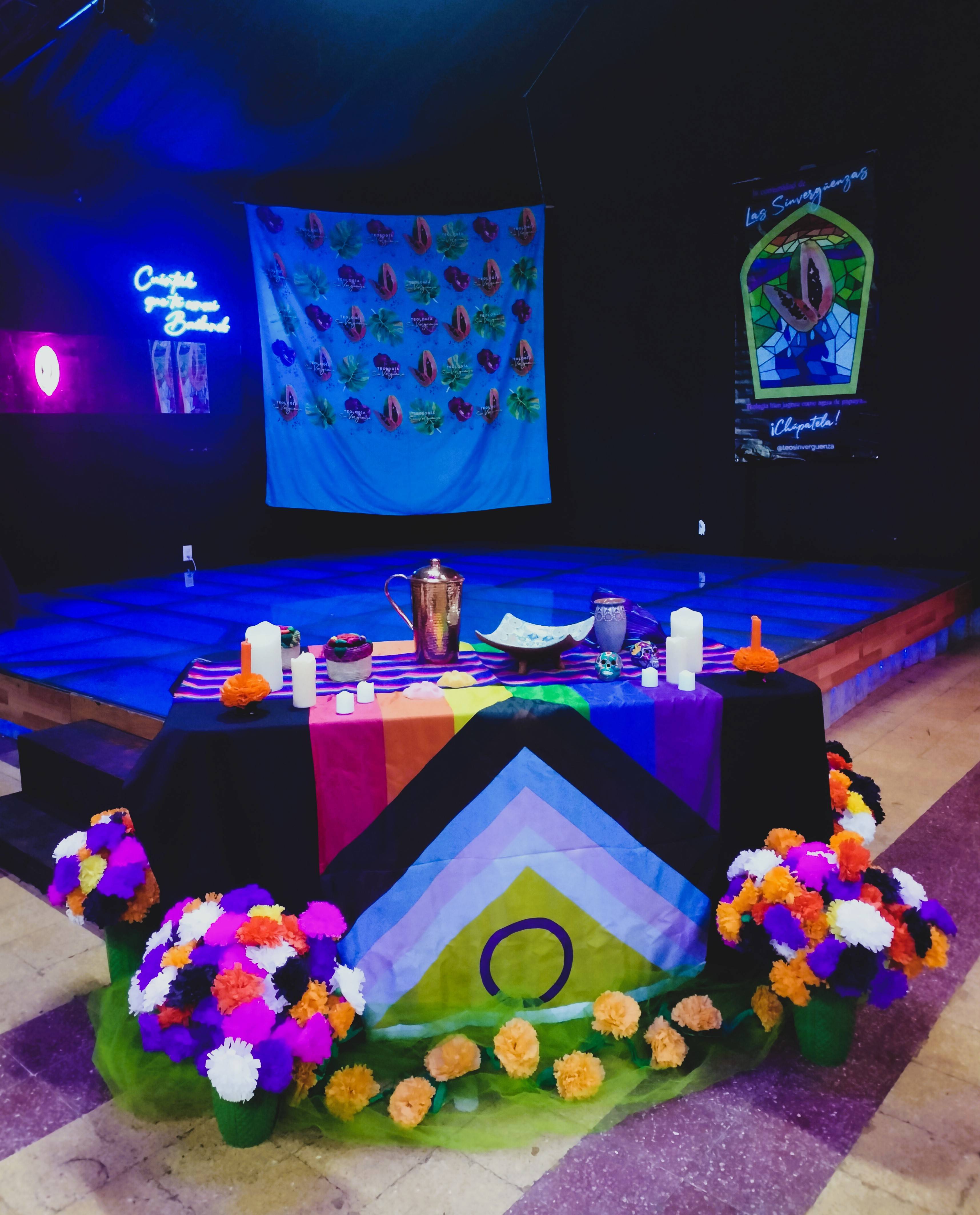
The Cuir Cult was held on Sunday, October 27, 2025 at Club Prophecy 9, in Mexico City. This is the first Cuir Worship that I have witnessed in person and it is the third of those that have been held publicly in Latin America. The first was in Bogota, Colombia, on July 29, 2023; and the second in Quito, Ecuador, on September 30, 2024. I recorded both from the live transmission that Teología Sin Vergüenza made through its Instagram account. In the three cults I identify four ritual practices that have been constant and that are its scaffolding: 1) the Exaltation to the small valentines., which consists of an act of recognition of the experiences of women and lgbtq+ people, for example, regarding abortion or dissident desires and emotions about non-hegemonic bodies that come out of the gender binary; 2) the Trans Baustimus; 3) the Rite of confession and altar call, and 4) the Celebration of the Eucharist. Between one and the other, there is dancing, singing, poetry and performance. However, the structure of the Culto Cuir is flexible in both content and form, allowing it to adapt to different socio-cultural contexts. In its Mexican edition, the Cuir Cult coincided with the Day of the Dead festivities, which was reflected in the setting of the altar, decorated with skulls and cempasúchil flowers. This fusion of ritual elements is particularly significant since, within traditional Protestant-Evangelical or orthodox congregations, the use of images or symbols associated with the cult of the dead is not doctrinally accepted. In this sense, the Cuir Cult transgresses the liturgical conventions of these religious traditions and incorporates popular and affective aesthetics that reconfigure the experience of the sacred.
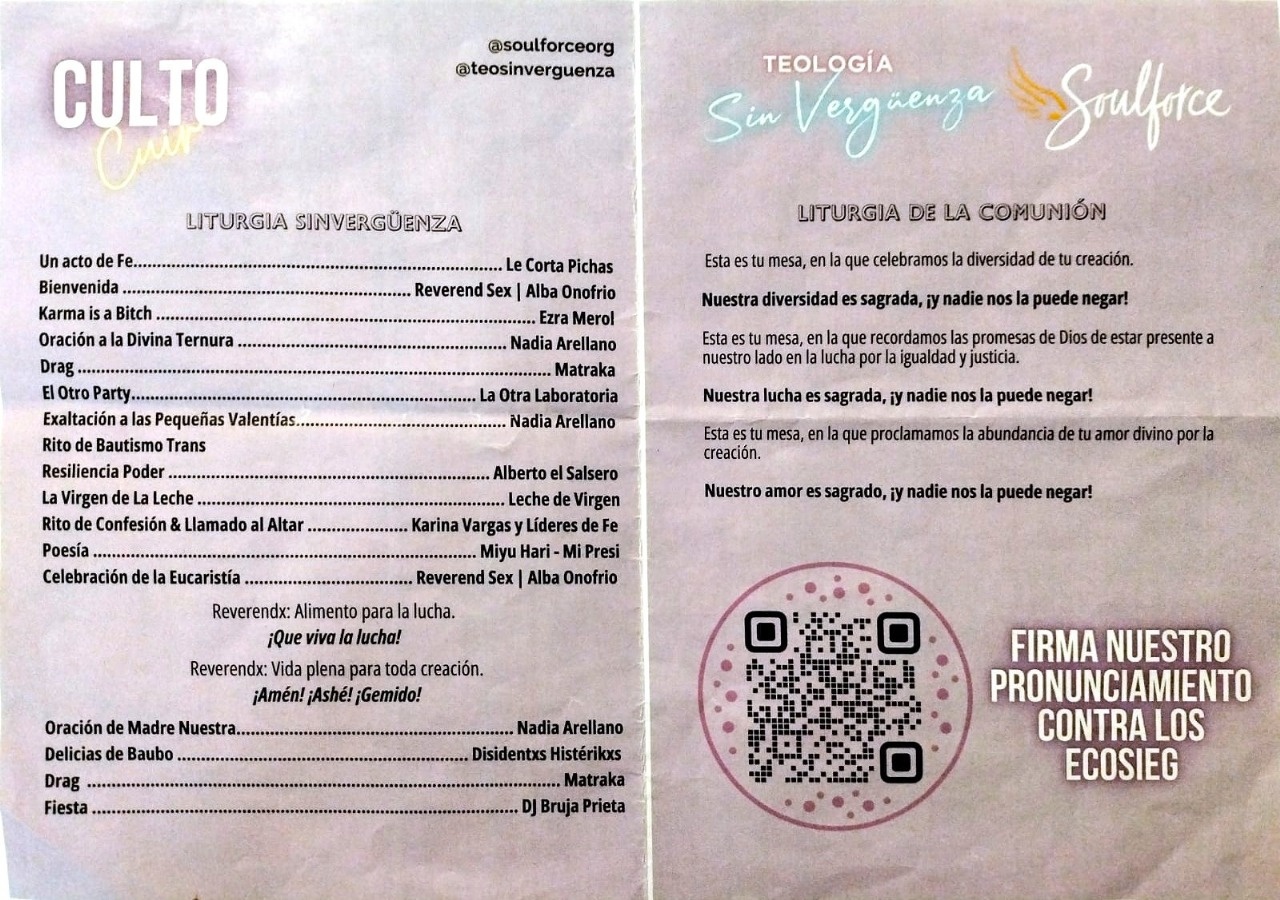
For this event, Teología Sin Vergüenza invited the public that “would like to experiment with their faith from a cuir perspective”. Invited performers included La Otra Laboratoria from Puerto Rico and Mexican artists Lechedevirgen Trimegisto from Querétaro; Disidentxs Histérikxs, Ezra Merol, drag king of Mexico City, and Matraka, drag queen from the state of Guanajuato, whose art mixes elements of Mexican culture in the reaffirmation of gender diversity. Club Profecía 9 is located in a central area of Mexico City. At some point the club opened its doors to the scene. ballroom,7 and on this occasion it became a cuir temple. To access the nave of the bar, one had to climb some stairs and, once at the end, one was greeted by a person from the Theology Without Shame team, who handed out the “program” of the liturgy (Figure 1).
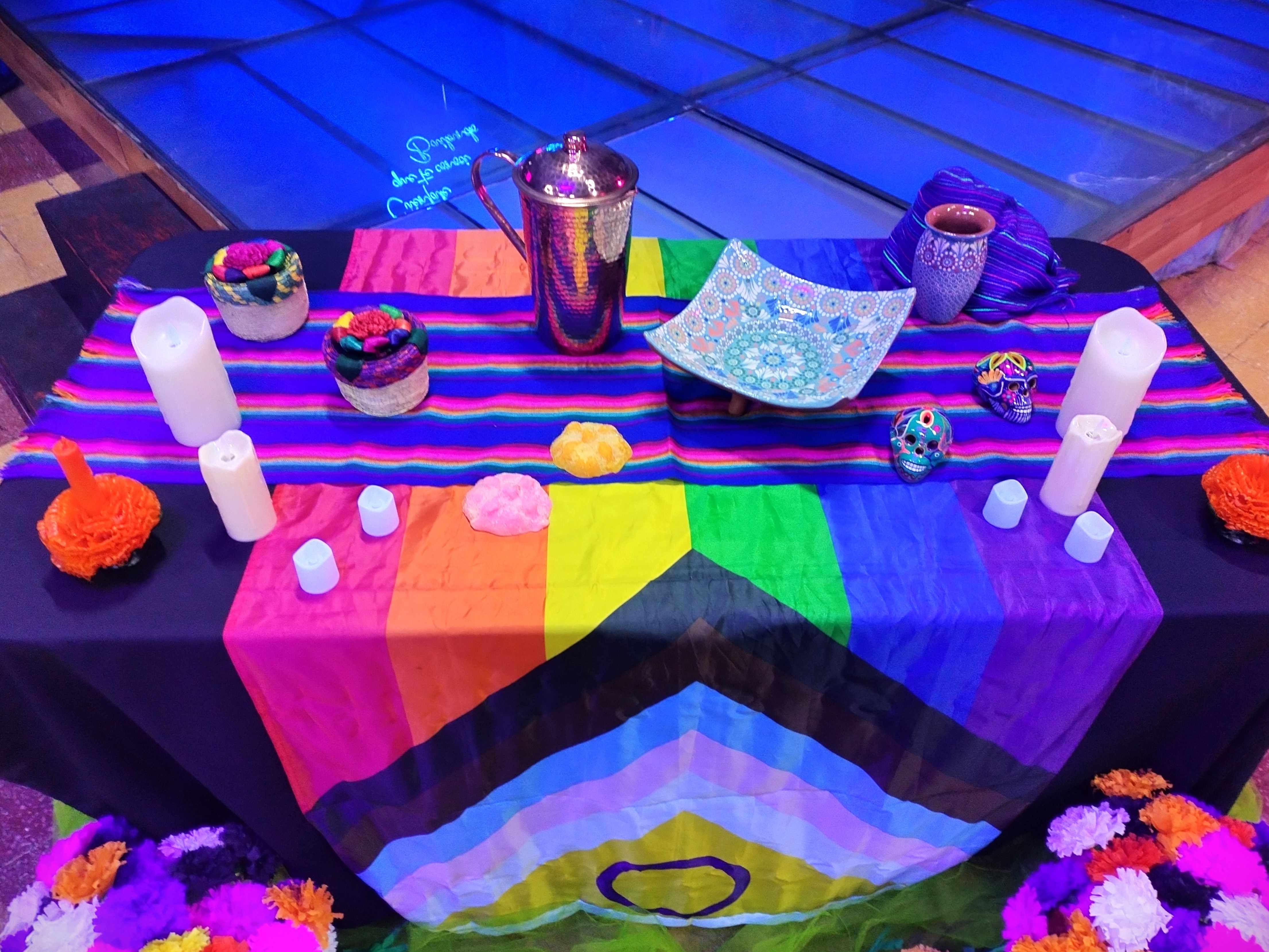
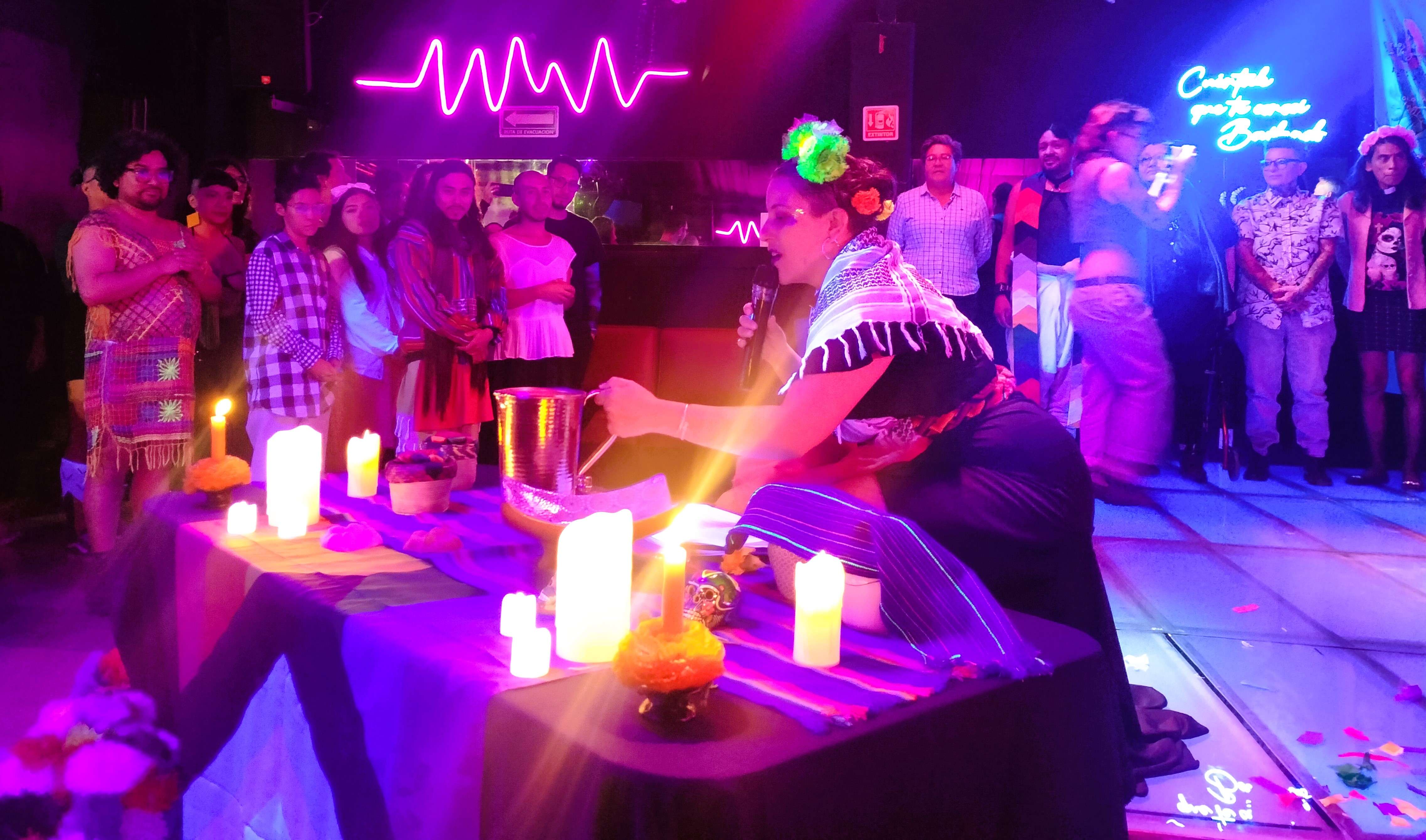
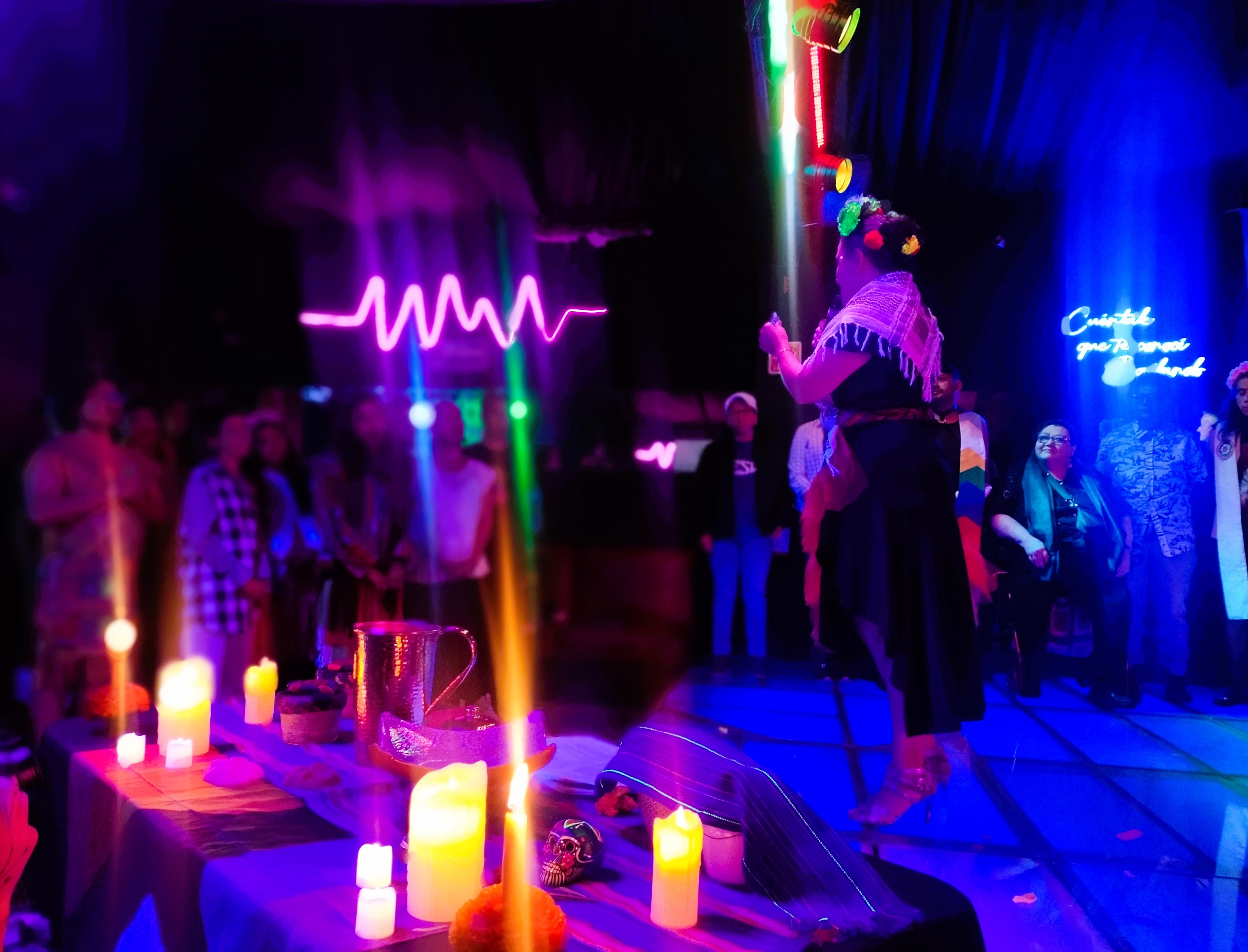
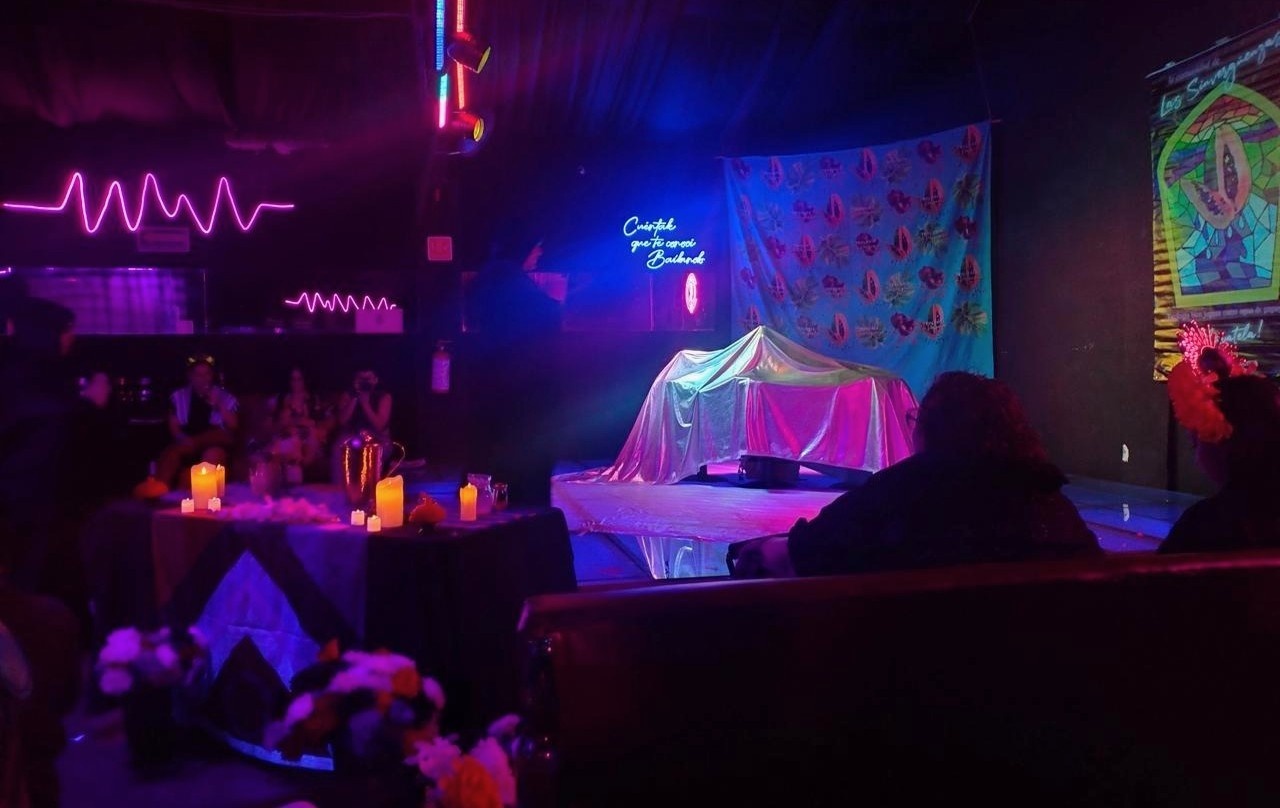
In the center of the room were red vinyl couches and chairs facing a stage illuminated with neon lights and surrounded by mirrors, where it was impossible not to see oneself and the rest of the audience. In front of the stage, the altar was adorned with the intersectional flag, a symbol that represents sex-gender diversities, ethnic and racialized identities, as well as the sun, health, life and spirit. In the center was the “water of the ancestras” with which the baptisms would be performed (Figure 2). Behind the altar was the stage and the back wall was decorated with the logo of Theology Without Shame: the stained glass window of a church with a papaya from which juice is flowing (Figure 3). A metaphor with which they vindicate pleasure and bodies with vulva, recognizing their sacred value as liberation of bodies that historically have been at the service of others. In the place we met approximately 80 to 100 people. We were asked to sit down and have our program ready to follow the directions. Le Corta Pichas took the microphone and began the liturgy with An act of faith to “create another world with our hands” (Fragment, Le Corta Pichas, October 27, 2024).
An exorcism to cure me of what?
After welcoming us, the drag king Ezra Merol presented Karma is a Bitcha performance focused on the procedures that are performed on lgbtq+ persons with the purpose of “curing homosexuality”. The pathologization of what does not fit into the binary classification of gender has led to mechanisms that are considered a form of torture.8 and which make up what is known as ecosieg.9 These are carried out by churches of different religious traditions, through rituals such as exorcisms, pressure to contract heterosexual marriages, and even by mental health professionals in psychological therapies. As part of these practices, some people, as in the case of lesbian women, have experienced “corrective rape” (Mazariegos, 2024). The discussion and struggle against ecosieg is part of the history of several of the groups present at the meeting, many of them formed by survivors.10 of these procedures who left their churches and founded collectives, faith communities or joined an inclusive church. Although in April 2024 ecosieg was criminalized in Mexico, it is no guarantee that it will cease to occur, hence the power of the message from the performance described.
The drag king Ezra Merol, through his performance, In the photographic sequence of Figures 4, 5 and 6, we can see the struggles, the loss of meaning in life and, finally, the recognition through the image of the image of the woman. In the photographic sequence in Figures 4, 5 and 6, the struggles, the loss of meaning in life and, finally, the recognition through the image of the muxe oaxacan that embraces difference, in a mixture of symbolic and representative elements of Mexican culture. The muxes are emblematic of the cuir population in Mexico, as they represent what has been called “the third sex” or “the third gender”. While the muxes most visible are those people assigned as males at birth who subsequently transitioned to a female identity, the term is also used by other non-normative gender expressions that are recognized within this category (Marcial, 2015).
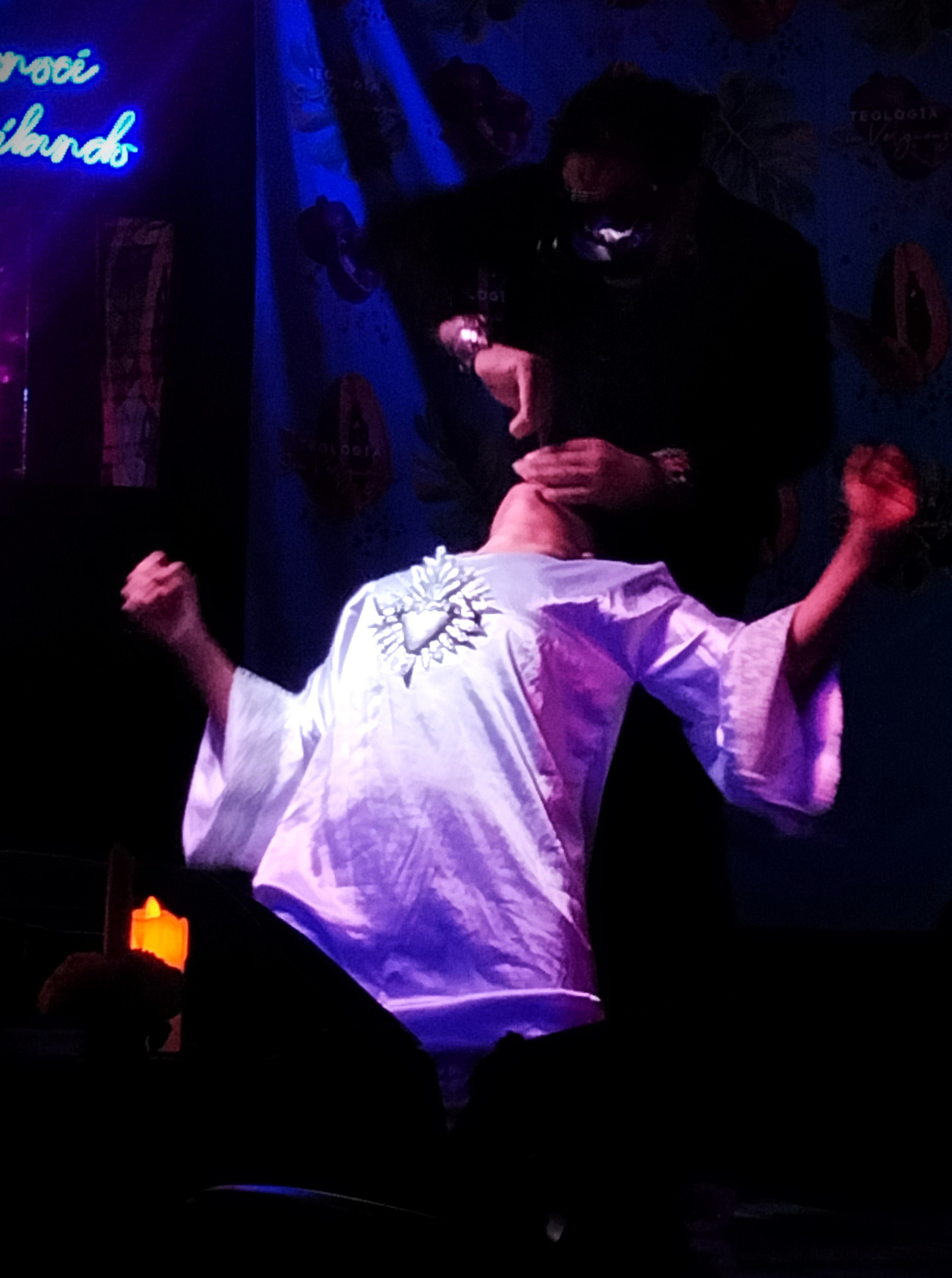
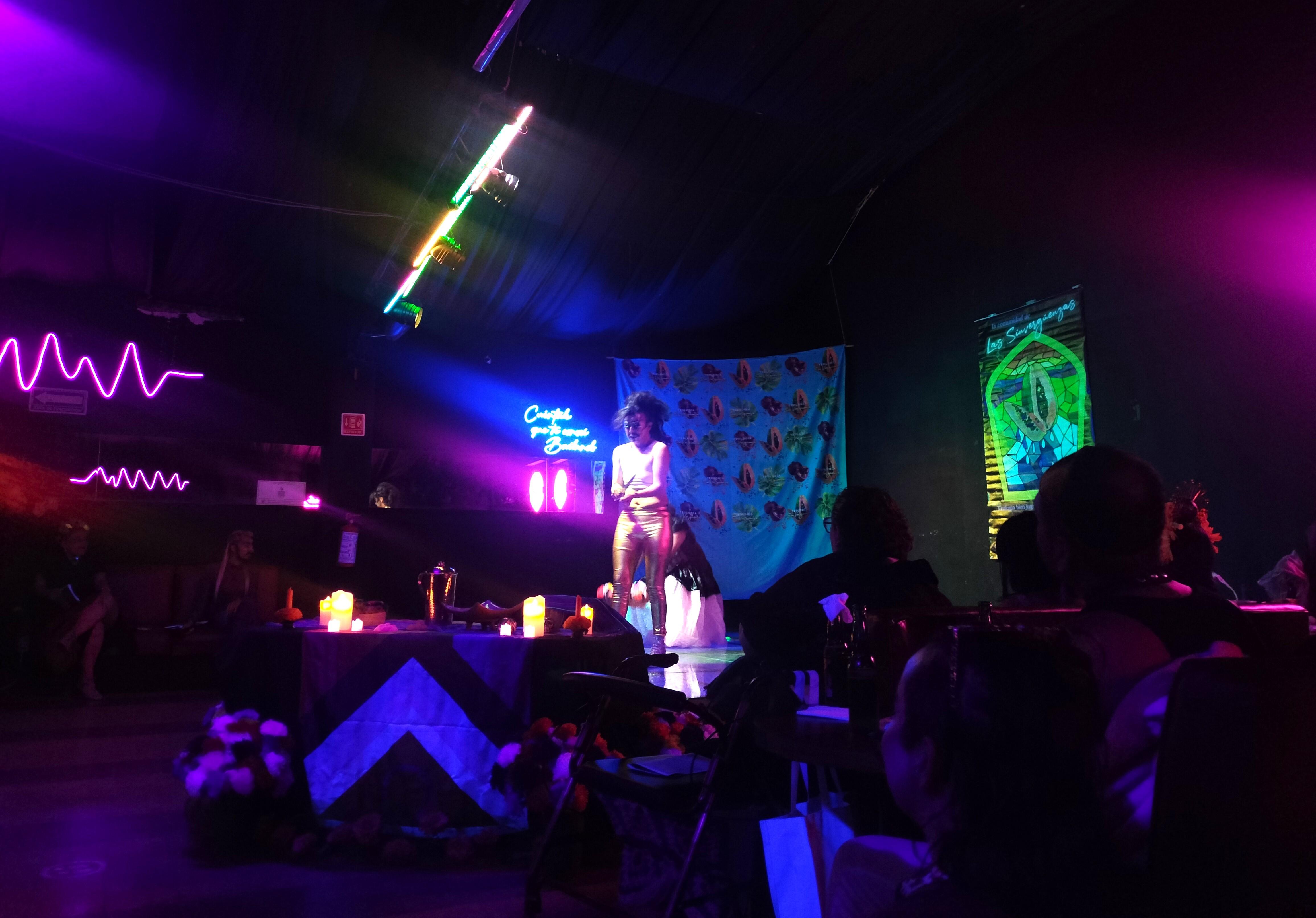
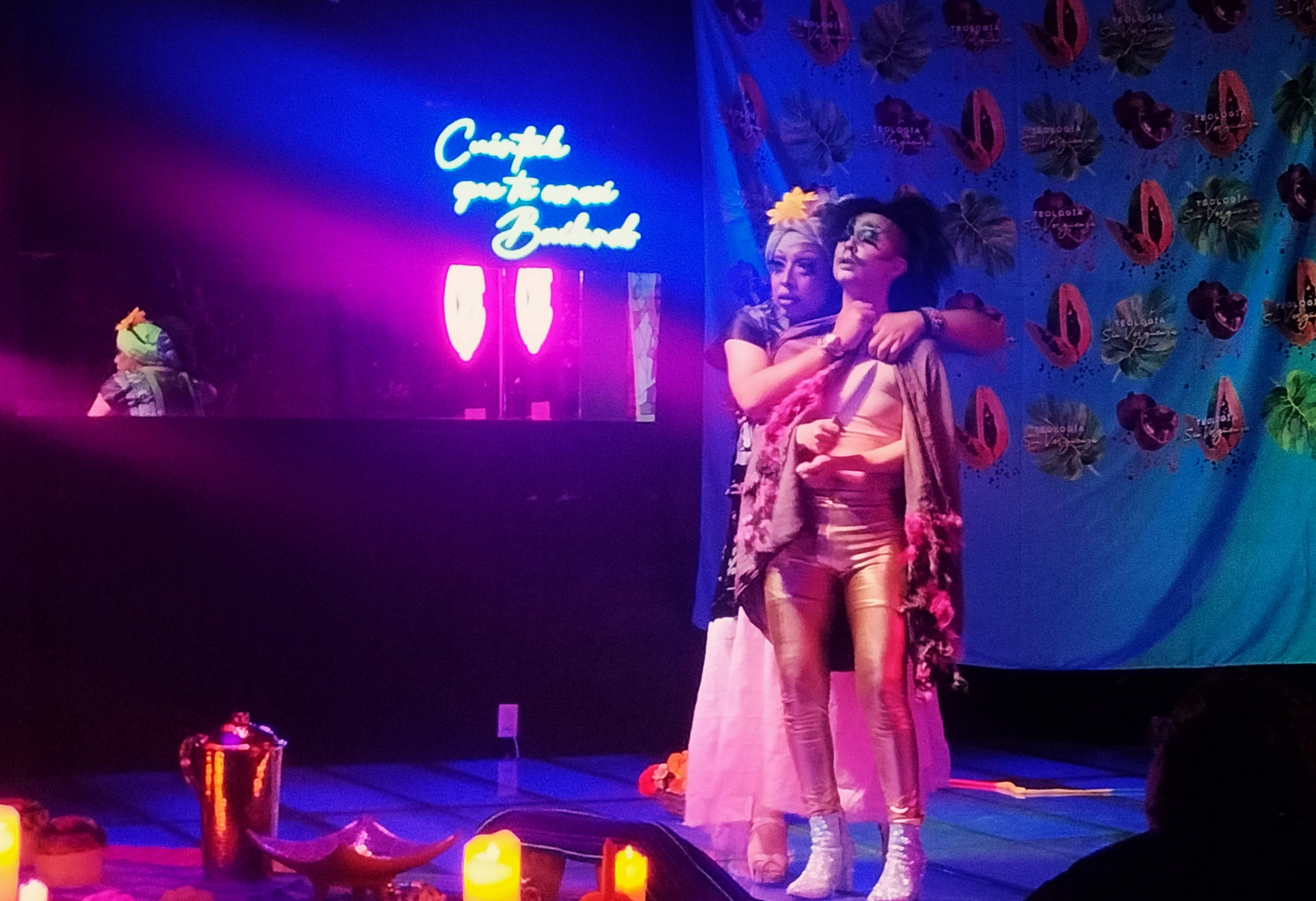
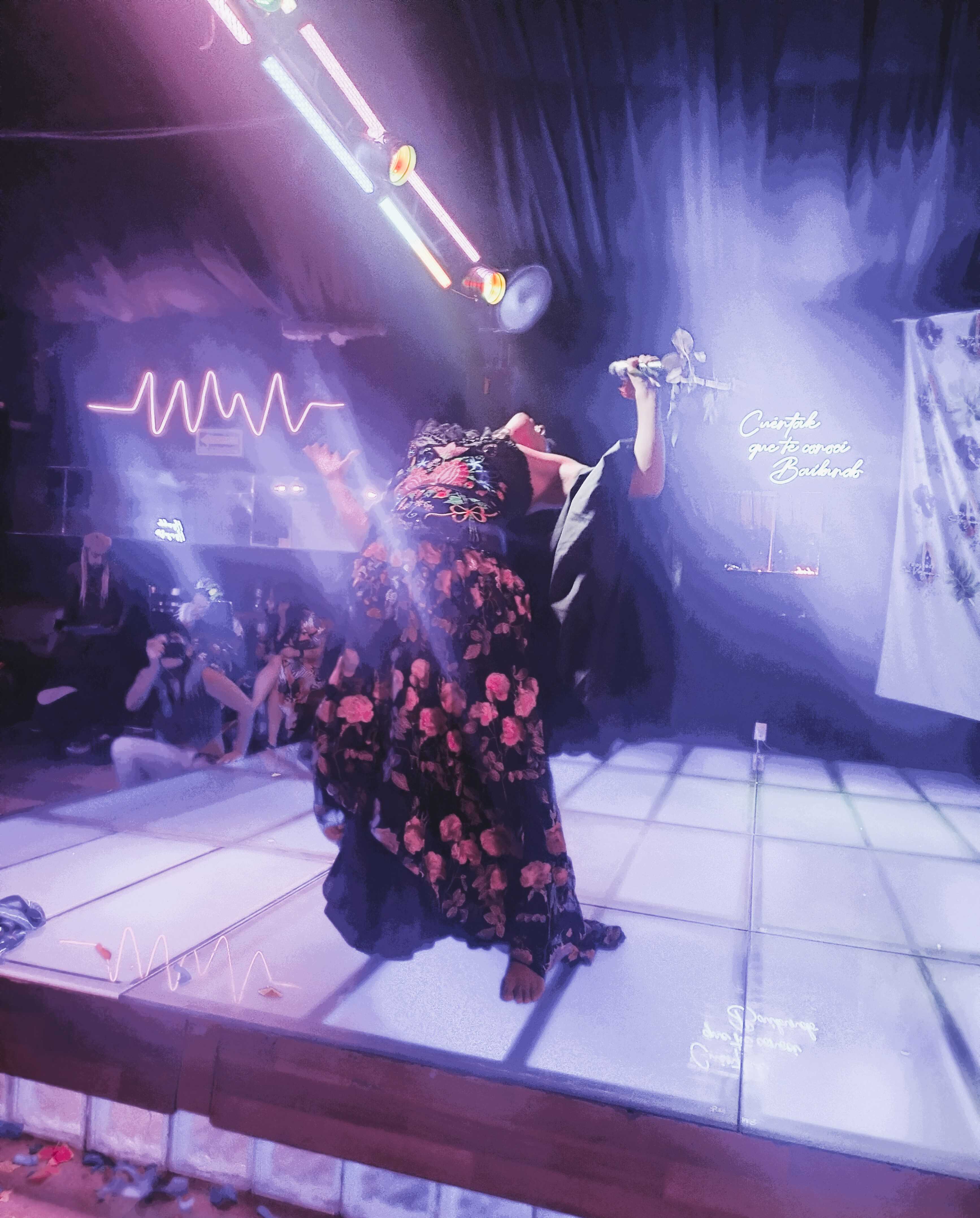
Its ethnic origin is in the Zapotec people, an indigenous community located in the region of the Isthmus of Tehuantepec, in the state of Oaxaca, Mexico. One of the characteristics of the muxes is the vindication of sex-generic and ethnic dissidence, by using the traditional dress of their culture, which, to a certain extent, accepts them within their dynamics and traditions and, at the same time, places them in the dispute of the right to ethnic and sex-generic belonging. The muxes have reached the screens of cinema, television and recently digital platforms such as Netflix, with the series El secreto del río (2024), directed by Mexican film director and screenwriter Ernesto Contreras, which has had a strong echo within the trans population. In his drag Matraka also showed the importance of the muxes as a symbol of liberation for sex-gender dissidence in Mexico (Figure 7).
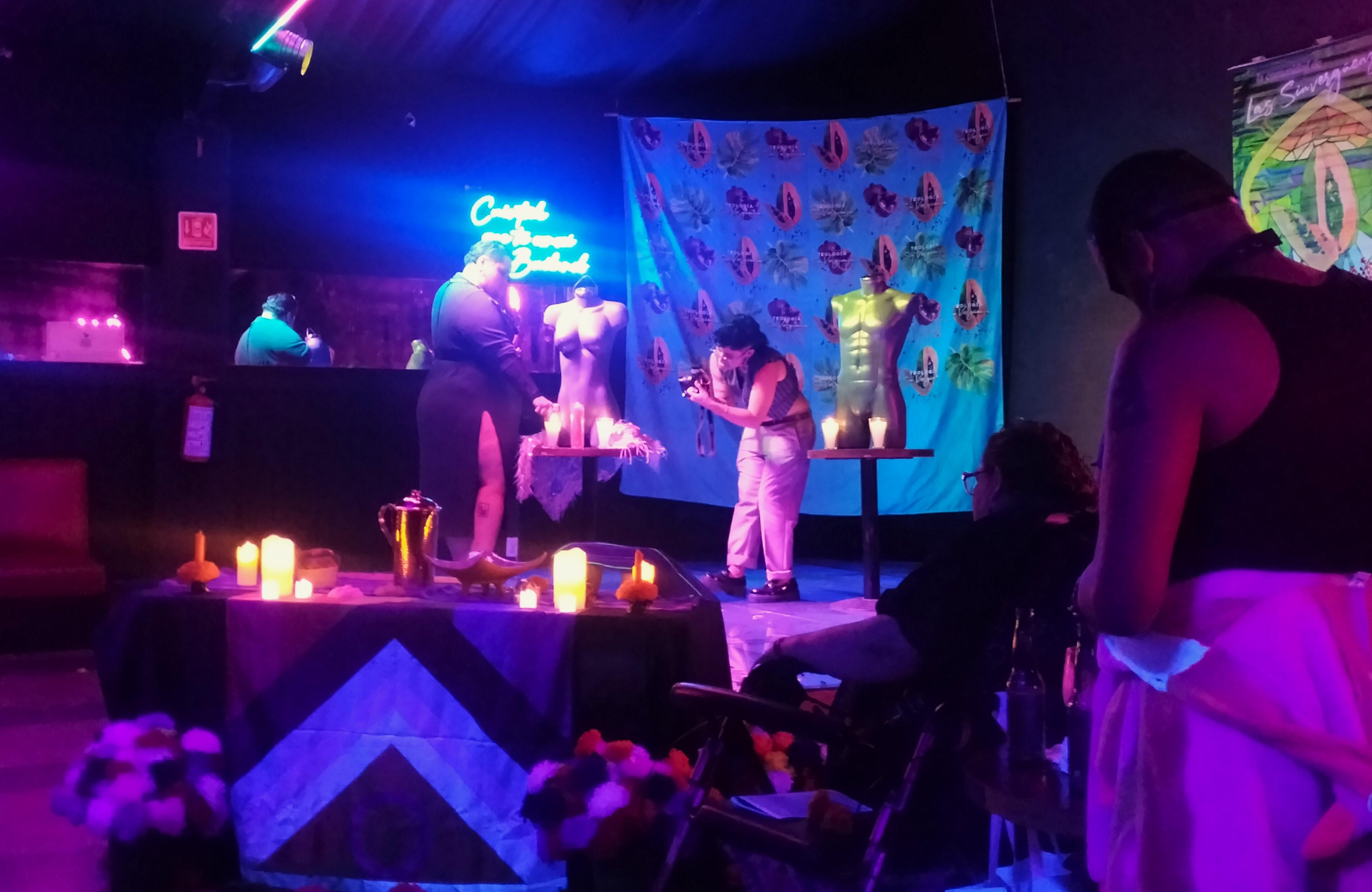
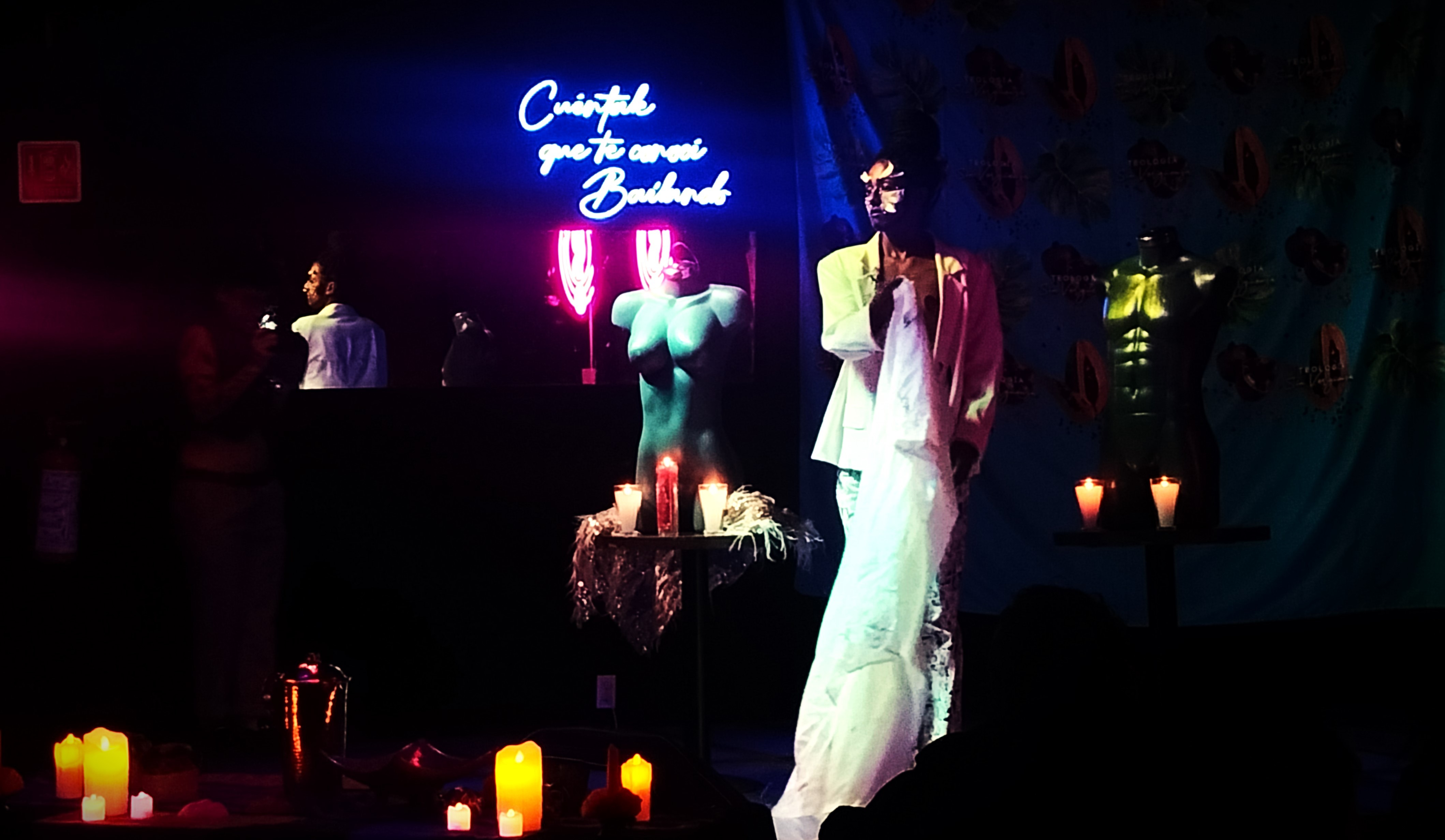
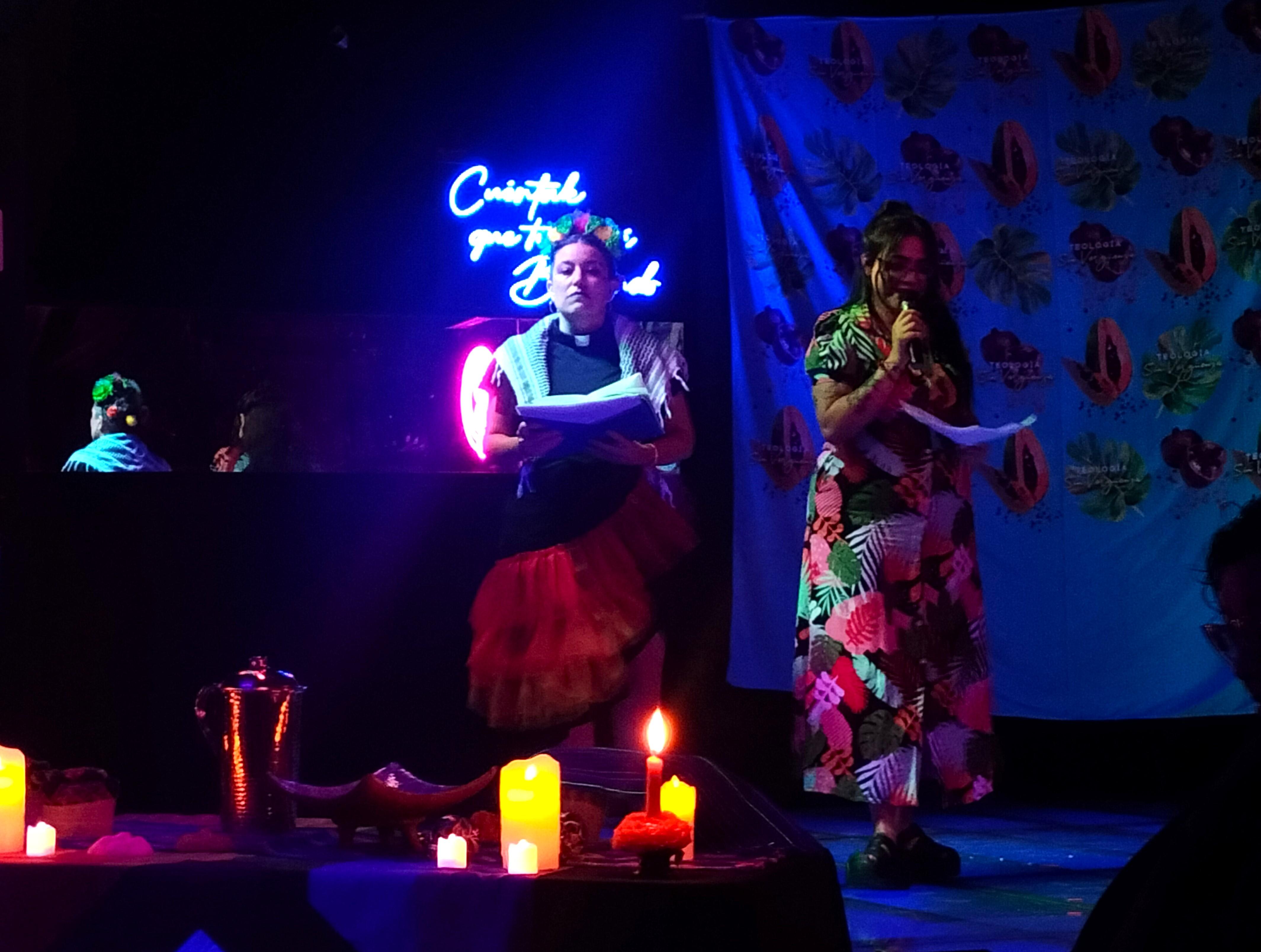
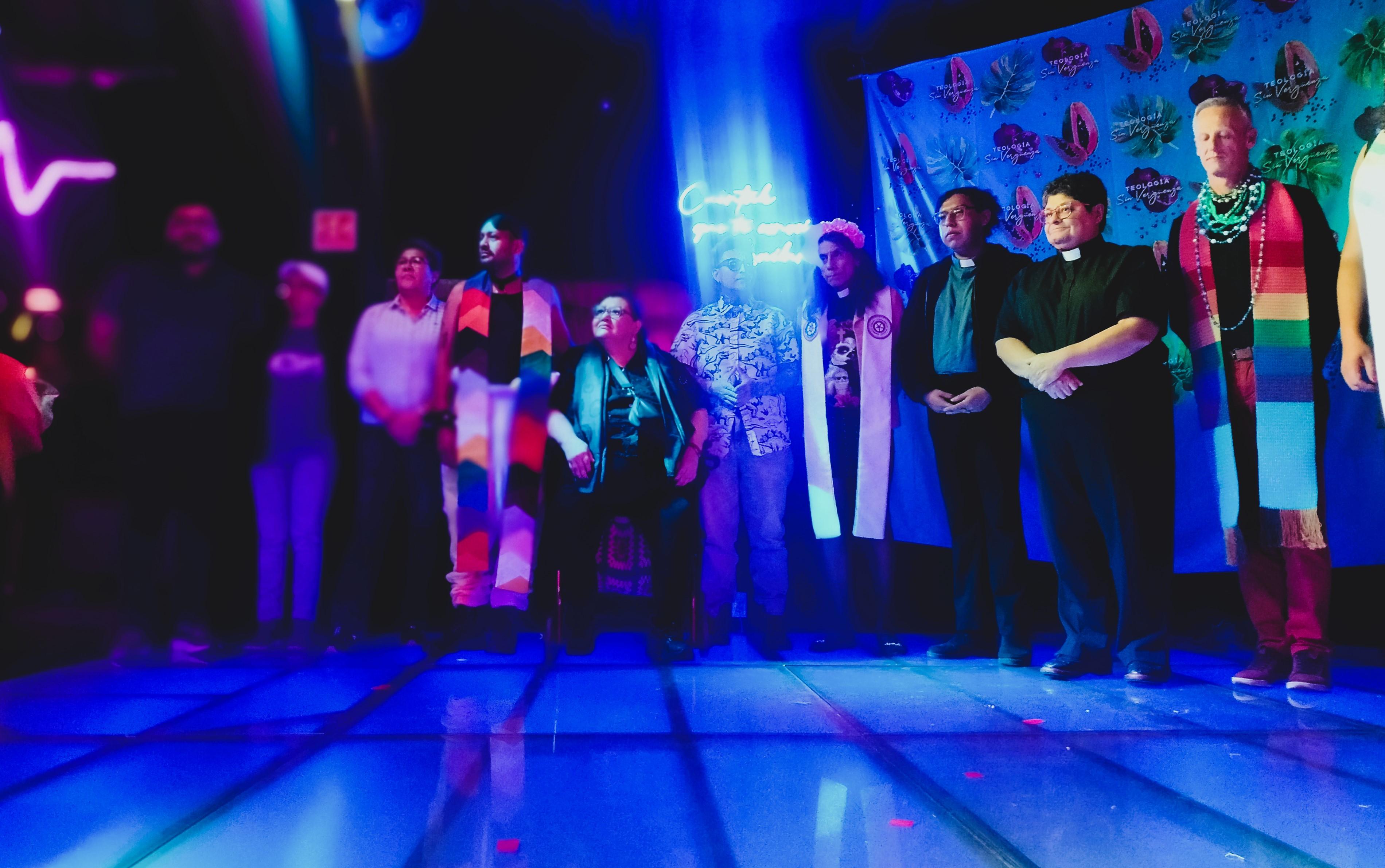
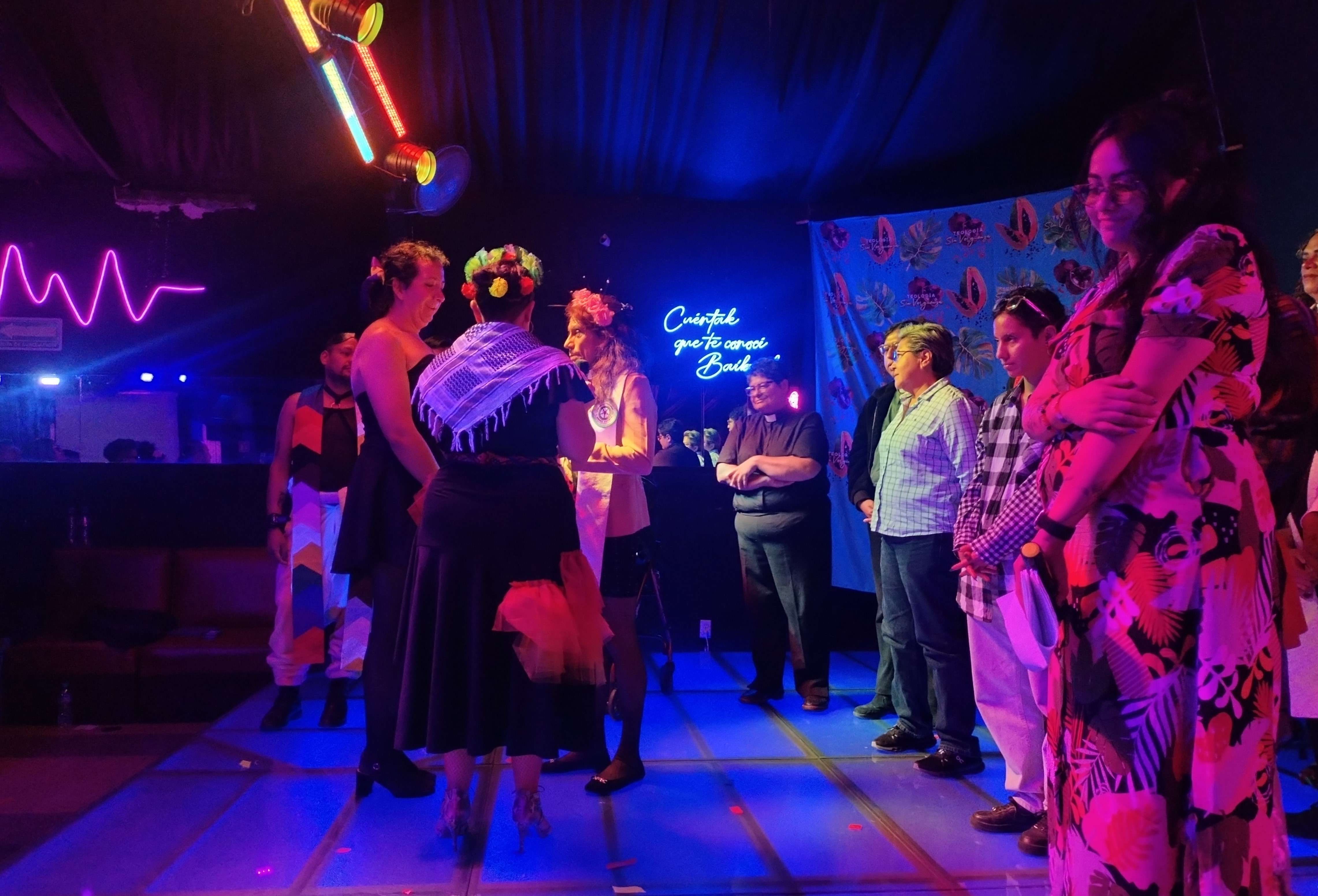
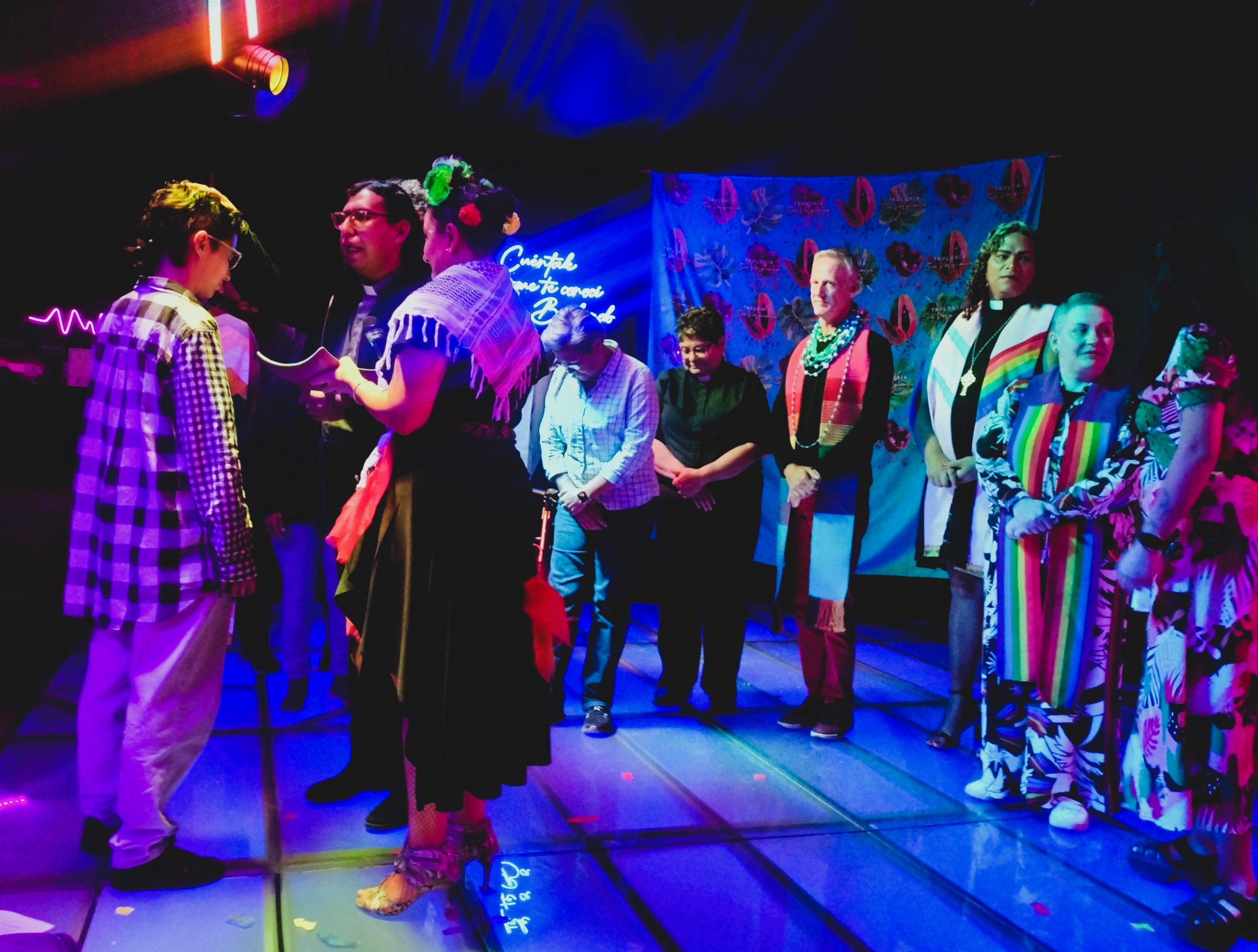
After Karma is a Bitch and the Prayer to the Divine Tenderness, the first Drag Matraka was the precursor to the performance The other party. The Other Lab prepared the space for the next act. Two busts were placed at the center of the stage, illuminated by the dim light of the candles that surrounded them (Figure 8). One, with breasts and vulva; the other, showing pectorals of a strong, exercised body. In the middle of the two was a person, trying to decide between these two figures, and asks the following question, “Why can't they call me by my name?”. The performance focused on questioning gender binarism and society's inflexibility in recognizing non-binary identities and the refusal to name them with the pronouns that identify them, beyond the male and female categories (Figure 9). Then came the Exaltation of Small Bravery (Figure 10) to introduce the Trans Baptisms. The pastors -all ordained in their respective institutions- were invited to come to the stage to recognize the future members of the community (Figure 11).
Trans baptisms
As part of the recognition of the trans population that professes some spiritual religious belief, Theology Without Shame began about two years ago to perform “trans baptisms”. Paraphrasing Reverend Sex, the objective of these is to break with the shame that conservative religious discourses have provoked in lgbtq+ populations and to assume the divine as part of their own by recovering the value of the sacred in their bodies, identities and affections. On this occasion, due to the previous meeting with theologians and pastors from different countries, the baptisms were performed not only by Reverend Sex, as had happened in previous services, but among all the pastors present. Reverend Sex explained that baptism is done with water because “it represents the fluidity of life, and this is where we come out of the matrices. From the water, right? Jesus Christ, when they put him here [points to rib], what came out? Water and blood. That was a moment of rebirth. What does it represent, that we are followers of a Jesus who gives new life” (Field Diary, Cuir Cult, Prophecy 9 Club, October 27, 2024).
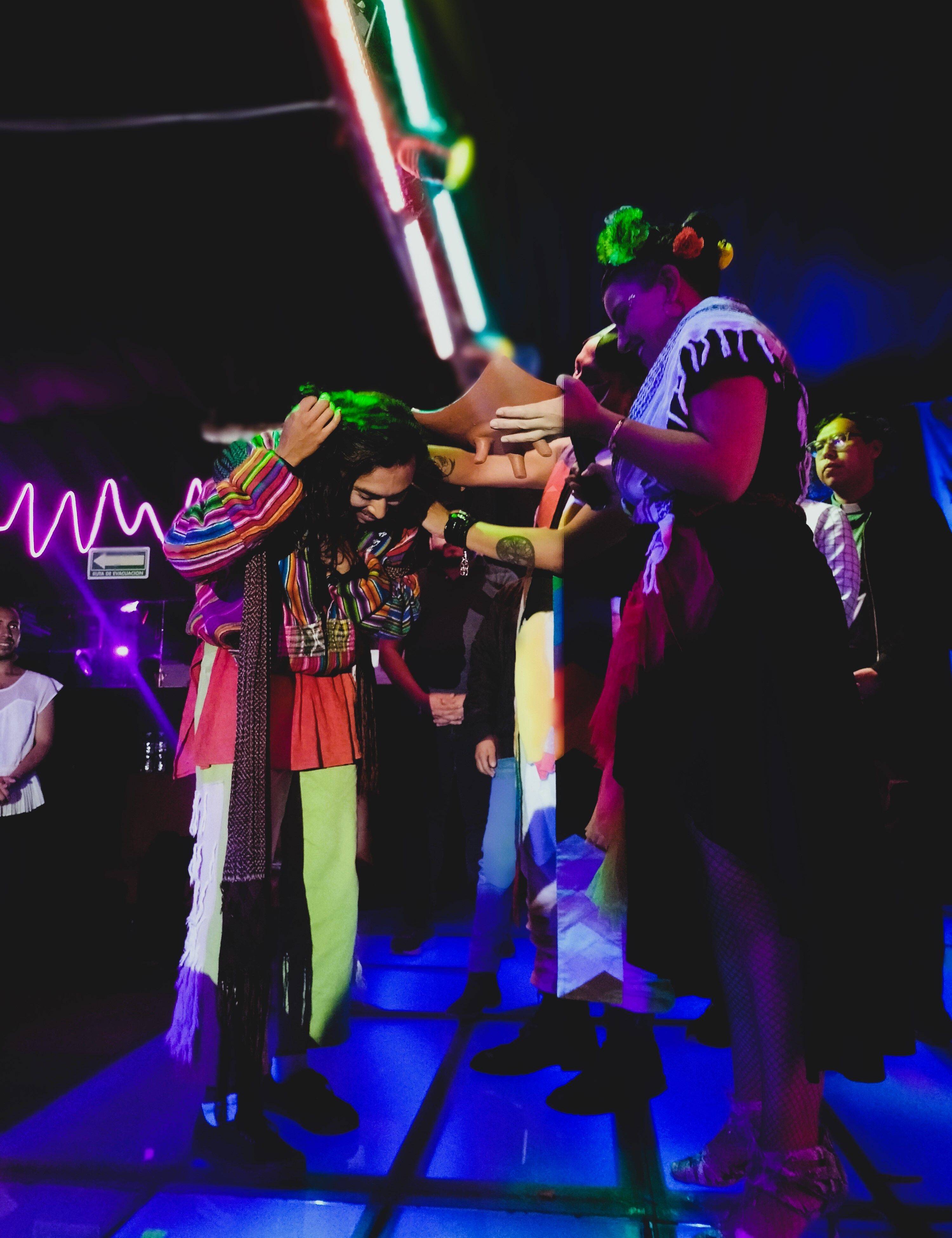
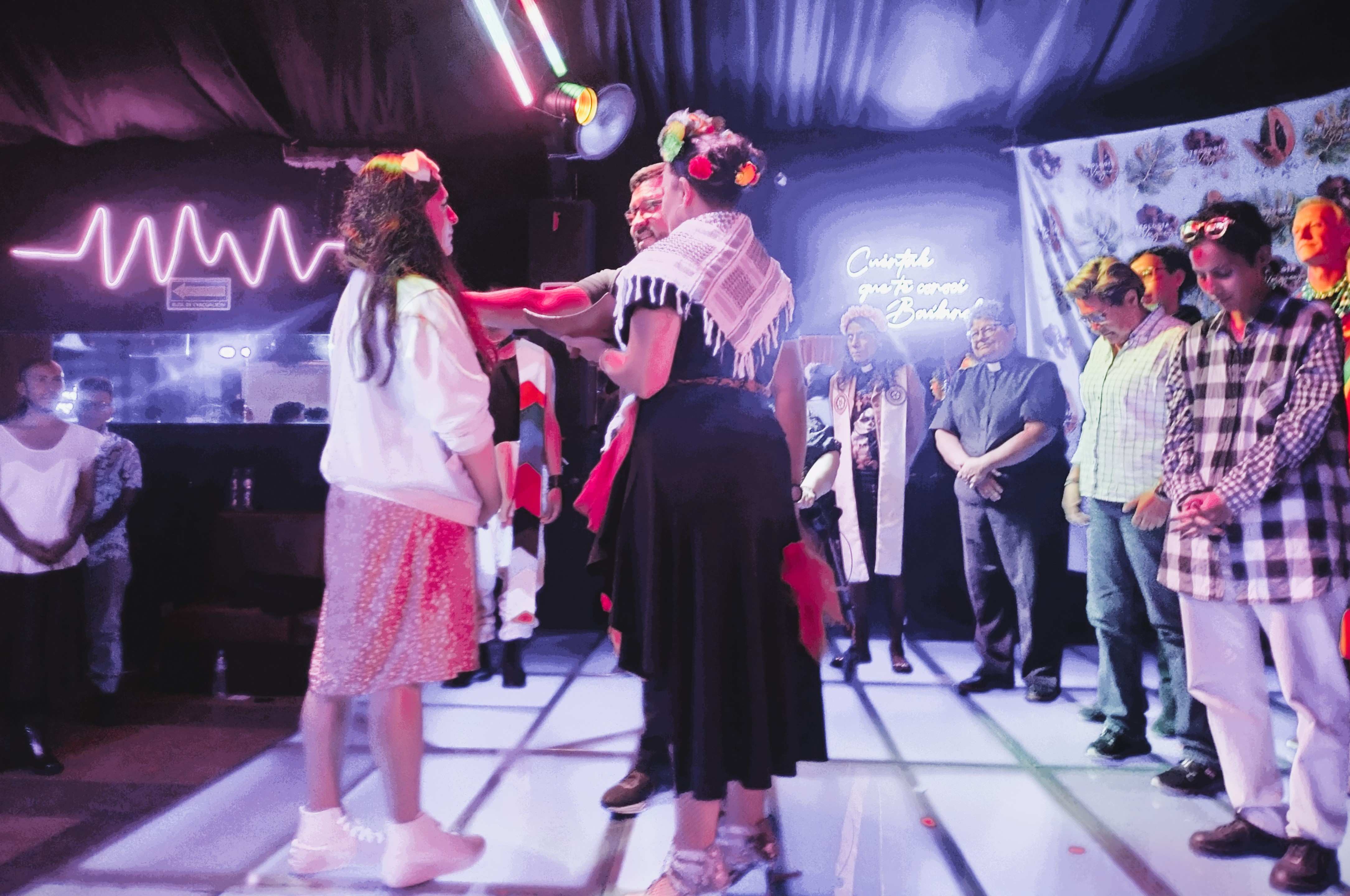
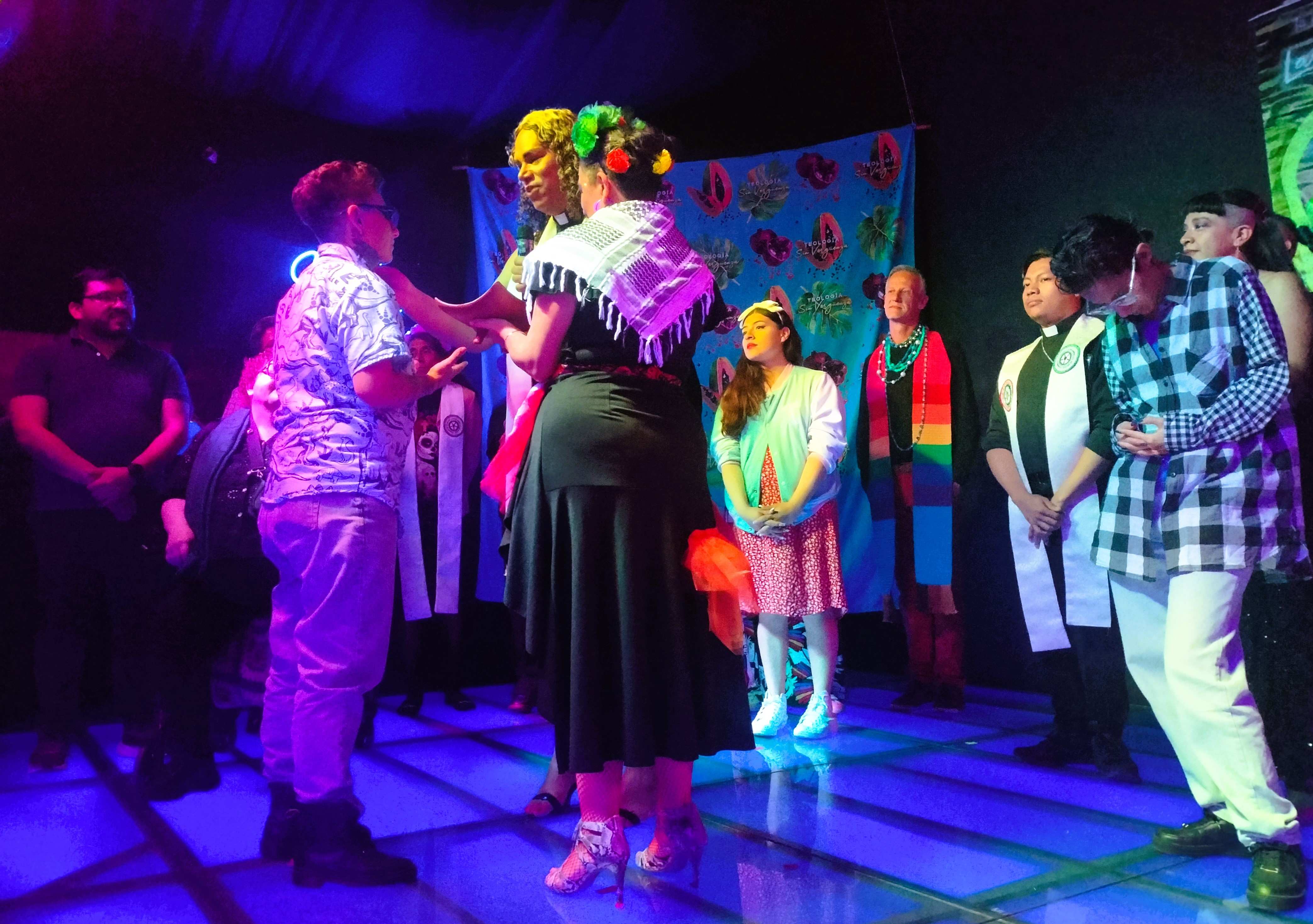
The water of the ancestors is sacred to them because, in the words of Reverend Sex, it is the mixture of different colonized territories that have fought for their freedom. It was collected, according to the shameless theologians, from different “estuaries” in Africa, Latin America, the glaciers of Iceland and the lakes of the Philippines, among many other waters from different places (Figure 12). Next, Reverend Sex explained the dynamics of the baptism: each person would come up to the stage and pronounce aloud his or her chosen name. Then, the shepherds who so wished would stand in front of the person to reaffirm their name and offer their blessing, placing the water of the ancestors on the part of the body that the baptized person chose: head, chest, forehead or neck (Figure 13). On this occasion, around 15 trans baptisms were performed on people of different ages, who were received in a large community of lgbtq+ people who mobilize for their rights through faith (Figures 14 to 18). The baptisms are the highlight of the Cuir Cult. An atmosphere charged with strong emotional energy is created. Sobs, smiles and exclamations of joy accompany the interventions of the baptized persons as they “bear witness” and explain how they chose their names. We hear “Amen”, “Amen", "Amen!Ashéor some moan in response, welcome and recognition.
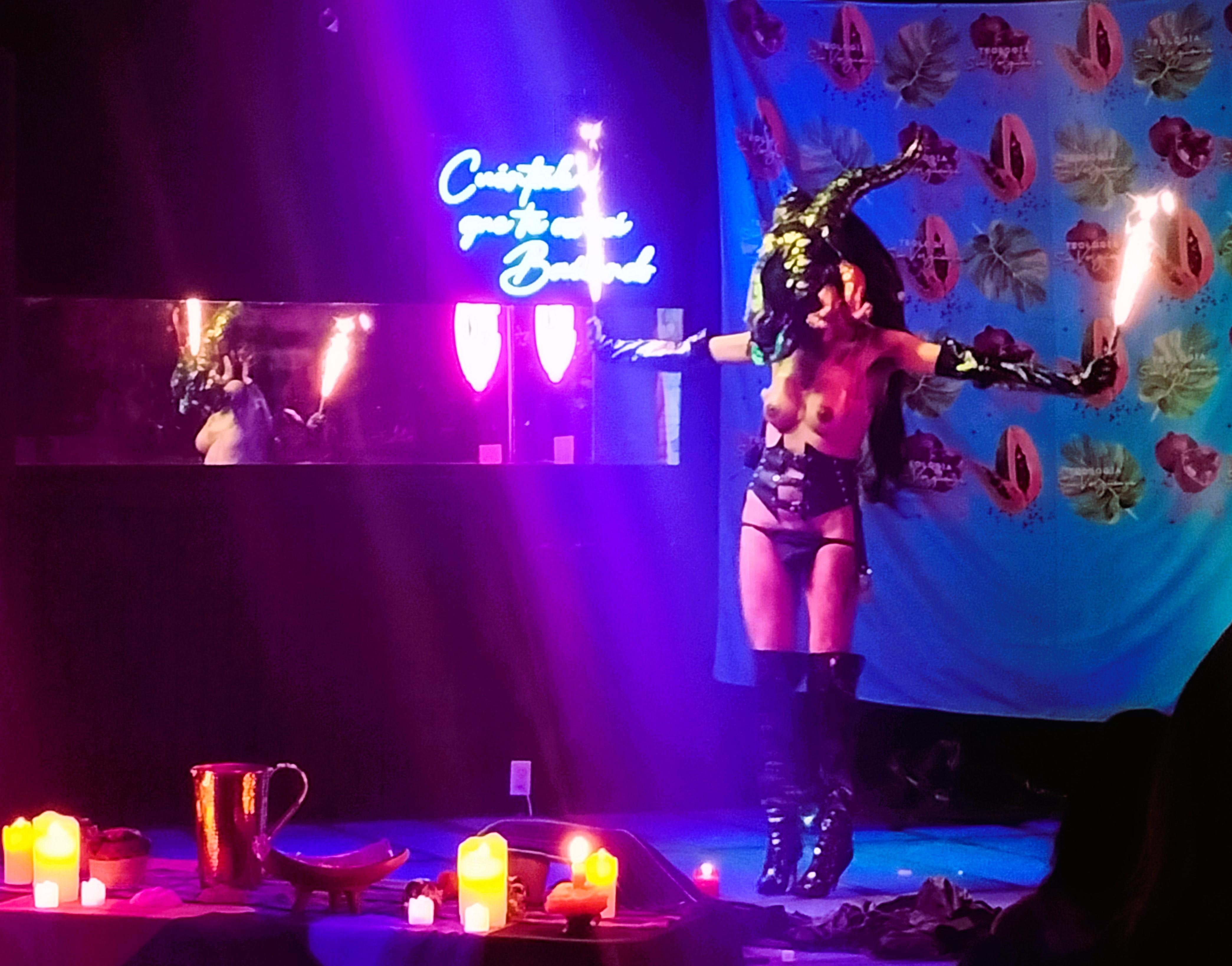
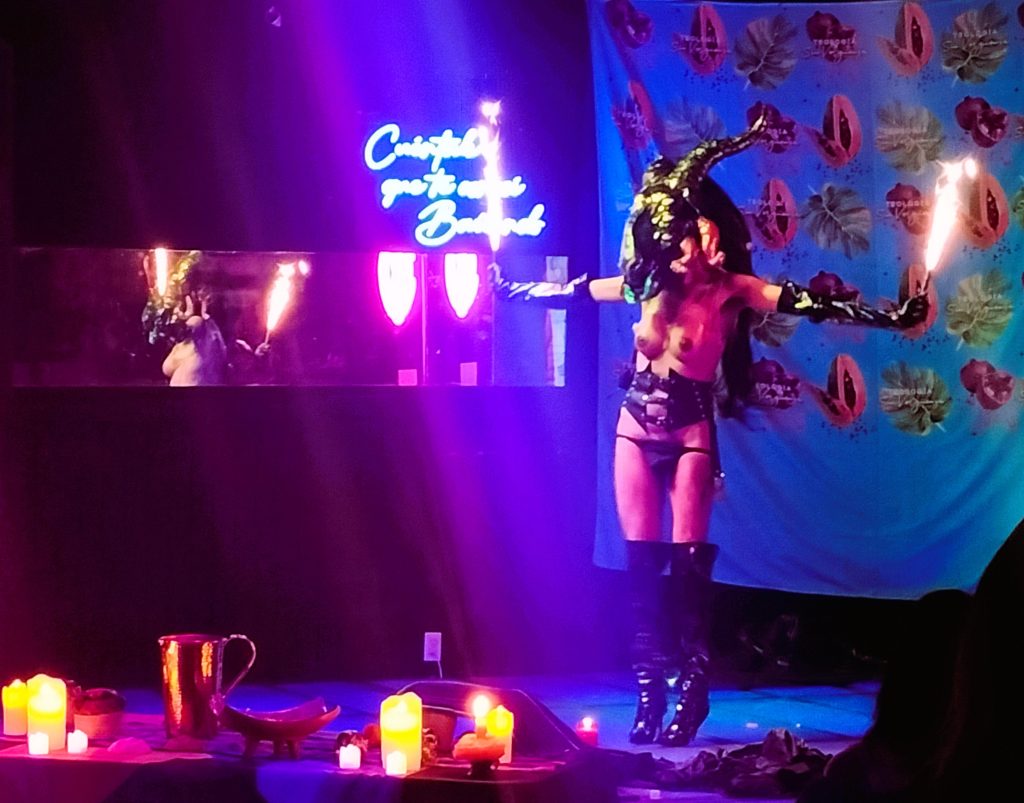
After the trans baptisms, as a celebration, we danced to the rhythm of Resilience power by Alberto Salsero, and then we moved on to a gloomy atmosphere. Lx artistx Lechedevirgen Trimegisto performed a performance titled La Virgen de la Leche. I was deeply distressed and moved by the incarnated discourse that highlighted how people of sex-gender dissidence have been historically constructed as animal bodies, overflowing, contaminating and demonized. I observed that some of the attendees left, others moved away from the stage and some avoided looking at the moving image of that which the performance represented as “the evil that is us, nosotres”. Lechedevirgen Trimegisto bent down and showed her buttocks; milk was flowing through her body: nourishment and pleasure but also excess, impurity, uncomfortable enjoyment. With dignity, she stood up and transfigured herself. She lit the fire and showed herself to us (Figure 19).
This performance, The performance, in particular, generated diverse reactions among the audience, both during and after the performance. Some people expressed concerns about its relevance within a space considered sacred, while others interpreted it as a necessary provocation that invited to rethink the boundaries between the spiritual and the performative. The piece also opened reflections on the very configuration of the Cuir Cult: was it a liturgical act, a spectacle or both at the same time? At times, the cult incorporated cultic and sacramental practices, while at the same time deploying scenic and aesthetic languages charged with symbolism. This ambiguity exemplifies the interstice that Homi Bhabha (1994) speaks of, where conflict and tension become creative potentials for reconfiguring frames of reference, especially for those who have been historically subalternized. Following the order of the program, the Rite of Confession and Altar Call, the poetry of Miyu Hari-Mi Presi, the Eucharist, the Prayer of Our Mother, and we immersed ourselves in the Baubo delicacies.
The Baubo delicacies
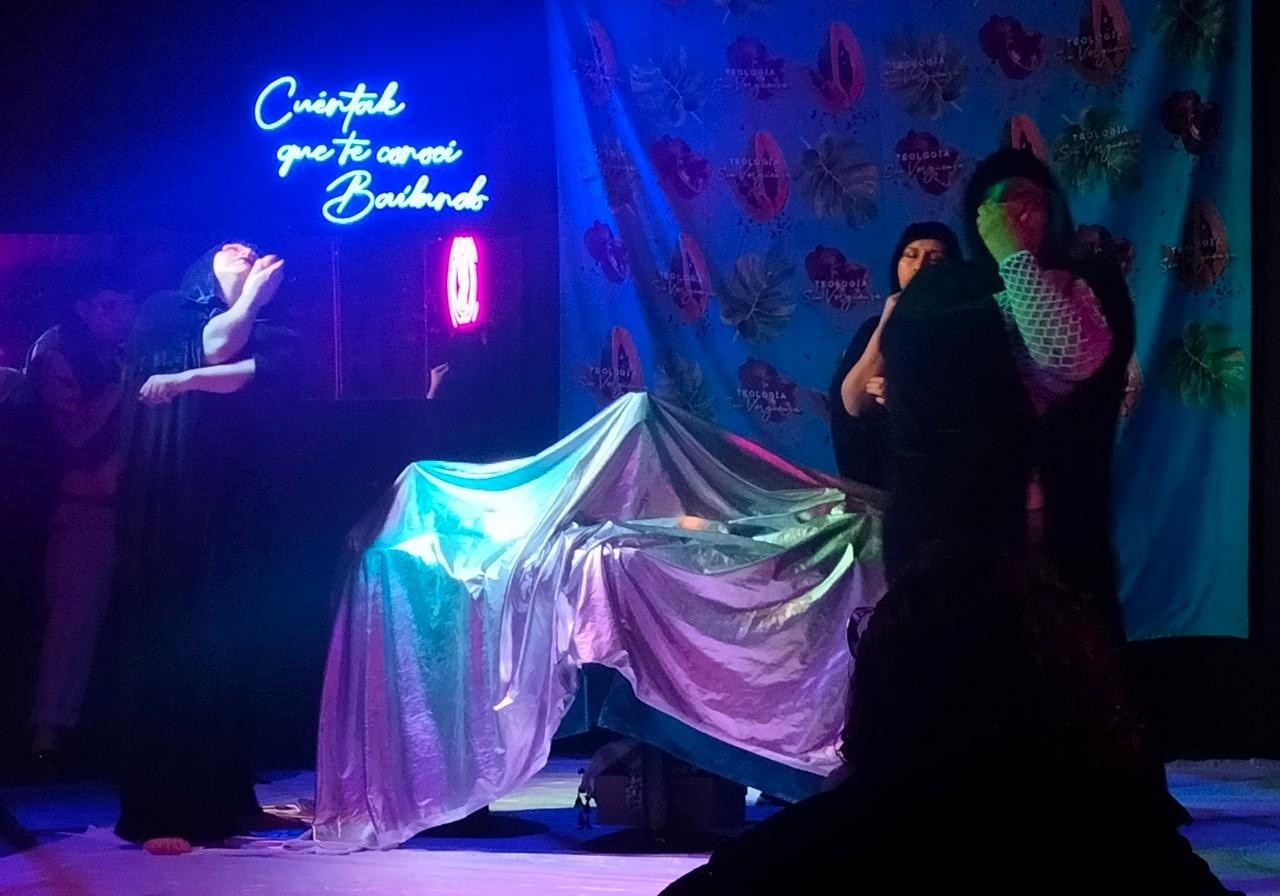
Disidentxs Histérikxs entered the stage covered from head to toe in black robes. To the rhythm of the praise “Wash me, Lord, with your spirit,” they walked cautiously around the rectangular table in the middle of the stage, covered with a silver cloth. Right in the center, the cloth was raised by what looked like a phallic figure (Figure 20). Dissidentxs Histérikxs paused in front of the table. The praise suddenly stopped and the following was heard Toca e fuga, theme of the film Dracula, while Disidentxs Histétrikxs tried to find out, with an attitude of fear and curiosity, what was hidden (Figure 21).
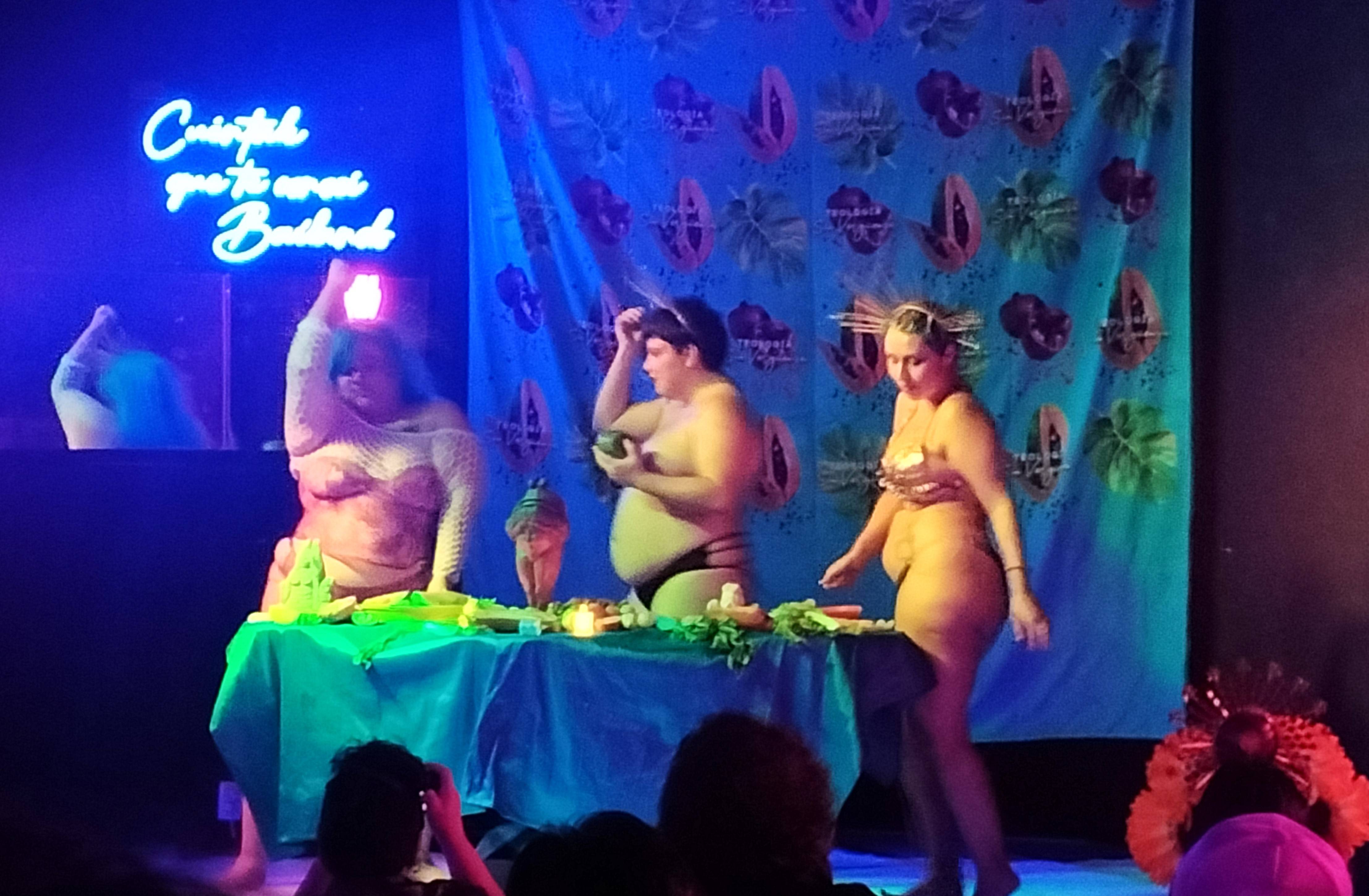
Once emboldened, they began to test what was underneath the fabric. It sounded Suicide (2023) by Moonvampire, as if they were about to give in to temptation. Finally they uncovered the table and a feast of fruits, vegetables, sweets and a figure of an erect clitoris, Baubo, rested in front of their eyes. They discovered their voluptuous bodies hidden in the layers (Figure 22). Sensual dances, spankings with celery, oranges squeezed into breasts and a performance of oral sex with a papaya followed the rhythm of klk of Arca and Rosalía. We were then integrated into the feast, walking through the audience while they offered the Baubo delicacies. As they were eaten, the air was infused with papaya, grapes and mango. There was a buzz, laughter, frenzied applause and the sound of thundering fingers and, also, discomfort expressed by some of those present. This performative discourse that activated our senses, full of erotic images, invited us to enjoy ourselves in bodies with non-hegemonic aesthetics, such as the desiring fat bodies. It is not by chance that the word histérikx is part of the name of these performers.
I commonly hear in the collective dialogues of dissident believers how the experience of cis women has been pathologized, for example, in hysteria as a “mental illness” located in the uterus (Medellín, 2022). Therefore, resorting to Baubo, a female goddess from Greek mythology, whose power is her laughter that liberates her sexuality and experiences pleasure, functions as a vindication of female sexuality stripped of pathologizing conceptions. Baubo is represented by a plump figure pointing to or touching her vulva or by the vulva itself; she is also known as the Goddess of the Womb.
Its history is based on different versions of the myth of Demeter,11 one of which tells that Demeter, immersed in sadness for the loss of her daughter, was encouraged by the humorist of the Greek city, Eleusis, who lifted her skirt and showed her vulva (Schwentzel, 2022). In the different versions of the myth of Demeter, a constant is the humorous character in which laughter and hilarity are positioned as erotic strength, solidarity among women and coping strategy (Schwentzel, 2022). The performance of Disidentxs Histérikxs is a political message that denounces how the female body has been historically constructed as an inciter of sin and associated with danger, madness, witchcraft or demonic possession, especially in relation to pleasure. This body, which we have been taught to fear, is now demanded to be liberated.
In each of the performances of the Cuir Cult a message was communicated. The development of the cult seems to have portrayed the process of the experience inside the closet, the decision to come out of it, the consequences and discoveries once outside. The cult itself was a sort of “rite of passage” (Turner, 1980, 2002) that allowed us to go through different stages marked by multiple emotions and sensations; ending with a dance to the rhythm of disco, reggaeton and cumbias as a celebration of the transitions of which we were spectators and protagonists.
Closing remarks
The images I share with you show an emerging phenomenon, not because the intersection portrayed did not exist before, but because the doors of the closets are beginning to open with greater force. To account for these non-hegemonic religious-spiritual practices allows us to unravel the ways in which the relationship between religion and politics is configured, the latter understood as a daily practice that goes beyond the State or partisan logic. Far from conservative positions, these experiences open paths and possibilities to be a believing and dissident person at the same time, framing the recognition and exercise of human rights through the resignification of the religious and the visibilization of lived violence.
However, therein lies its complexity. Writing/creating this photo essay was a challenge in several ways. The first was to place the gaze on the performance, a perspective that until now I had not addressed, but in which I have begun to immerse myself because it is what the field and its agents are showing as a fundamental hinge between dissidence, the religious and the political. The second led me to learn the feminist theological language cuir, which involves an intricate process because of its wide range of meaning and interpretation. A third and not minor challenge was to go beyond the local and observe the phenomenon beyond national borders and identify how the networks that are formed through events such as the encounter and the Cuir Cult described here function; their differences, tensions and bridges of communication, all traversed by markers of gender, racialization and class.
On the other hand, Theology Without Shame does not intend, or so far has not made it explicit, to form a new church cuir. Each of its members experiences their faith in different spaces, churches and in the way they consider to be the best. What I observe is that there is a need to politicize belief/faith in terms of defending the human rights of racialized and migrant lgbtq+ people. What is evident is the intention to establish inter-institutional and transnational alliances to strengthen a movement of dissident feminist believers who dialogue with the governments of their countries in peace building processes. One example was the presence of Theology Without Shame in the public hearing with the First Commission of the Senate of the Republic of Colombia, to promote the prohibition of ecosieg in that country in June 2024. In addition, they launched a statement against these practices for which they requested the signature of ministers, allies, activists and health professionals, which was incorporated into the Shameless Liturgy Program.
In the face of Trump's victory in the U.S. presidency, it is time to monitor the impact that his conservative anti-immigrant, anti-feminist, anti-abortion and anti-LGBTQ+ policies will have on the activism of groups such as Theology Without Shame, whose headquarters are located in that country, and the consequences for those who reside in Latin American countries. However, neither the religious from these feminist cuir perspectives, nor diverse women, nor lgbtq+ people intend to return to the hidden corner of the closet; on the contrary, their practices build communities of belonging for some social minorities and widen the paths in the struggle for their rights, recognizing the religious-spiritual-artistic as a fundamental element in the construction of their identities and activisms.
From this first approximation, in my opinion, the performance within the Cuir Cult is neither a simple aesthetic tool nor an accessory to the rite, but a theological and political choice. Traditional ways of enunciating the sacred - primarily the biblical text - prove insufficient to fully acknowledge the experience of lgbtq+ people, inasmuch as these texts have historically been produced, interpreted and canonized from a male, cisheterosexual and patriarchal perspective. Faced with this limitation, the shameless theologians resort to the performance as an alternative way of producing and transmitting spiritual meanings, from the body, gesture and shared action. In this context, the performance becomes a means of intervention that not only subverts the exclusionary logics of hegemonic religious discourses, but also affirms other possible forms of faith, community and relationship with the divine. In times when gender binarism, white supremacy, religious conservatism and nationalist fundamentalisms are re-emerging with greater force, we will need an act of faith cuir.
Bibliography
Bhabha, Homi (1994). The Location of Culture. Nueva York: Routledge.
Butler, Judith (1990). Gender Trouble: Feminism and the Subversion of Identity. Nueva York: Routledge
— (2002). Cuerpos que importan: sobre los límites materiales y discursivos del “sexo”. Buenos Aires: Paidós.
Citro, Silvia (2011). “La eficacia ritual de las performances en y desde los cuerpos”, ilha. Revista de Antropología, vol. 13, núm. 1, pp. 61-93.
Contreras, Ernesto (dir.) (2024). El secreto del río [serie de televisión]. Netflix.
Devereux, George (1984). Baubo. La vulva mítica. Barcelona: Icaria.
ilga Mundo y Lucas Mendos (2020). Poniéndole límites al engaño: un estudio jurídico mundial sobre la regulación legal de las mal llamadas “terapias de conversión”. Ginebra: ilga Mundo.
Instituto Nacional de Estadística y Geografía (2021). Encuesta Nacional sobre Diversidad Sexual y de Género (endiseg). Aguascalientes: inegi. Disponible en: https://www.inegi.org.mx/contenidos/programas/endiseg/2021/doc/endiseg_2021_resultados.pdf
Marcial, Ernesto (2015). “Identidades muxes’ en Juchitán, Oaxaca: prácticas sexo/genéricas y consumos culturales”. Tesis de maestría. Tuxtla Gutiérrez: Universidad Autónoma de Chiapas.
Mazariegos Herrera, Hilda (2024). “‘Torcer’ la fe para sanar: mujeres, iglesias incluyentes terapéuticas psicoespirituales”, Convergencia. Revista de Ciencias Sociales [s.l.], vol. 31, pp. 1-31. Disponible en: https://doi.org/10.29101/crcs.v31i0.22094
Medellín, Martha (2022). “Disidencia femenina: reflexión desde las representaciones de los cuerpos histéricos, posesos y feministas de las mujeres en Occidente”, en Susana Gutiérrez-Portillo, Martha Medellín y Alejandra Díaz (coords.). Arte, género y representación. Querétaro: Universidad Autónoma de Querétaro, pp. 66-76.
Organización de las Naciones Unidas (2020). Informe del experto independiente sobre la protección contra la violencia y la discriminación por motivos de orientación sexual o identidad de género. Disponible en: https://www.ohchr.org/sites/default/files/ConversionTherapyReport_SP.pdf
Schwentzel, Christian-Georges (2022, 13 de enero). “La vulva de Baubo: humor femenino y obscenidad positiva”, The Conversation. Academic Rigour, Journalistic Flair. Disponible en: https://theconversation. com/la-vulva-de-baubo-humor-femenino-y-obscenidad-positiva174663?utm_source=whatsapp&utm_medium=bylinewhatsappbutton
Taylor, Diana (2011). “Performance, teoría y práctica”, en Diana Taylor y Marcela Fuentes (eds.). Estudios avanzados de performance. Ciudad de México: fce, pp. 7-30.
— (2012). El archivo y el repertorio: la performance y la memoria cultural en las Américas. Santiago de Chile: Ediciones Universidad Alberto Hurtado.
Turner, Victor (1980). La selva de los símbolos. México: Siglo xxi Editores.
— (2002). “La antropología del performance”, en Ingrid Geist (comp.). Antropología del ritual. México: inah, pp. 103-144.
Field notes
Culto Cuir. “Diario de campo”, Club Profecía 9, 27 de octubre de 2024.
Reverend Sex, “Charla informal”, WhatsApp, 7 de noviembre de 2024.
Teología Sin Vergüenza, “Entrevista grupal”, 21 de marzo de 2025.
Hilda María Cristina Mazariegos Herrera is a social anthropologist. D. in Anthropological Sciences from the Universidad Autónoma Metropolitana-Iztapalapa. Lines of research: female participation in Protestant-Evangelical congregations; gender and sex-gender dissidence; body and emotions. She has written books, book chapters and articles on these topics. Member of the Axis “Religion, gender and sex-gender diversities”, linked to the gt-clacso: Religions and society. Tensions, diversities and mobilizations in debate. She is part of the Research Network on Emotions and Affections from the Social Sciences and Humanities (renisce International). She is a member of the National System of Researchers (SNI). She currently teaches at the Faculty of Political and Social Sciences of the Universidad Nacional Autónoma de México (unam) and the Universidad Iberoamericana.
Institutions



 EN
EN  ES
ES  FR
FR  PT
PT