
Where two souls heal, a photographic essay on the animita as an artifact of healing in the Chilean everyday life
- Lili Almási-Szabó
- David Arturo Espinoza Zamudio
- Pedro Pablo Medina Andrade
- - see biodata
Where two souls heal, a photographic essay on the animita as an artifact of healing in the Chilean everyday life
Receipt: September 20, 2025
Acceptance: December 4, 2025
Abstract
This photographic essay explores the phenomenon of animitas in Chile, small popular altars erected for the souls of tragically deceased persons. Over time, these have begun to occupy a role that goes beyond the commemorative. Not only are they visited by the loved ones of the deceased, but also by neighbors and other practitioners of popular religiosity, giving them a relevant place in the healing of body and spirit. Based on an ethnographic process of research-creation, the project proposes to understand the animitas as nodes of multidirectional healing, as they provide support to bereaved family members, symbolic care to the soul of the deceased, a space of rest and mediation for the community, as well as a resignification of the place of the accident. Through images and testimonies, the essay shows how the animitas become places of faith and collective care.
where two souls are healed: a photographic essay on the animita as a healing artifact in chile
This photographic essay examines animitas, small popular shrines erected across Chile at spots where a person has suffered a tragic death. Over time, these sites have come to occupy a role that exceeds commemoration. Besides the deceased's loved ones, neighbors and other devotees of popular religion also visit these shrines as part of daily life, giving animitas a meaningful role in the healing of body and spirit. Grounded in an ethnographic process of both research and creation, the essay explores animitas as nodes of multidirectional healing: besides resignifying the site of the accident, they provide support for grieving relatives, symbolic care for the soul of the deceased, and a space of rest and mediation for the surrounding community. Through images and testimonies, the essay shows how animitas become sites of worship and collective care.
Keywords: animitas, popular religiosity, healing, memory, mourning, Chile.
Introduction
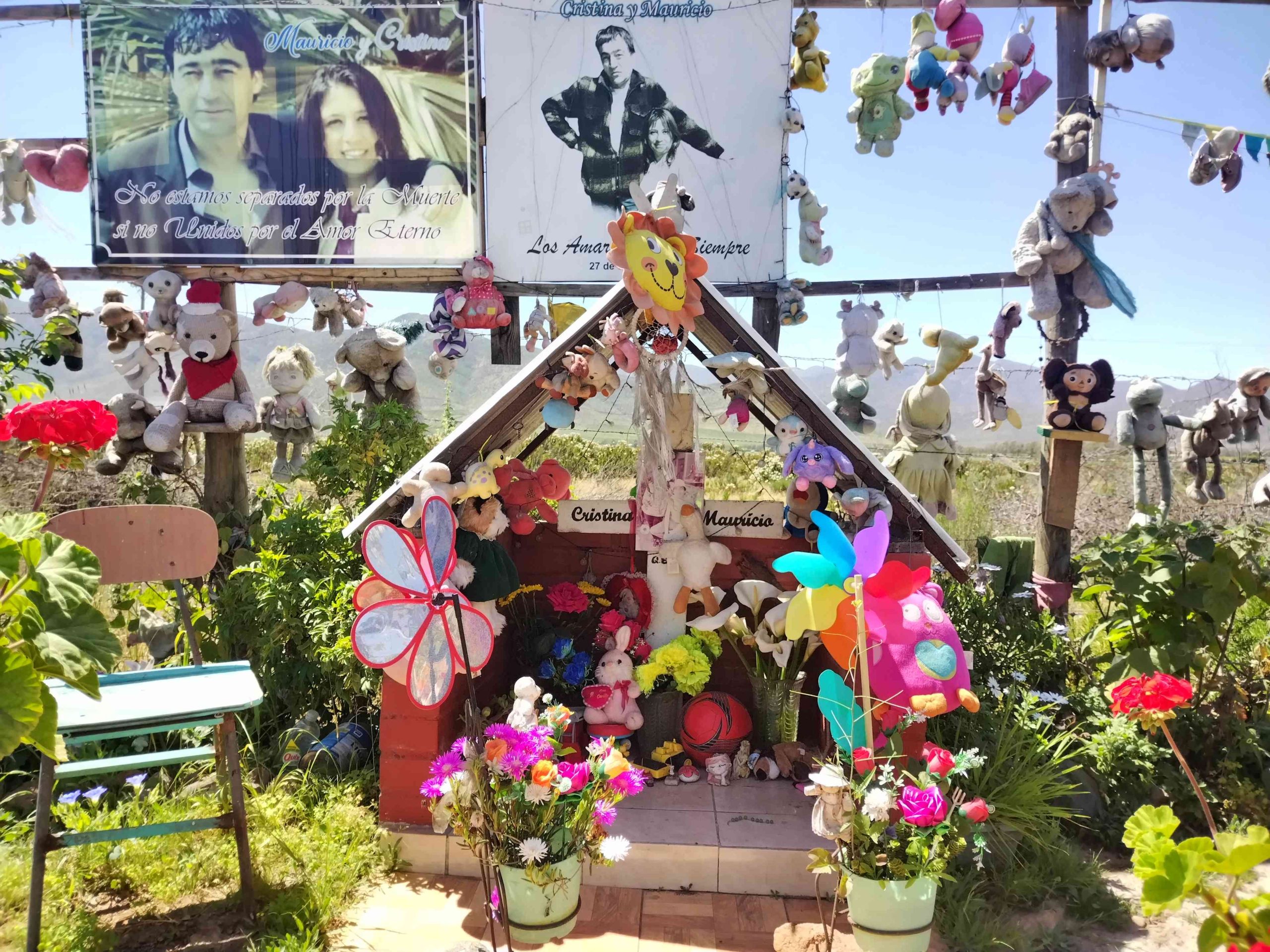
Animitas are part of the everyday landscape in Chile. These small popular constructions, erected in memory of people who have died in tragic or unexpected circumstances, are spaces where memory, popular religiosity and healing practices are intertwined. On highways, urban corners or neighborhood corners, the animitas are frequented by relatives and neighbors, drivers and passers-by. Moved by faith or respect,1 Some light a candle, leave an offering, honk their car horn or simply stop their step or gaze for a moment.
Fabián Claudio Flores (2023: 2) proposes the need to “make the hidden visible and penetrate the universe of immateriality in order to rethink materiality itself”. The author takes up Alicia Lindón (2011: 19), who argues that space is not only an object of manufacture and material modeling, but that its construction involves more complex processes that integrate immaterial dimensions: knowledge, words, images, fantasies and imaginaries. Based on this approach, we propose that the animitas in the Chilean public space show how their apparently minimal objects -casitas, candles, plaques, images- enable a displacement in an extended temporal axis. In this sense, the animitas allow a singular access to memories and traumas (dimension of the past), to mourning, to the lived affections of the present, as well as to mandates, desires, aspirations and practices of personal or collective healing (dimension of the future). Each animita constitutes a portal, a sacred space that emerges in the midst of the profane.
The animita is an encounter of the deceased with the visitor, in which spontaneous healing can occur. The title Where two souls heal interprets this dynamic that can take multiple directions. For the relatives, the animita is a place where they can express and share the pain of loss, opening the possibility for others to join in this gesture and accompany them in their mourning. At the same time, the animita itself - as a representation of the soul of the deceased - receives care and support from the community, which allows us to think that the grieving soul finds in these gestures the strength to resolve pending issues in the earthly sphere and, eventually, ascend to heaven. For their part, neighbors and passers-by find in the animita a space to turn to with their own supplications. Finally, the place of the trauma itself - the corner, the road or the place where the tragic death occurred - is transformed by the presence of the animita. In this way, the animitas transcend their materiality and become spaces that communicate messages of warning, consolation, faith, memory and care.
This photographic essay seeks to offer a visual representation of some animitas from different geographical areas of the country,2 with the aim of illustrating how to live with them through testimonies from neighbors, family members or officials of national institutions.3 Our intention is to answer how animita could be understood as a means for individual and communal healing.
The project's trajectory
This photographic essay arises as part of the research-creation project “Where Heaven and Earth meet”, initiated in 2015 from the author's Master's thesis in Cultural Anthropology.4 Since then, the project has continued in a self-managed manner and has expanded its scope. In 2023, the production of a feature-length documentary was formalized.5 The initial team consisted of the researcher and three anthropology students, who participated both in the field work and in the development of the script. The audiovisual production is supported by the Laboratory of Anthropology and Visual Archaeology (laav) of the School of Anthropology of the Catholic University of Chile (uc). Over the years, the project has been consolidated as a collective research, involving neighbors and devotees of the animitas, relatives and friends of the deceased, users of the routes, independent artists and public officials. This diverse network of participants has made it possible to build a unique ethnographic archive of the animitas in Chile. The photographic essay “Where two souls heal” gathers part of the results of the material collected to date in order to make an aesthetic and reflexive approach to the phenomenon studied.
The animita: memory, popular religiosity and altar in the public space
Context in Hispanic America
The animitas can be understood as a situated expression of a broader ritual repertoire of Andean and Hispano-American religiosity, whose logics overflow the modern binary categories between the religious and the secular, the natural and the supernatural. Andean belief traditions6 have historically persisted as relational frameworks that articulate identities, territorialities and forms of agency that are not exclusively human, resisting and resignifying in the face of colonial evangelization processes and dominant cultural Catholicism (Rappaport, 1993; Brosseder, 2012; Morandé, 2015; De la Torre, 2012). Far from suppressing indigenous cosmologies, colonization promoted forms of dynamic and conflicting syncretism that continue to structure contemporary ritual practices (De la Torre, 2012; Frigerio, 2018).
In this framework, the cult of the so-called “miraculous dead”, widespread throughout Latin America, finds its Chilean version in the animitas (Parker, 1992), generally materializing as small edicules erected in the public space at the site of a tragic death and operating as popular cenotaphs that commemorate the soul of the deceased in the absence of his body (Plath, 1993; Ojeda, 2013). Homologous practices are registered in different countries with local denominations,7 those that account for a shared ritual repertoire that sacralizes violent death in spaces of transit and circulation (Ojeda, 2013: 49).
From recent approaches, authors such as Marisol de la Cadena (2010, 2019) and Penelope Dransart (2019) have questioned the classical notion of religion by highlighting the agency of entities -mountains, waters or winds- that cannot be reduced to either the natural or the supernatural, but that reinforce ethical and social relations between humans and non-humans in the contemporary Andean world. In this relational logic, several studies show how the construction of altars, crosses and the giving of offerings on roads and places of passage continue to be central practices in the production of collective memories and the configuration of local identities (Richard, 2013; Galdames Rosas, 2013). et al.2016; Gaytán and Nava, 2021; Readi Garrido, 2016). Elements such as apachetas (Galdames Rosas et al., 2016), crosses (Lira, 2016) or payments to the earth (Bastien, 1978) find continuity in these urban and rural altars, resisting and adapting to modernity (Orr, 2016; Richard and Ortúzar, 2023).
Animitas in Chile
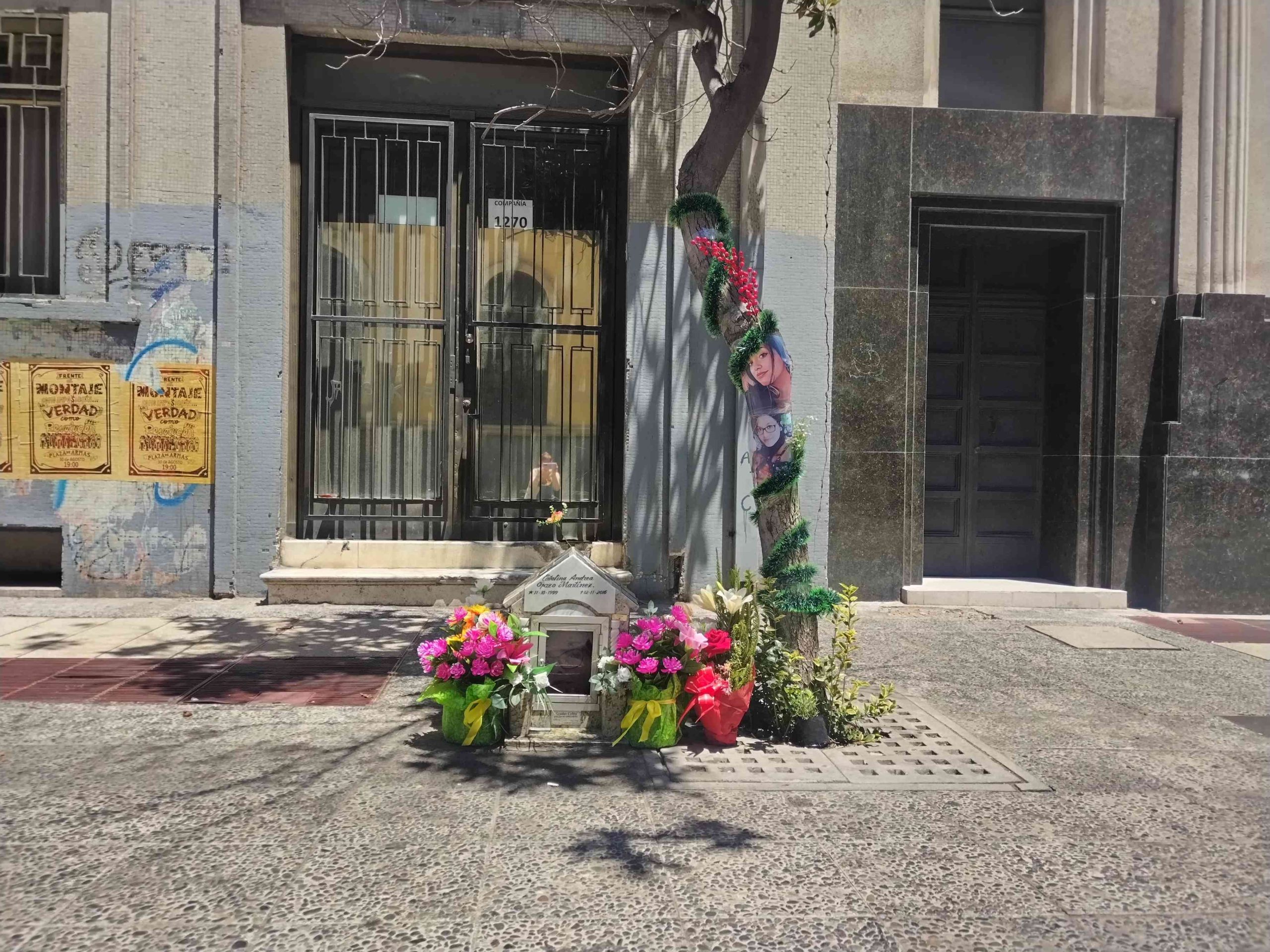
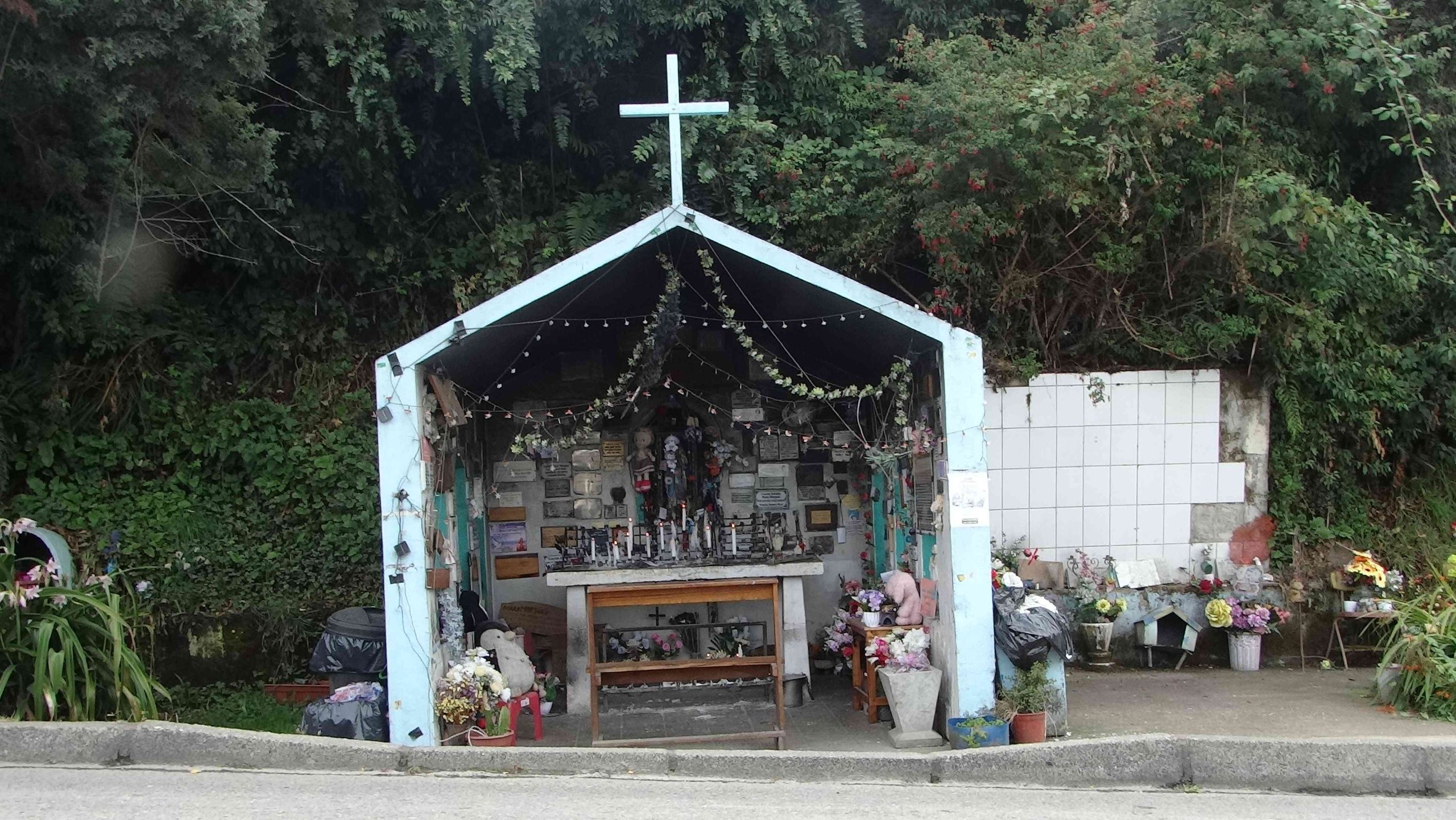
In Chile, animitas are small popular altars erected in memory of people who have died tragically or suddenly, usually in the place where the death occurred (Plath, 1996; Parker, 1982, 1997; Readi Garrido, 2016). On the one hand, this tradition takes up from the customs introduced during the conquest the gesture of spatially marking the site of a violent death; on the other hand, it incorporates elements of the Andean conception of the apacheta, understood as a sacred space where mediation between the human and the divine is established through offerings (Thomson, cit. in Readi Garrido, 2016: 20). Although their construction is documented since the nineteenth century, today they are widespread throughout the country, from isolated roads to densely populated urban neighborhoods (Salazar, 1999; Pumarino, 2012; Canales, 2014). They usually take the form of small houses, grottos or miniature chapels, adorned with plants, plaques, photographs, religious images and offerings such as candles (Ojeda, 2013: 54).
Several researchers have defined animitas as popular cenotaphs (Plath, 1996; Ojeda, 2013; Gaytán and Nava, 2021), that is, commemorative monuments that evoke the deceased in a place different from the one where his remains rest. Oreste Plath (1996: 15) explains that, according to Chilean popular beliefs, when a violent death occurs, the soul of the deceased remains in the place of the tragedy. From there it begins to act as a mediator between the human and the divine to later reach God (Plath, 1996: 16). In this way, visitors can be heard by the anima, who can influence the fulfillment of their requests (Plath, 1996: 15). When these are fulfilled, they are interpreted as miracles. Over time, some animitas come to be venerated as “saints of the people” or “non-canonized saints” (Salas, 1999; Parker, 1993).
The omnipresence of animitas throughout Chile has been recorded by several researchers, who rely on testimonies of locals (Benavente, 2011). An interviewee, in the framework of our research, speaks of the animitas in this way: “The animitas are important; they are part of Chile. They are part of what is ours. There is no city, not even the most entrenched in the Republic, where they do not appear” (Emilio, 2025).
This extended and naturalized presence in the everyday landscape allows us to understand the animitas not only from their territorial aspect, but also from the logic of ritual expressions known locally. In this sense, the animitas operate in a similar way to domestic altars:8 are also adorned with personal objects and become a gathering point on death anniversaries, birthdays or holidays. In both cases, the accumulation and personalization of objects functions as a ritual language that articulates intimate experiences with collective imaginaries. The animita, as an altar located in the public space, offers -in our interpretation- a point of union between heaven and earth, as well as a place for the elaboration and healing of the trauma that has occurred.
Animite as healing
The miraculous and healing power of animitas has been referred to by numerous authors (Acevedo and Cortés, 2016; Ysern, 1974; Plath, 1993; Ojeda, 2013). Sebastián Acevedo and Claudio Cortés (2016: 48) suggest that this special power has promoted the development of a cult around his figure. From our ethnographic materials collected over the years, we will show a possible reading of the healing power of the animitas, which manifests itself in multiple interrelated axes: supporting the mourning process of the closest circles; accompanying the community through the attribution of miracles; resignifying local spaces marked by tragedy; promoting mutual care in a wider community and, finally, communicating a universal message around the cycle of life and death.
Individual healing
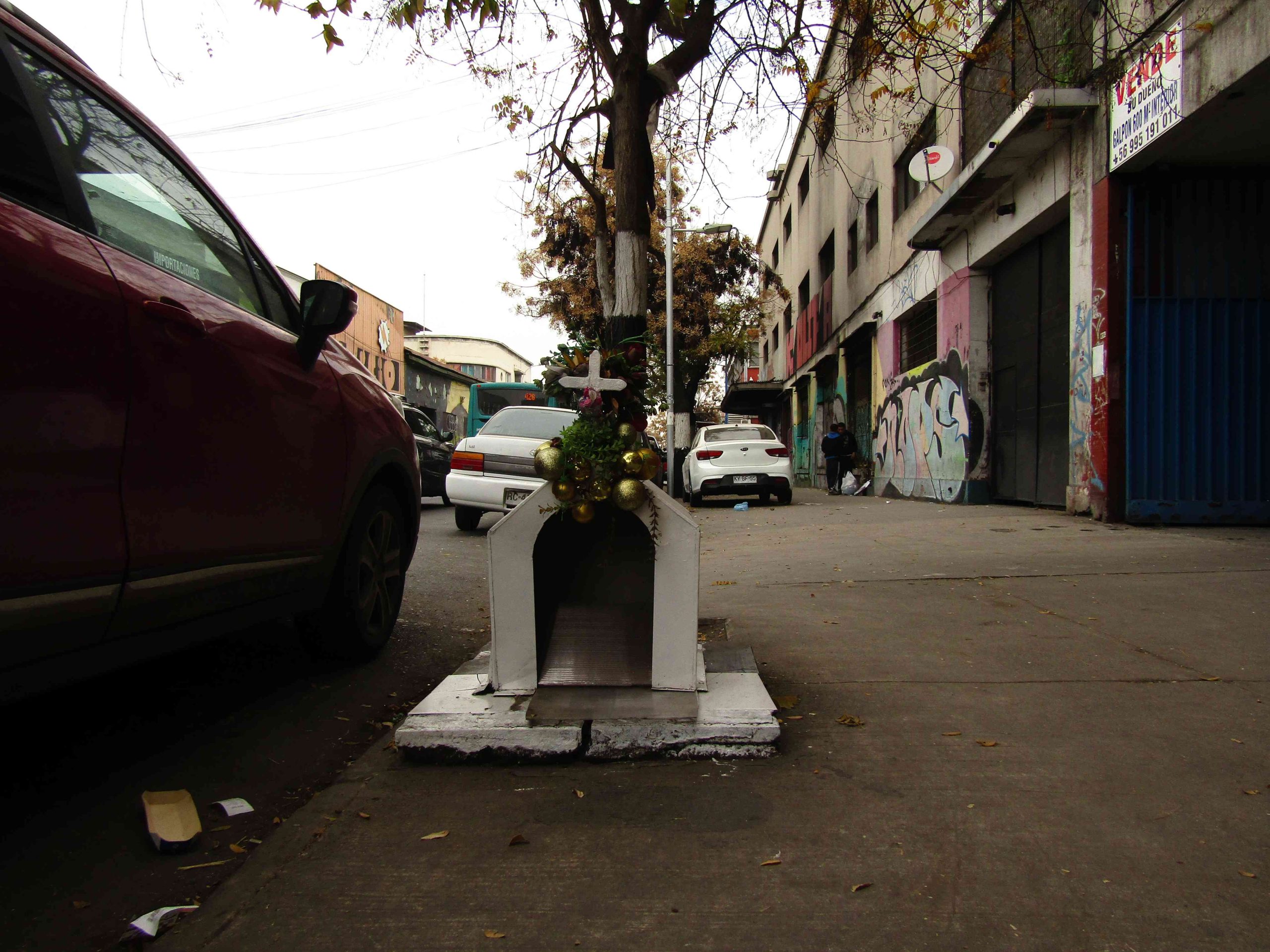
First, these sanctuaries serve an important function that supports the grieving process experienced by family members (Bermúdez and Bermúdez, 2002: 341; Urrutia and Valenzuela, 2019). In order to explore the mechanisms through which they operate, we interviewed Daniela Marino, a clinical psychologist who works in a unit specialized in trauma and has several years of experience in the care of patients who have faced the loss of family members and close people. According to the specialist, the animitas can be understood as follows:
From a psychological perspective, an animite can be understood as an early intervention aimed at preventing acute psychopathology following a traumatic event, such as a fatal accident, for example. Once the memory of the event is consolidated - which occurs approximately one month after a potentially traumatic event - a possible post-traumatic stress disorder can be initiated and anchored. During that first month there is a window of time for early interventions to deactivate a memory that might otherwise become fixed in an excess of intolerable distress. The animita functions as an early intervention to prevent psychopathology from setting in. It is a ritual that can facilitate and organize the person's life. In addition, in the construction of the animita, the community contributes to accompany the pain and make it more manageable (Daniela Marino, 2025).
In this sense, the animita fulfills a healing function by operating as a symbolic-therapeutic resource with concrete effects on mental health, as the specialist explains. This occurs through its construction, which acts as an input for the prevention of a possible psychopathology; in addition, the bereaved can receive early support from the community. As an example, we cite here a testimony that we have recorded on the occasion of a family lunch with the closest relatives of Juan José, a young motorcyclist who died at the age of 26 in a serious accident in Villa Alemana (2025). One of the sisters of the deceased Juan José tells us about the construction of the animita:
Right when my brother had his accident, there were some tires left in the house. So I said to my sister, “We should do something to commemorate my brother where the accident happened. Everyone said yes. We took the tire, tied it to the pole the first day, and put candles on it. A friend of his said that he could make a little candle for it. We helped him with money for the materials. Just when my brother was measuring the space for the animita, a gentleman we didn't know arrived, and he gave us a little glass house for the candles. And my brother made the whole structure out of iron, with a roof, cement and bars. The friend was also adding things. You open the door and the lights come on. Then the animita lights up and you can see what is inside, the photo of my brother, a little stone and little motorcycle gifts, a coin that was from the year he was born. A lady left him a plant, later we brought him more. It's already like a little life, very pretty, very respected (Eli, 2025).
Eli's testimony shows precisely the mechanism explained by the clinical psychologist in practice. The initial construction of the animita arises from the initiative of the family at the site of the tragedy, as a conscious gesture of commemoration. This process progressively leaves the intimate sphere and is sustained, validated and enriched by the participation of friends and neighbors, even unknown passers-by. In this way, the animita is consolidated as a shared space, built and maintained in community. Thanks to this social fabric, the mourning process is expedited.
Community healing: the miracles of popular saints
According to Claudia Lira, each construction responds to the worldview of the society that gave rise to them and explains, in part, the beliefs that exist regarding life and death (Lira, 2016: 357). The animitas are collectively constructed to the extent that people deposit in them their affections of the moment. In addition, they project aspirations towards the future through mandas (Ysern, 1974; Rojas, 2012). In line with Peter Jan Margry and Cristina Sánchez-Carretero (2011: 2) and Jack Santino (2011: 97), it is understood that the animita can convey collective demands, give visibility to unmet needs or even activate processes of social mobilization.
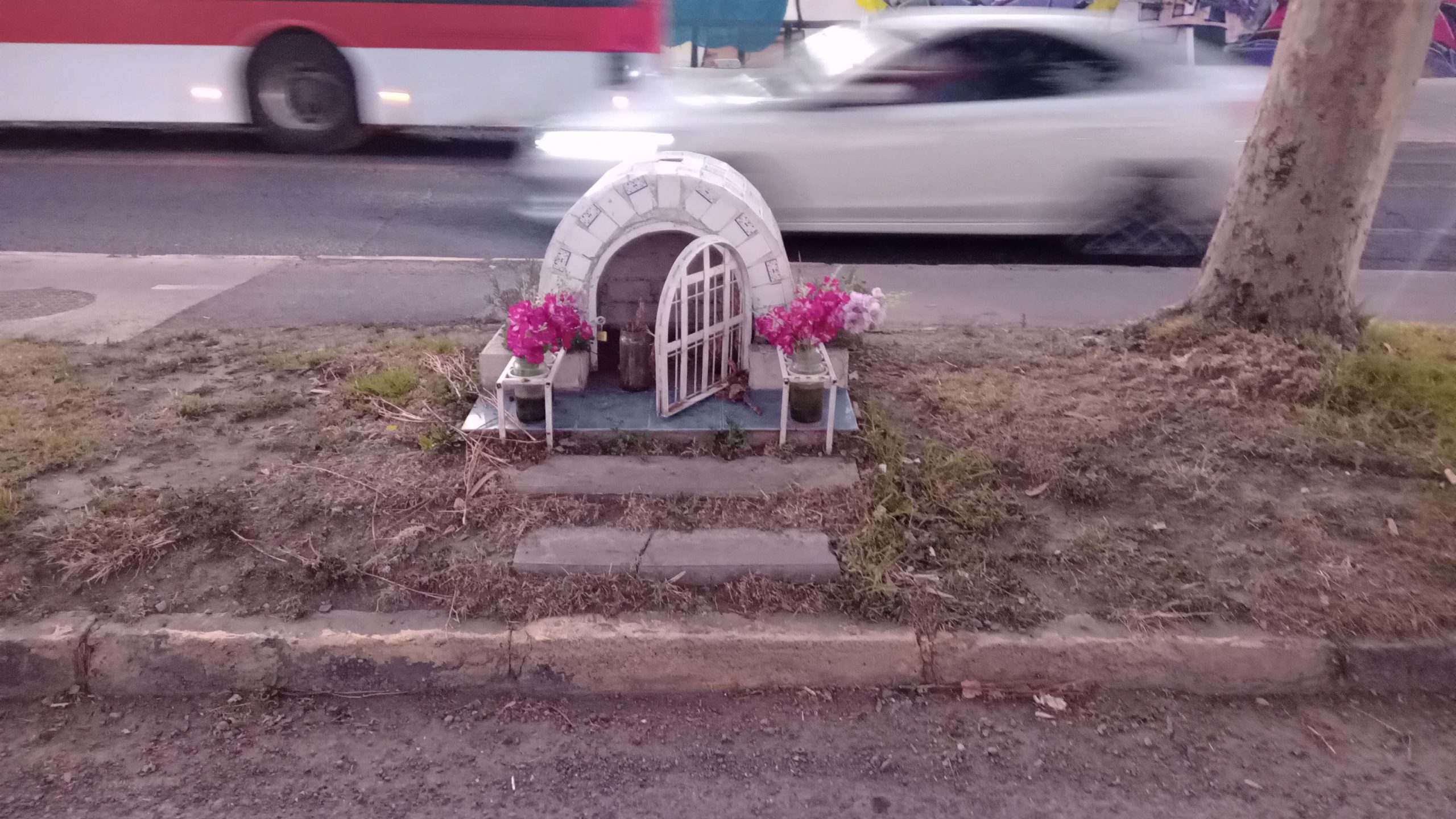
This manifestation has roots, according to Plath (1993: 16), in Chilean popular beliefs; according to them, “the animas have to work to reach God, that is why they help people”. Understanding that there is a need on the part of both parties - the anima and the community - the dynamics of mutual exchange of favors is established. The anima reaffirms its social role as protector. This process begins with acts of individual devotion and intensifies through collective practices such as pilgrimage, installation of votive offerings, enlargement of the main altar, as well as the reiteration of offerings. The culmination of this cycle occurs with the community recognition of a “miracle,” socially legitimizing the deceased as a sacralized figure (Guerrero Jiménez, 2012, 2015; Almási-Szabó, 2017; Urrutia and Valenzuela, 2019). The protective role of the miraculous anima is to mediate daily solutions, alleviating shortages and anguish of the community itself.
The healing of space
A third axis of healing is manifested in the resignification of space itself. To anchor this idea theoretically, we see an example from author Huub de Jonge (2011: 268), who reports on the power of purification rites based on an ethnographic case in Bali, referring to the ritual cleansing of a bombing site that had marked the Balinese community with a tragic loss. The author describes how the space - perceived as “physically and spiritually contaminated” - is subjected to a ceremonial process aimed at deactivating the contamination and restoring the symbolic balance (De Jonge, 2011: 268). The trauma that occurred at the physical site is recognized as symbolic contamination, which must be restored so that the site can once again function normally.
In this wounded space, the animita acts as a healer. In the words of Paula (26 years old, Santiago): “the animita serves to make the horrible place where the accident happened somehow beautiful and acceptable [...] Imagine if you had to spend every day at the corner where your six-year-old son was run over. You would be depressed, then you wouldn't be able to stand the pressure, and then you would have to move.” In this interpretation, the bereaved tend to reject or avoid being in a space where something terrible happened. In the interviewee's interpretation, the animita restores the harmony of the site.
Healing: towards greater awareness
As a fourth point, this renovated space also communicates to passersby and drivers who do not know the story of the tragedy. It is a reminder of the value of the life lost and evidence of the need to take care of oneself and others. In the words of Emilio, a civil servant of the Ministry of Transport and Telecommunications, who works in the region of Antofagasta and has managerial responsibilities: “The animita warns you that it is a dangerous curve or that the slope is risky [...] Throughout Chile this is almost an obligatory comment: ‘Watch out there, where there are so many animitas’”. From this point of view, the animita on the road is immediately interpreted as a warning signal by users. As Emilio points out: “An animita is more than a sign for those who drive there [...] One knows that behind an animita there is a death”. The animitas activate a greater awareness of the latent danger.
According to the interviewee, the animitas in the desert have a special role. They accompany drivers on the road, who must drive in an environment that is too uniform, which sometimes causes accidents. The animita is a reference to visually measure the progress of the vehicle on the road. Often, drivers honk their horns when passing by an altar as a gesture of respect to the animita and also to the desert, recognizing human fragility and the ever-present possibility of death. The testimony of Lieutenant Francisco Cabezas in charge of the Providencia Sur Subcommissariat (2025) describes how the presence of animitas on the roads reinforces road risk awareness in a public way:
With respect to the little animations where the figure of a carabinero appears, for us as an institution [Carabineros de Chile] it is particularly striking. We try to take advantage of this eye-catching character to also call on people to be more careful [...] We try to use the animitas to carry out preventive and awareness campaigns, especially in places where signage alone does not achieve the same impact (Lieutenant Francisco Cabezas, 2025).
The lieutenant's testimony reaffirms that road signs are less effective in prevention than roadside signs. Some public agencies9 incorporate the visual reference to the animitas as part of campaigns10 aimed at promoting preventive behaviors on the roads.
A message of universal healing
The animitas have operated as a fertile nucleus of inspiration for creators of diverse artistic disciplines for contemporary Chilean cultural production. These altars are aesthetic and symbolic references; this can be seen in musical and audiovisual works (Parra, 2024;11 De la Jara and Caruz, 2025; Muñoz Beck, 2022; Cárdenas and Los Piolitas Cueca Brava, 2019; Bastidas Cárcamo, 2019; Oyarzún Vera, 2018 ), installation proposals (Jacobsen, 2017; Osses, 2026), signature jewelry (Ruiz, 2014),12 paintings (Miranda Osses, 2024a13 and 2024b;14 Molina Henríquez, 2011; Vidor, 1980a, 1980b, 1980c; Bontá, 1990a, 1990b) and staging (Teatro Municipal de San Javier, 2022). In these works, the animitas propose a dialogue on popular faith, both local and national identity, and encourage discussion on issues surrounding traumatic death, while at the same time being a tool for healing itself.15 As an example, the work You are here, installation by Pía Osses Espinoza (2026), introduces the issue of suicides in the Santiago Metro into the public debate. The work contributes to the healing of the author herself and to the dissemination of knowledge about the number and location of the incidents, promoting greater awareness regarding mutual care in transit spaces.
The animita in images: a guide to the photographic essay
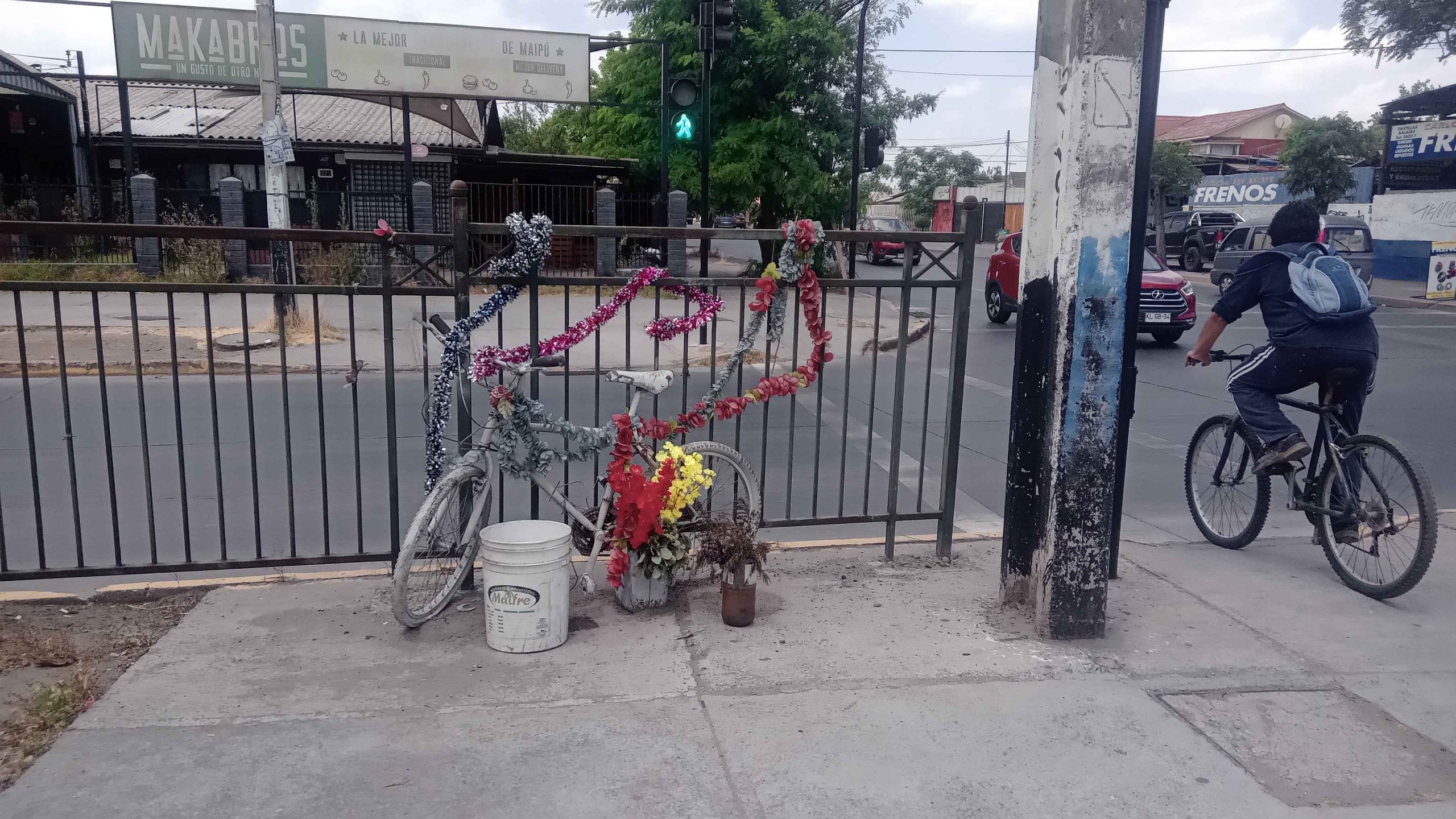
In this section of the essay we will learn, through photographs and testimonies, what the animita is in the words of the Chileans themselves. The essay opens with a series of images that show the animita as a place where the anima persists. Through the images in this section we observe that the animita functions both as an intimate memorial and as a public warning. The first photographs show the exact sites of accidents or violent deaths, marked by the irruption of tragedy into everyday space. The animita appears in different places from north to south, on the edge of a road, on the corner of a neighborhood, on the sidewalk of a busy city. Each one points to a painful event, but also warns those who pass by: something happened here, a life was lost here in an unjust way.
Miraculous animitas: presentation of some figures
In this section, the photographic record presents the animitas in their dimension of popular saints, emphasizing the miracle narratives and devotional practices that sustain them. The images allow us to observe not only the stories of intercession attributed to each figure, but also the deep respect that devotees, local communities and even certain institutions show for these animitas, which are considered miraculous. This article shows the relational logic of the devotion, with a dynamic of symbolic exchange between promises, offerings and favors granted, interpreted from the words of the people interviewed.
The photographs gathered here correspond to animitas with strong territorial roots and devotional recognition: the María Márquez animita, located in Nercón (Chiloé), associated with the protection of children and travelers; the Fortuoso Soto animita, in the Bellavista neighborhood of Puerto Montt, recognized for its intercessory power in matters of health, protection and family welfare; the animita of Romualdito, located in downtown Santiago, one of the most visited in the country and an urban symbol of popular faith; and the animita of Astrid Soto, the Beautiful Girl, located at kilometer 22 of Route 78, especially linked to the protection of drivers and motorcyclists.
The animite in the everyday space
This section is organized in three moments: daily encounters, reclaiming space and the presentation of a series of animitas as close figures. In the first moment, the photographs show the daily coexistence with the animitas. The second shows how the public space is reconfigured from the wounds left by the tragedy. The railings of a supermarket can be transformed into a place of prayer. Spilled blood can modify our relationship with the territory. The animite arrives there affirming its right to occupy that place. In a third moment, the animitas are explicitly presented as people “just like us”, endowed with personality, tastes and recognizable roles within the community. These animitas appear humanized through the objects that surround them and the stories that name them; they have tastes and preferences that are understandable to those who visit them. The figures introduced here embody singular identities.
The animita can't be left out
What happens when an animita is gone? The photographs and testimonies in this section show that this absence is perceived as a double loss. Not only is the material object lost, but also a space of mediation. As Federico Aguirre (2025) suggests, what is at stake is not an abstract symbol of death, but the concrete presence of the deceased. The image, the personal objects and the offerings are indispensable to affirm the presence of the animita and the anima that inhabits it. The animita cannot not be there because the spilled blood has already marked the place and, from that moment on, the anima becomes its inhabitant.
Healing
The essay concludes by focusing on the healing dimension of animitas. As a closure to the ethnographic exploration so far, this section identifies some of the axes through which the healing associated with animitas - in our interpretation - operates in multiple directions. The photographs and fragments in this section show how this process is simultaneously intimate and collective: it heals the family member who finds a space where to express and elaborate his pain; it supports the soul of the deceased, who receives care and accompaniment; it heals the community, which finds in it a place of encounter and mediation; and it also heals the space of the accident itself, transformed into a significant, re-signified and protected site.
Bibliography
Acevedo Muñoz, Sebastián y Claudio Cortés Aros (2016). “Animitas y espacio público: apropiación informal de una expresión popular”, Revista Hombre y Desierto, núm. 20, pp. 47-61.
Aguirre Romero, Federico (2025). Fiesta, imagen y revelación: hacia una teología latinoamericana de la imagen. Santiago de Chile: Ediciones Universidad Alberto Hurtado.
Allen, Catherine (2020). “Inqaychus andinas y la animacidad de las piedras”, en Óscar Muñoz Morán (coord.). Ensayos de etnografía teórica: Andes. Madrid: Nola Editores, pp. 196-226.
Almási-Szabó, Lili (2017). “‘Ahol az Ég és a Föld összeér’: Út menti halálhelyek Chilében” [ Donde el cielo y la Tierra se juntan: lugares de muerte junto los caminos de Chile]. Tesis de maestría. Budapest: Universidad de Budapest, Facultad de Ciencias Sociales.
— (2025, 12 de diciembre). “Grupo focal con artistas participantes del documental Donde el cielo y la Tierra se juntan” [grabación de audio no publicada]. Archivo personal de la autora.
— (2015-2025). Entrevistas individuales a participantes del documental Donde el cielo y la Tierra se juntan [grabaciones de audio no publicadas]. Archivo personal de la autora.
Apipilhuasco Miranda, María Fernanda (2022). “Ensayos de etnografía teórica: Andes”, Revista Colombiana de Antropología, vol. 58, núm. 1, pp. 386 -391. Disponible en: https://doi.org/10.22380/2539472X. 2047
Bastien, Joseph William (1978). “Mountain/Body Metaphor in the Andes”, Bulletin de l’Institut Français d’Études Andines, vol. 7, núms. 1-2, pp. 87-103. Disponible en: https://doi.org/10.3406/bifea.1978. 1501
Bastidas Cárcamo, Marco (2019, 1 de marzo). “Homenaje a Animita Márquez (vals religioso)” [página web]. Recuperado de: https://micancionerochilote.blogspot.com/2019/03/homenaje-animita-marquez-vals-religioso.htm
Benavente, Antonia (2011). “Las ‘animitas’: testimonio religioso e histórico de piedad popular en Chile”, Estudios Atacameños, núm. 41, pp. 131-138. Disponible en: https://doi.org/10.4067/S0718-1043 2011000100008
Bermúdez, María y Stanley Bermúdez (2002). “AltarMaking with Latino Families: A Narrative Therapy Perspective”, Journal of Family Psychotherapy, vol. 13, núms. 3-4, pp. 329-347.
Bontá, Marco (1990a). La animita [óleo sobre tela, 72 × 91 cm]. Museo Municipal de Bellas Artes de Valparaíso. Disponible en: https://pinturachilena.cl/obras/la-animita/
— (1990b). La animita [litografía sobre papel, 41 × 57 cm]. Museo Nacional de Bellas Artes, Santiago de Chile, colección Arte Chileno, grabado. Disponible en: https://www.surdoc.cl/registro/2-776.
Brosseder, Claudia (2012). “Cultural Dialogue and its Premises in Colonial Peru: The Case of Worshipping Sacred Objects”, Journal of the Economic and Social History of the Orient, vol. 55, núms. 2-3, pp. 203-227. Disponible en: https://doi.org/10.1163/15685209-12341240
Comisión Nacional de Seguridad de Tránsito (Conaset) (2011, 13 de diciembre). “Gobierno lanza programa ‘Manéjate por la Vida’ para prevenir accidentes de tránsito”, La Tercera. Disponible en: https://www.latercera.com/noticia/gobierno-lanza-programa-manejate-por-la-vida-para-prevenir-accidentes-de-transito/
— (2025, 7 de septiembre). “Por un 18 seguro: mtt lanza campaña preventiva para Fiestas Patrias 2025”. Disponible en: https://www.conaset.cl/por-un-18-seguro-2025/
De la Cadena, Marisol (2010). “Indigenous Cosmopolitics in the Andes: Conceptual Reflections Beyond ‘Politics’”, Cultural Anthropology, vol. 25, núm. 2, pp. 334-370. Disponible en: https://doi.org/10. 1111/j.1548-1360.2010.01061.x
— (2019).” Earth-beings: Andean Indigenous Religion, but not Only”, en The World Multiple, vol. 25, núm. 2, pp. 11-34. Abingdon: Routledge. Disponible en: https://doi.org/10.4324/9780429456725-2
De Jonge, Huub (2011). “Purification and Remembrance: Eastern and Western Ways of Dealing with the Bali Bombing”, en H. Peter Jan Margry y Cristina Sánchez-Carretero (eds.). Grassroots Memorials: The Politics of Memorializing Traumatic Death. Nueva York: Berghahn Books, pp. 262-282.
De la Torre, Ángela Renée (2021). “Home Altars: Material Expressions of Spiritual Do-it-Yourself”, International Journal of Latin American Religions, vol. 5, núm. 1, pp. 1-24. Disponible en: https://doi.org/10. 1007/s41603-021-00131-9
— (2012). “La religiosidad popular como ‘entre-medio’ entre la religión institucional y la espiritualidad individualizada”, Civitas-Revista de Ciências Sociais, vol. 12, núm. 3, pp. 506-521. Disponible en: http://www.redalyc.org/articulo.oa?id=74225010005
Dransart, Penelope (2019).” At the Mountains’ Altar: Anthropology of Religion in an Andean Community”, Mountain Research and Development, vol. 39, núm. 1, pp. 55-64. Disponible en: https://doi.org/10.1659/mrd.mm231
Encuesta Bicentenario (2022). “Religión: principales resultados”. Santiago: Instituto de Sociología, Pontificia Universidad Católica de Chile. Disponible en: https://encuestabicentenario.uc.cl/resultados/resultados-religion/2022
Flores, Fabián Claudio (2023). “Geografías ocultas de los bordes metropolitanos: paisajes de la devoción y esperanza en contextos de sanación popular”, Anuario de la División Geografía, vol. 17, núm. 1, pp. 1-14.
Frigerio, Alejandro (2018). “¿Por qué no podemos ver la diversidad religiosa?: cuestionando el paradigma católico-céntrico en el estudio de la religión en Latinoamérica”, Cultura y Representaciones Sociales, vol. 12, núm. 24. Disponible en: https://doi.org/10.28965/2018-024-03
Galdames Rosas, Luis, Carlos Choque Marino y Alberto Díaz Araya (2016). “De apachetas a cruces de mayo: identidades, territorialidad y memorias en los altos de Arica, Chile”, Revista Interciencia, vol. 41, núm. 8, pp. 526-532.
Gaytán Alcalá, Felipe y Ernesto Nava (2021). “Geografías de lo religioso en el espacio público, marcadores urbanos de lo sagrado: altares, cenotafios y humilladeros”, en Cecilia Delgado-Molina, Hugo José Suárez y Karina Bárcenas (eds.). Formas de creer en la ciudad. Ciudad de México: Instituto de Investigaciones Sociales, unam, pp. 23-60.
Guerrero Jiménez, Bernardo (2012). “La presencia de la animita en el relato salitrero del norte grande de Chile”, Márgenes, vol. 9, núm. 10, pp. 19-24. Disponible en: https://doi.org/10.22370/margenes.2 012.9.10.354
— (2015). “Religiosidad popular y vida cotidiana en el Norte Grande de Chile”, Cuadernos de Teología, vol. 7, núm. 2, pp. 35-46. Disponible en: https://doi.org/10.22199/s07198175.2015.0002.00002
Jacobsen, Jon (2017). Animita Exhibition, International Fashion Showcase, Somerset House [página web]. Recuperado de: https://jon-jacobsen.com/project/britishcouncil-2
Lindón, Alicia (2011). “Las narrativas de vida espaciales: una expresión del pensamiento geográfico humanista y constructivista”, en Beatriz Nates Cruz y Felipe César Londoño López (coords.). Memoria, espacio y sociedad. Madrid: Anthropos, pp. 13-32.
Lira, Claudia (2016). Lecturas de la animita: estética, identidad y patrimonio. Santiago : Ediciones uc.
Maciel Canales, Cyntia (2014). “Animitas en el siglo xxi: al encuentro del significado en una sociedad contemporánea”, Folklore Latinoamericano, Instituto Universitario Nacional del Arte, núm. 14.
Martes Mañana: Tema (Enya de la Jara y Tomás Caruz) (2025, 6 de mayo). Animita
Margry, Peter Jan y Cristina Sánchez-Carretero (2011). “Rethinking Memorialization: The Concept of Grassroots Memorials”, en Peter Jan Margry y Cristina Sánchez-Carretero (eds.). Grassroots Memorials: The Politics of Memorializing Traumatic Death. Nueva York: Berghahn Books, pp. 1-50.
Molina Henríquez, Javier Arturo (2011). La animita del camino [gouache sobre papel, 50 × 32.5 cm]. Recuperado de: https://www.artelista.com/obra/9992701264284612-laanimitadelcamino.html
Morandé, Pedro (2015). “La religiosidad popular como crítica al neo-iluminismo latinoamericano”, en Antología del pensamiento crítico chileno contemporáneo. Buenos Aires: clacso, pp. 199-206. Disponible en: https://doi.org/10.2307/j.ctv270kv29.12
Montes, Fernanda (administradora) (2025). “Animitaslov” [perfil de Instagram]. Recuperado de: https://www.instagram.com/animitaslov/
Muñoz Beck, Diego [Yaqob96] (2022, 28 de diciembre). Fortuoso
Ojeda Ledesma, Gonzalo Lautaro (2013). “Animitas: apropiación urbana de una práctica mortuoria ciudadana”, Nueva Antropología, vol. 26, núm. 78, pp. 99-121.
Orr, David (2016). “Regulating Mobility in the Peruvian Andes: Road Safety, Social Hierarchies and Governmentality in Cusco’s Rural Provinces”, Ethnos, vol. 81, núm. 2, pp. 238-261. Disponible en: https://doi.org/10.1080/00141844.2014.923013
Oyarzún Vera, Patricio (2018, 18 de septiembre). Cueca Fortuoso Soto
Parker, Cristián (1982). “Creencias religiosas y cultura popular urbana”, Revista Mensaje, vol. 31, núm. 312, pp. 475-479. Disponible en: http://repositorio.uahurtado.cl/handle/11242/14533
— (1992). Animitas, machis y santiguadoras: creencias religiosas y cultura popular en el Bio-Bio. Santiago de Chile: Ediciones Rehue.
— (1993). “Otra lógica en América Latina: religión popular y modernización capitalista”, Revista de Sociología, vol. 1, núm. 8, pp. 148 -150. Disponible en: https://doi.org/10.5354/0719-529X.1993.27637
— (1997). “Estudios sobre religión”, Newsletter de la Asociación de Cientistas Sociales de la Religión en el Mercosur, núm. 4, pp. 1-6. Recuperado de: https://www.academia.edu/35244642/Newsletter_4_Septiembre_1997
Plath, Oreste (1993). L’animita: hagiografía folclórica. Santiago: P&P Editorial.
— (1966). Folklore religioso chileno. Santiago: Platur.
Pumarino, Felipe (2012, marzo). “Chile, campeón mundial de las animitas”. Las Últimas Noticias: Feria del Transporte, pp. 18-19.
Rappaport, Joanne (1993). “Review of Religion in the Andes: Vision and Imagination in Early Colonial Peru Sabine MacCormack The Huarochirí Manuscript: A Testament of Ancient and Colonial Andean Religion”, en Frank Salomon y George L. Urioste”. Ethnohistory, vol. 40, núm. 4, pp. 653 -656. Disponible en: https://doi.org/10.2307/482598
Readi Garrido, Pía (2016). “Origen e historia de la animita”, en Claudia Lira (ed.). Lecturas de la animita: estética, identidad y patrimonio. Santiago: Ediciones Universidad Católica de Chile, pp. 17-26.
Richard, Nicolás y Diego Ortúzar (2023). “La penúltima curva de Paposo: agentividad técnica, social e histórica de una infraestructura vial”, Revista Punto Sur, núm. 9, pp. 28-47. Disponible en: https://doi.org/10.34096/ps.n9.12715
Rodríguez Droguett, Jocelyne (2025). Altares domésticos [portafolio en línea]. Recuperado de: https://jrdroguett.cl/portfolio-item/altaresdomesticos/
Rojas Farías, Víctor (2012). “Emilio Dubois, una animita de santo de veneración popular”, Revista Márgenes, vol. 9, núm. 10, pp. 63-72. Disponible en: https://doi.org/10.22370/margenes.2012.9.10.351
Santino, Jack (2011). “Between Commemoration and Social Activism: Spontaneous Shrines, Grassroots Memorialization, and the Public Ritualesque in Derry”, en Peter Jan Margry y Cristina Sanchéz-Carretero (eds.). Grassroots Memorials: The Politics of Memorializing Traumatic Death. Nueva York: Berghahn Books, pp. 97-107.
Salas, Ricardo (1999). “Los verdaderos santos del pueblo”, Revista Chilena de Investigaciones Estéticas, vol. 32, pp. 74-97.
Salazar, Gabriel (1999). “Ciudadanía e historia oral: vida, muerte y resurrección”, Revista Proposiciones, vol. 29, pp. 1-13.
Teatro San Javier (tmsjtv) (2022, 3 de noviembre). Favor concedido
Urrutia Steinert, Isidora y Eduardo Valenzuela Carvallo (2019). “Religiosity at the Roadside: Memorials, Animitas, and Shrines on a Chilean Highway”, Journal of Contemporary Religion, vol. 34, núm. 3, pp. 447-468. Disponible en: https://doi.org/10.1080/13537903.2019.1658434
Vidor, Pablo (1980a). Animitas (estudio) [óleo sobre tela, 65 × 54 cm]. Colección Sven Heldt. Disponible en: https://pinturachilena.cl/obras/animitas-estudio/
— (1980b). Animitas [óleo sobre tela, 96 × 130 cm]. Colección Sven Heldt. Disponible en: https://pinturachilena.cl/obras/animitas/
— (1980c). Animitas (boceto) [óleo sobre tela, 19 × 21 cm]. Colección Sven Heldt. Disponible en: https://pinturachilena.cl/obras/animitas-boceto/
Ysern de Arce, Juan Luis (1974). La manda en la religiosidad popular: liturgia del umbral. Santiago de Chile: Ediciones Paulinas.
Lili Almási-Szabó is a professor at the School of Anthropology, Faculty of Social Sciences, Pontificia Universidad Católica de Chile. Director of the research-creation project “Donde el cielo y la Tierra se juntan”.
David Arturo Espinoza Zamudio is a student in the undergraduate program in Anthropology, School of Anthropology, Faculty of Social Sciences, Pontificia Universidad Católica de Chile. Assistant of the research-creation project “Donde el cielo y la Tierra se juntan” (Where the sky and the earth meet).
Pedro Pablo Medina Andrade is a student in the undergraduate program in Anthropology, School of Anthropology, Faculty of Social Sciences, Pontificia Universidad Católica de Chile. Collaborator of the research-creation project “Where Heaven and Earth meet”.
Institutions



 EN
EN  ES
ES  FR
FR  PT
PT