
From the movies to the union: An actress, a star and a supportive partner: Dolores del Río
- Daria Sofia Rodriguez Olvera
- - see biodata
From the movies to the union: An actress, a star and a supportive partner: Dolores del Río
Receipt: November 21, 2024
Acceptance date: March 31, 2025
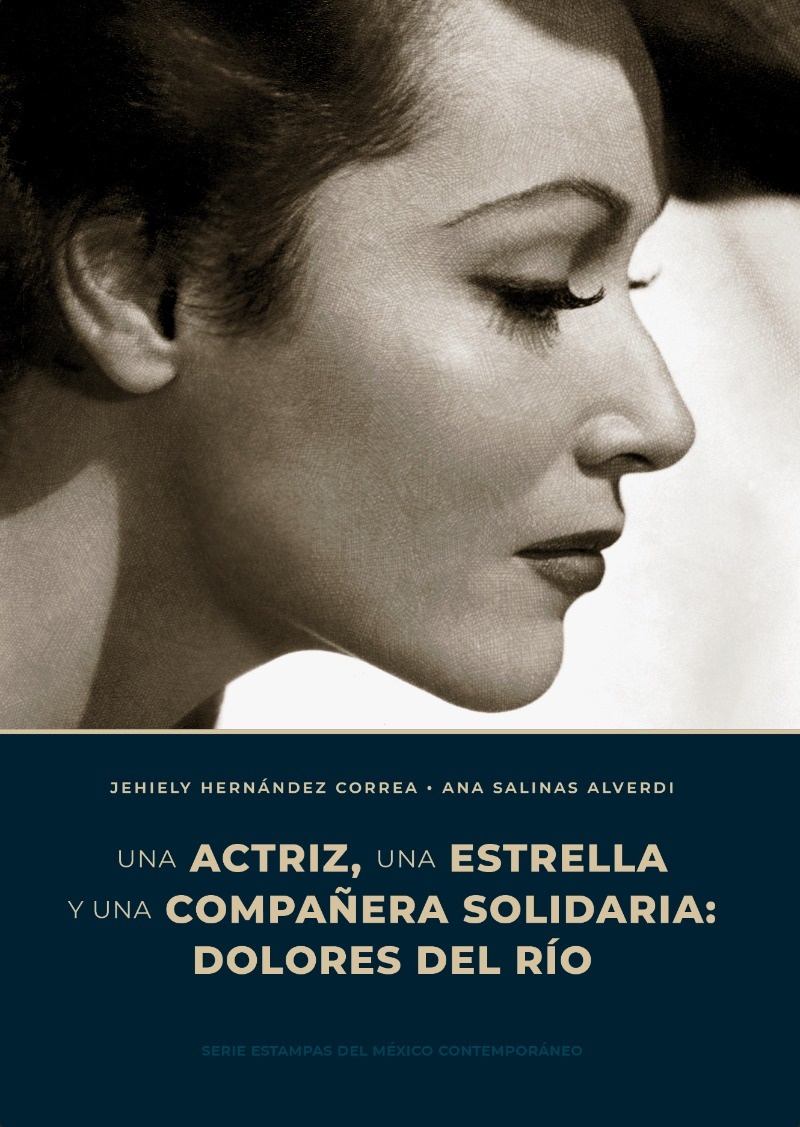
An actress, a star and a supportive partner: Dolores del Río
Jacquelin Jehiely Hernández Correa and Ana Lilia Salinas Alberdi, 2024 Instituto Nacional de Estudios Históricos de las Revoluciones de México, Durango, http://inehrm.gob.mx/recursos/Libros/2024_unaactriz_unaestrella_dolores_del_rio.pdf.
There is no doubt that the world of entertainment and show business attracts a lot of attention: singers, actors and artists are the main focus of this media. Wanting to know about people who are under the spotlight of fame, surrounded by glamour and charisma, is something that fans crave. There is nothing more interesting than those idols who reigned in the golden age of audiovisual production at the beginning of the 20th century. The Golden Age of Mexican cinema, which spanned from the thirties to the sixties of the last century, crossed barriers worldwide, making known faces such as those of Pedro Infante, María Félix, Luis Aguirre, Jorge Negrete, Sara García. The actress María Dolores Asúnsolo López, also known as Dolores del Río, is a member of this acting group.
An actress, a star and a supportive partner: Dolores del Río is a work presented by researchers Jehiely Hernández Correa and Ana Salinas Alverdi in collaboration with the Institución Nacional de Estudios Históricos de las Revoluciones Mexicanas (inehrm). The research addresses the life of the actress both in the world of the cameras and in the political world. The book is part of the collection Historia de las Mujeres en México, which includes topics related to feminism, such as access to vote, women in the Revolution, teachers and a couple of biographical studies. The work reviewed here is biographical in nature; the style is French, since mention is made of the most important aspects of the life of the subject of study (in this case, Dolores del Río): “It is less ambitious in terms of biographical information but approaches fiction due to its concern for literary writing” (Dosse, 2007: 18).
The book is divided into five chapters and accompanied by beautiful photographs, which leaves a sense of satisfaction and awakens the interest in knowing more about this artist. The first chapter is titled with the full name of the actress, and narrates the first years of her life as part of the Mexican aristocracy until 1925 when she meets a person who changes the course of her life. Daughter of Antonia López Negrete and Jesús Leonardo Asúnsolo, a banker and cattle producer of high reputation, María Dolores Asúnsolo López (1904-1983) received a quality education, with what “every young lady of her class needed to know”: manners, Christian values and the “precepts to be a good wife and mother” (Hernández Correa, 2024: 11).
At the age of 17 she met and married Mexican landowner Jaime Martínez del Río Vinet. Upon her return to Mexico, after her long honeymoon in Europe, the young couple was invited to a party where they met Edwin Carewe, a man who would change her life, as he was a renowned American film producer and director in Hollywood. During the celebration, Dolores showed her talent in singing and dancing, which caught the producer's attention. In 1925 Carewe offered Dolores a contract that assured her an acting career in Hollywood with the production company First National. This contract included her husband to start a new life with his wife in the United States, where Dolores opened the doors to acting.
The second chapter: “The Star System of Hollywood. Dolores del Río (1920-1940)” focuses on the fifteen years of her career in Hollywood, her love life and her return to Mexico in the 1940s. Upon her arrival in the United States, Henry Wilson began a major campaign to sculpt the new Mexican star and give her a stage name, with the aim of placing her in the media as a commodity and “hooking the general public, as well as brands and filmmakers”. Dolores' talent required advertising work to guarantee the profitability of her image. In this way, the actress entered the Star System of Hollywood.1 Thus, Dolores del Río stood out in leading roles starting with her debut in the film Joanna, followed by works such as What Price Glory? (1926), Resurrection (1927), Ramona (1928), among others.
The 1920s were a path to glory in her work in the United States as she was part of silent films and, later, the talkies introduced in 1927. This chapter of the play shows the first setbacks in Dolores' career, from having to adapt to the changing standards of beauty in American cinema imposed by actresses such as Marlene Dietrich and Joan Crawford, whose features were more powerful, of mature, determined and reckless women, as opposed to Dolores', whose facial features were more delicate; in addition, there were the challenges of language. The play shows how her acting rise contrasted with the instability of her love life. Her marriage to Jaime Martínez del Río went through a crisis that ended in divorce in 1928; that same year she met Cedric Gibbons, artistic director of Metro-Goldwyn-Mayer, whom she married in 1930. According to the book, Cedric was a great support for her when she temporarily retired from film due to health problems.
On the other hand, the working relationship with Edwin Carewe came to an end in 1929 due to the frictions he had with Dolores. Del Río's second marriage came to an end in 1941 with the appearance of Orson Welles. With this third couple, Dolores' participation in the U.S. film world began to decline as she was unable to adapt to the new standards of American cinema and faced box office failures. A love breakup, acting scandals, together with personal, work and even political problems, forced Dolores to return to Mexico in 1942.
From the third chapter, “El regreso a tierras mexicanas. Cine de oro nacional”, onwards, the authors focus on her entry and triumph on the big screen, as well as on her professional relationships and political participation in a country with multiple social, economic and administrative changes that emerged in the mid-twentieth century. It should not be forgotten that in the last 20 years of her life, Dolores was very present in activities related to the cultural defense of the nation. Her return to the country was complicated because she was not seen with good eyes by the Mexican public, due to the fact that she already had a history in Hollywood; but, thanks to her approach with Mexican production companies to participate in feature films, she decided to be part of the team of Mexican director and actor Emilio “El Indio” Fernández (1904-1986), participating in films such as Wild flower (1943) y María Candelaria (1944), to mention the most iconic ones. The forties saw her reborn and become a national myth.2
Del Río and actor Pedro Armendáriz were the most popular faces in Mexican cinema, as they worked together in other films with “El Indio”: The abandoned (1944), Bugambilia (1945), La malquerida (1949). María Candelaria is the film that honors this acting couple. “Although the friendship between Dolores del Río and Pedro Armendáriz was only professional, both were united by their North American formative experience” (García and Aviña, 1997: 30-31).. Her work not only remained in the world of cinema, but also in the theater, a short-lived stage but with good results, as narrated in the fourth chapter of the book, in addition to Dolores again participated in films in the United States and Europe as a supporting actress.
The work goes beyond her life as an actress. Hernandez and Salinas highlight her participation in the union struggle within the actors“ guild in Mexico and her collaboration in the National Actors” Union in 1950 and activities related to the nation's cultural defense in the 1960s. The 20th century was a time marked by social changes -such as the right of women to vote- and economic achievements in the country, thanks to industrial and technological development: Mexico had gone through a Revolution to reach “modernity”, a "moment of peace" halfway through; however, such peace was surrounded by union nonconformities, which led to demonstrations against an authoritarian government. In 1951 Dolores del Río, together with other colleagues from the artistic world, joined the union struggle within the Mexican union to become part of the National Actors Union after the problems that existed within the film industry;3 The book makes it clear that his place in the union was a big step in actively participating in the defense of the union's labor rights.
In the late sixties and early seventies, Dolores, in collaboration with Rodolfo Echeverría, led the creation of the Cervantino International Festival in Guanajuato and the creation of the Cineteca Nacional, a festival and institution that continue to this day. Not to be forgotten is her role as president of the Estancia Infantil de la Asociación Nacional de Actores (anda) from 1972 to 1981, created in response to the need of fellow actresses to work and at the same time educate their children.4 The authors mention that her peers recognized her for her professionalism and effort to responsibly manage the center, as she demonstrated her commitment by traveling to London to provide the necessary help and acquire the knowledge to manage the daycare centers. Thus, she incorporated pedagogical methods such as Montessori and the Summerhill system, for which she was declared “Woman of the Year” by the Association of Lady Publicists of Mexico. A story by reporter Reyna Avendaño in The universal -which I find touching- narrates how Dolores herself was the “mother” of more than one hundred children in her care at the facility, although she never considered adopting, due to the demands of her work. In an interview, she expressed the following: “Being a mother is the most wonderful thing that exists, I have never given birth, but I understand very well the feeling of every mother” (Avendaño, 2024).
This free-access biographical work, besides being of interest to the curious, students of film or disciplines such as sociology or history, as is my case, can be read easily. It not only talks about a famous actress of the last century, but also about a woman out of her time. Yes, for sure there were women in that time who stood out for their ideas, way of life and influence on society, but the one who had the spotlight was her, whose name is on the cover of this digital work. On the big screen she played submissive women, as she represented the type of woman idealized in the collective imaginary, as can be seen in her work in María Candelaria (Hernández, 2022). But in real life she was a woman who took advantage of the economic and privileged position in which she was born to work on her own, have contacts, participate in political and cultural associations, meet new people to involve herself in familiar means not only for personal benefit, but also for colleagues and friends who needed it.
The research work by Jehiely Hernández Correa and Ana Salinas Alverdi was presented on the occasion of the 120th anniversary of the birth of the actress at the Museum of History and Contemporary Art, located in Durango, last August. Undoubtedly, Dolores del Río was and is the actress par excellence of this state, who began her acting life in Hollywood to become one of the best known national and international faces of 20th century cinema.
Bibliography
Asociación Nacional de Actores (anda) (s. a.). “Estancia Infantil y Jardín de Niños anda ‘Dolores del Río’”. Recuperado de: https://laanda.org.mx/la-voz-del-actor/estancia-infantil-y-jardin-de-ninos-anda-dolores-del-rio/
Avendaño, Reyna (2024, 3 de agosto). “La faceta maternal de Dolores del Río: la diva del cine mexicano que nunca fue mamá”, El Universal. Recuperado de: https://www.eluniversal.com.mx/espectaculos/la-faceta-maternal-de-dolores-del-rio-la-diva-del-cine-mexicano-que-nunca-fue-mama/
Dosse, François (2007). El arte de la biografía. Entre historia y ficción. México: Universidad Iberoamericana.
García, Gustavo y Rafael Aviña (1997). Época de Oro del cine mexicano. México: Clío Libros y Videos.
Hernández, Mariana (2022). “La esencia de la raza mexicana. Dolores del Río y los textiles en María Candelaria and Deseada”, Ichan Tecolotl, año 37, núm. 362. Recuperado de: https://ichan.ciesas.edu.mx/la-esencia-de-la-raza-mexicana-dolores-del-rio-y-los-textiles-en-maria-candelaria-y-deseada/
Salinas, Ana (2024). “Dolores del Río (1904-1983)”. Durango: inehrm. Recuperado de: https://inehrm.gob.mx/es/inehrm/Dolores_del_Rio_1904-1983
Secretaría de Cultura (2024). “El inehrm y Cultura Durango rinden homenaje a Dolores del Río, actriz, estrella y compañera solidaria” [página web]. Recuperado de: https://www.gob.mx/cultura/prensa/el-inehrm-y-cultura-durango-rinden-homenaje-a-dolores-del-rio-actriz-estrella-y-companera-solidaria
+QCine (s. a.). “Star System” [página web]. Recuperado de: https://masqcine.com/glosario-cinefilo/star-system/#:~:text=Star%20System%20%2D%20+QCine.
Daria Sofia Rodriguez Olvera is a student of the Bachelor's Degree in History, Universidad de Guadalajara. Areas of interest: history of contemporary Mexico and women's history.
Institutions



 EN
EN  ES
ES  FR
FR  PT
PT