How should we teach—or how should we learn—history?
- Adriana Mata Puente
- - see biodata
How should we teach—or how should we learn—history?
Received: December 5, 2025
Acceptance: January 20, 2026
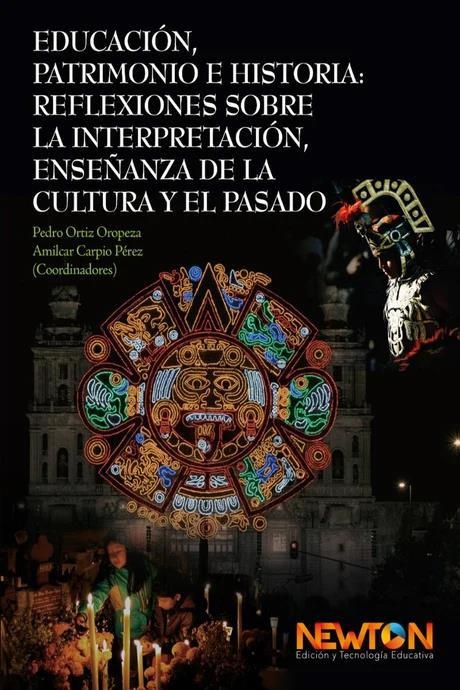
Education, Heritage, and History: Reflections on Interpretation, Teaching Culture, and the Past
Pedro Ortiz Oropeza and Amílcar Carpio Pérez (eds.), 2025 Newton Educational Publishing and Technology, Mexico City, 250 pp.
The central theme of the book I am reviewing is education and how to teach the public about historical and cultural heritage; therefore, it is primarily intended for teachers of history and subjects related to cultural and historical heritage. This work focuses both on formal schooling—with the goal of “providing teachers at various educational levels with a range of tools, content, and methods for interpreting Mexico’s cultural heritage” (p. 15)— as well as on non-formal education to highlight cultural traditions and raise awareness of spaces such as museums in order to enrich experiences and foster an appreciation for this heritage, “addressing topics such as collective memory, identity, appreciation of cultural diversity, citizenship education, and interculturality, among others” (p. 15).
Education, Heritage, and History: Reflections on Interpretation, Teaching Culture, and the Past It was coordinated by two education specialists who are professors at the National Pedagogical University (upn), with extensive experience in educational processes, particularly in the teaching of history. It consists of eleven chapters and features contributions from fourteen authors with extensive experience in the fields of education, history, and cultural heritage.
The text is organized into two parts: “Interpreting and Educating Through Heritage: Reflections on Teaching Culture and the Past” is the first part and consists of seven chapters, allowing the reader to immerse themselves in diverse experiences and contexts for teaching history and cultural heritage. The opening chapter, written by Joan Santacana I. Mestre and Tania Martínez Gil, is titled “Making History with Objects.” The authors follow object-based pedagogy as a guiding methodology developed to decode various objects found in museums, which they refer to as “discovery learning” (p. 24). Through various examples, they illustrate how objects allow us to understand and learn about the past; hence, it is important to observe them, learn to read them, and interpret their meanings to aid in the understanding and teaching of history. For this to happen, cultural heritage must be valued and preserved, whether in the hands of private individuals or in institutions open to the public, such as museums.
In the second chapter, “The Educational Role of Heritage: A Perspective from Educational Psychology. Interpretation at the National Museum of World Cultures,” Florentino Trejo Navarrete helps us understand the issues related to cultural heritage through the lens of educational psychology; this perspective serves as a strategy for interpreting heritage in ways that facilitate its use in both formal and informal settings. The author proposes taking the student’s perspective into account to connect them to the museum’s history and, in doing so, spark their interest in the significance of the historic site. By connecting life in the past, the objects people used, and their connection to the present, visitors are invited to travel back in time and imagine how people lived in the past, while comparing that to life today. The author emphasizes the importance of having spaces that house valuable collections, as well as managing and ensuring their proper functioning and, above all, encouraging local residents to take ownership of them.
In the third chapter, “Who Were They and Who Are We? A Look at Society in the Northern Region of the State of Guerrero Through the Tradition of Graves and Offerings on the Day of the Dead,” Pedro Ortiz Oropeza and Alba Martínez Carmona explore the feelings of residents in communities across the northern region of the state of Guerrero regarding the offerings and graves dedicated to the deceased. The study is enriched by oral testimonies from residents involved in the design and creation of graves or altars in honor of the region’s deceased in cities such as Iguala, Teloloapan, and Ixcateopan de Cuauhtémoc. The display of these graves and offerings is valuable for the educational sector, as “the contemplation, appreciation, and study of cultural heritage foster citizens” understanding of both their surroundings and the changes and continuities in human activities over time” (p. 56).
In his essay “The Reenactment of the Battle of May 5 as Mexico City’s Living Heritage: Intangible Heritage and Learning from the Past,” Amílcar Carpio Pérez analyzes how the reenactment of the Battle of May 5 takes place in the Peñón de los Baños neighborhood and the town of San Juan de Aragón in Mexico City. The author highlights the spontaneous nature of the tradition, given that the residents of these communities did not participate in the battle against the French army in 1862. Nevertheless, he demonstrates the importance residents attach to this tradition in shaping their sense of Mexican identity, as well as in learning history outside the school setting. He also presents an educational proposal to foster a better understanding of the reenactment as a cultural heritage object. Carpio Pérez points out the importance of activities that involve the active participation of residents through various committees or commissions—activities that fill them with pride because they represent a historical event that gives them a sense of belonging to their past, present, and future.
The chapter written by Rosa Neli Serna Ramírez, titled “Heritage and Identity: The Role of Local Festivals in Teaching History,” discusses the use of cultural heritage as a resource for teaching history at the secondary level. She analyzes the festival honoring Cuauhtémoc in Ixcateopan, Guerrero, with the aim of helping students in the region understand the significance of cultural events taking place near their community, feel a sense of connection to them, and contribute to the development of their identity as part of the community. The author highlights the importance of innovating in how this subject is taught at this level; her proposal focuses on guiding students to find their role in society through the construction of knowledge they can relate to within their own context. Thus, cultural heritage is considered a selection of assets and values of a culture that form part of the symbolic or tangible property of specific groups. Furthermore, becoming familiar with aspects of the festival through direct contact gives it value and meaning, and makes it an event in which a large number of people from both that town and neighboring areas participate.
In the chapter “School Photographs as Historical Heritage and Their Educational Uses in Higher Education,” Norma Ramos Escobar and Armando René Espinosa Hernández highlight the importance of school materials as part of an institution’s heritage. They refer specifically to the photographic archive recovered by staff of the Regular State Education System, whose contents can serve as documentary support for various research projects on different aspects of formal education in the state of San Luis Potosí, including infrastructure, social, and pedagogical aspects, among others. The authors present some examples of what can be achieved and the educational value these materials can provide when used in the training of teachers or education professionals. Heritage, as a living entity, allows for interpretations from different perspectives—as triggers for memory, sources for the history of education, and as teaching resources. These interpretations—among many others that can be drawn from the school’s graphic heritage—make educational heritage a valuable tool for recovering the pedagogical memory of schools and for enabling teachers and students to approach its uses in a critical and analytical manner.
The following chapter, “Toward a Pedagogy of Photographic Heritage: Problem-Based Approaches from Cultural History,” written by Carlos Enrique Torres Monroy, focuses on the heritage value of the photographs selected and documented in various archives, such as that of the National School of Anthropology and History (enah). Torres emphasizes the importance of family archives given the wealth of information that can be gleaned from photographic records. His well-reasoned arguments promote an understanding of the ways in which photographic cultural heritage can be interpreted, the possibilities for interpreting photographs from a cultural-historical perspective, and the historical problematization that arises through the analysis of photographs. The book concludes by integrating these elements into an educational proposal for the training of historians or those who intend to teach the discipline of history.
These last two chapters invite us to explore the past through photographs to understand daily life in schools. The images depict the educational setting; its people—teachers and students; and the activities taking place: attending class, participating in an exhibition, and other school-related activities. The photographs reveal the physical aspects depicted in the image: the classroom, the teachers, and their students. As the authors point out, the themes that emerge from analyzing each of the elements reflected in the image provide valuable information for shedding light on the school environment and its dynamics during a specific time period. As a reader, this chapter reaffirmed the importance of preserving photographs as part of our cultural heritage. More than simply viewing the photographs, their characteristics, and the wealth of information they contain, this allows the reader to form a visual image of the past and understand daily life in schools at a specific moment, as well as what has remained constant or changed over time.
The second part of the book is titled “Critical Reflections: Understanding Heritage and Culture” and consists of four chapters. Appropriation is an essential aspect of valuing heritage. Here, too, the emphasis is on memory and identity, since what we remember gives us our identity; we remember what has both personal and collective value. The text highlights the role of the state in creating the conditions necessary to preserve and disseminate documentary value; it also emphasizes the role of the teacher, who is responsible for conveying content to students, and the role of the student, who is responsible for generating their own knowledge—a process that facilitates subjective interpretation and reinterpretation among the various stakeholders.
In the chapter “Reflections on Thinking About and Exploring Heritage,” Ariel Corpus presents several arguments that invite us to carefully consider the various proposals for defining the concept of heritage and their implications for historical research and teaching through heritage objects as primary sources of information. The text revolves around two lines of analysis: the construction of a perspective from which to understand cultural and historical heritage—one that is not confined to institutional and centralized spheres but rather takes the issues of memory and identity as its point of reference; the second calls for studying historical heritage through a dialogic method involving the researcher, hegemonic narratives, and the individuals who interact with the heritage object (p. 150).
This section continues with the text by María de los Ángeles Gómez Gallegos, titled “Decolonial Theory as an Approach: Three Frameworks for Pedagogical Practice,” which addresses the topic of heritage from the perspective of decolonial theories. This text considers the urgent need to break free from oppressive social structures in order to examine current social needs based on demands to dismantle the global order imposed by and through colonization. It posits that the concept of historical heritage is a point of intersection between the three dimensions of the colonial matrix: power, knowledge, and being. The text proposes a reflection on teaching practice: What do teachers do, and how do they guide students toward an environment of “knowing” and “being”—rather than merely “power” and “knowledge”? The author presents various anti-colonial and decolonial proposals with the goal of reclaiming inherited paradigms of knowledge and, building on them, critically examine both the classroom and its content, as well as the social context and institutions—including the objective and subjective aspects of the actors (teachers and students) in relation to that content.
Furthermore, Alejandro Cornejo Oviedo, in “Educational Inclusion and Transversal Skills in a Field Study in the Field of Anthropology” i and ii high school cch: ”The Protection and Preservation of Historical and Cultural Heritage in My City,” presents a conceptual analysis of cultural heritage—both tangible and intangible—and then offers some reflections on the skills and abilities demonstrated by incoming students at the Colleges of Sciences and Humanities (cch) of the National Autonomous University of Mexico (unam). It also describes how a research project was conducted on the preservation of the local heritage of the neighborhoods where the students come from. The examples serve to publicize the achievements and to revive the initiative, make adjustments, and replicate it in other school settings.
The book concludes with an essay by Washington Maciel da Silva, in which he discusses the state of cultural heritage in Brazil in “Cultural Rights and the Teaching of History in Brazil after 1988: The Path(s) of Policies on Historical and Cultural Heritage and Citizenship.” This chapter illustrates the stages of consolidation in the policies governing historical and cultural heritage and their relationship to basic education. The essay highlights that cultural heritage policy in Brazil was shaped by the national identity fostered by various republican projects. According to the author, the teaching of history equips students with the ability to analyze the historical process of heritage. For this reason, he considers interpretive plurality to be essential for teaching a variety of subjects, themes, methodologies, time periods, and specializations that reflect everyday social realities and address specific historical and social contexts at the regional, local, or situational levels.
The authors of the various chapters, each with their own style, present a range of strategies they have adopted for teaching history, with the goal of making it a lifelong learning experience—one in which understanding the past to comprehend the present and build the future fosters a sense of belonging. The text invites readers to analyze the topic from different perspectives: as citizens who live, coexist with, protect, and preserve heritage; as students of history; and through the value placed on objects, monuments, cultural expressions, and even historical figures.
Undoubtedly, in this regard, it encourages readers to reflect on how they have learned—and how they should continue to learn—about history and heritage. As a history teacher, I believe it is an invitation to explore the pedagogical strategies and factors at play in the classroom that help students learn about history and heritage, thereby contributing to the recognition of tangible and intangible heritage.
Readers will find examples to help students engage with cultural heritage, which, in turn, enables them to learn to value and respect the heritage of their communities. It is proposed that, through cultural heritage, teachers find opportunities to enhance their professional development and expand their involvement in creating learning activities centered on two main themes: culture and the past. As a teacher—whether in elementary, middle, or higher education—, Education, Heritage, and History: Reflections on Interpretation, Teaching Culture, and the Past It invites reflection on the teaching of history, its content, and the strategies used in the classroom; it also highlights additional resources that educators incorporate into their teaching activities with students, along with their strategies, so that these can serve as examples and be adapted to the specific needs of each context.
On the topic of cultural heritage, in each chapter, the authors offer their definition of tangible and intangible heritage. They provide examples of this heritage, emphasizing that it belongs to each and every resident of that territory and is what gives it its identity—as is the case with monuments, historical events, and patron saint festivals. Everyone contributes to creating and valuing this heritage, which is why it is so important to preserve it and appreciate it through monuments, the reproductions found in museums, or the images preserved in various media. One aspect that would be very helpful would be to include examples from other regions of Mexico, since the chapters focus on the cultural expressions of the central and southern parts of our country.
Likewise, throughout the book, there is also discussion of those who preserve our heritage, with reference to archives and the people in charge of these documents, since they decide what is kept and what is not—that is, what will endure over time. It is thanks to the interest that some people have in preserving documents that today we have libraries with old books, historical archives, museums, and photographic collections—among other institutions—to record and safeguard this heritage. These institutions and documents—including manuscripts, printed materials, photographs, films, and sound recordings—also encompass natural heritage as well as architectural heritage.
The goal is for students to identify, explore, and recognize our country’s cultural heritage so that, in turn, they can value and preserve it in archives, libraries, photo archives, and any institution specializing in cultural heritage. All of these documents are extremely valuable because they also encourage students to study other topics. Incidentally, while photographs are mentioned, there are other media that serve as evidence of educational activities over time. Photographs of places that no longer exist or that have changed over time, as well as monuments, are of the utmost importance, since for those who lived in those times, remembering is like reliving the experience; for those who did not—like many of you reading this text now—seeing them in photographs allows us to observe how the city, our schools, and even ourselves have changed.
In the same vein, I believe it is important to reflect on digital heritage: in many cases, we have photographs because they were printed, but today images are digital—what should we do to preserve them so that, a hundred years from now, someone will be able to see them? One challenge is preventing them from disappearing due to the storage media that technology renders obsolete in a short time. This concern relates to the accessibility of our heritage—what are we leaving for future generations regarding the publications we create today?
Adriana Mata Puente She holds a Ph.D. in Library and Information Science from the National Autonomous University of Mexico (unam). She is recognized as a full-time professor with a “Desirable Profile.” She is a member of the National System of Researchers, 2022. Since 2005, she has been a research professor in the School of Information Sciences at the Autonomous University of San Luis Potosí (uaslp). Her research focuses on reading and public and school libraries, both in the present and in the past. She has helped coordinate three books (2019, 2021, 2022); she is the co-author of one book (2024), has published eight articles in specialized journals, and 15 book chapters. She has also presented her research findings at more than 40 national and international conferences. In the area of academic training, she has advised six master’s and bachelor’s theses and has taught courses at the master’s and bachelor’s levels.
Institutions



 EN
EN  ES
ES  FR
FR  PT
PT