
Votive Offering, Bastion, and Sanctuary: Between History, Autoethnography, and a Visit to the National Basilica of Luján (Argentina)
- Patricia Alejandra Fogelman
- - see biodata
Votive Offering, Bastion, and Sanctuary: Between History, Autoethnography, and a Visit to the National Basilica of Luján (Argentina)
Received: May 20, 2025
Acceptance: January 20, 2026
Abstract
The Basilica of Our Lady of Luján was built at the end of the century xix in fulfillment of a promise (a votive offering); my argument is that it was erected as a bastion of the Church in competition with the liberal state. Despite being the most important national shrine, it contains almost no other votive offerings. This essay proposes, in the form of an autoethnography, some ideas about the materiality of the basilica, the practices of its visitors, and the role of the candle stands and souvenirs that surround the temple.
Keywords: Argentina, stronghold, basilica, city of Luján, votive offer, sanctuary
Ex-voto, Bastion, and Sanctuary: Autoethnographic and Historical Reflections on the National Basilica of Luján (Argentina)
In the seventeenth century, a cart carrying goods from Brazil mysteriously came to a halt on the banks of the Luján River, in a rural area of the city of Buenos Aires. The cargo included a statue of the Virgin who would eventually become Argentina’s patron saint. Today, pilgrims and tourists venerate her image at the National Basilica of Our Lady of Luján, built in the late nineteenth century to fulfill a promise (an ex-voto). In this article, I argue that the enormous neo-Gothic basilica was erected as a bastion of the Church in competition with the liberal state. Despite being the country’s most important national shrine, it houses almost no other ex-votos. This essay adopts an autoethnographic approach to reflect on the materiality of the basilica, the practices of its visitors, and the role of the candle and souvenir stalls that surround the temple.
Keywords: City of Luján, Argentina, basilica, ex-voto, sanctuary, bastion.
This text will address three aspects of a shrine dedicated to the Virgin of Luján in the province of Buenos Aires, Argentina: it will be examined as a votive offering and briefly contextualized as a bastion of the Catholic Church in the face of the liberal Argentine state at the end of the century xix, and we will also describe some of its current characteristics as a sanctuary that differs from other contemporary sites in terms of the display of offerings.
The National Basilica of Luján (bnl)1 It is an important Neo-Gothic church built to house a small statue of Mary under the title of the Pure and Immaculate Conception, which was created in a Brazilian workshop and has become the patroness of Argentina. Although I have previously worked on a doctoral dissertation and several published articles regarding this devotion—focusing on its history and the social actors who promoted the cult of Our Lady of Luján— here I have set out to undertake a different exercise: one that will draw on some of that research, combine it with a kind of personal ethnography centered on my professional interest in the votive aspects of the shrine, and integrate it with interviews I conducted with four visitors to the basilica who share certain common characteristics: they are women, they are Catholic, they are teachers at various educational levels, and one lives in the City of Buenos Aires while three live in the province of Buenos Aires.
Fifteen years ago, I began to focus on the offerings of thanksgiving inspired by alleged Marian interventions on behalf of those seeking special help. That [imaginary?] relationship between believers and a sacralized figure that materializes—or is embodied in an object or an action—led me to reflect on spaces of devotion and, in particular, on the shrine as the setting for these manifestations, as well as an offering in and of itself: an offering that was—in turn—a collection of others (such as votive offerings), which changed its approach to them over time, and which continues to be a space for the fulfillment of promises, but… in what ways?
The bnl It is a votive offering (a vow fulfilled, a promise kept out of gratitude) and is also a central space/object/materiality not only within the context of Argentine Catholicism but also a highly significant cultural object in my personal experience as a researcher in the history of religion. Although I am not a religious person, my relationship with this subject of study over the decades has provided me with an experiential entry point into this essay.
And why? For many reasons, but one of them is that before I began studying the history of Marian devotion (1987–1988), while I was an undergraduate history student at the National University of Luján (unlu) and lived in the city of Luján, I made candles: candles sold from the “stalls” in the plaza in front of the basilica, to which a small prayer card and colored ribbons are attached, and which pilgrims and visitors buy to give thanks for help received or to ask the Virgin for it. I made them to earn a few pesos on some Saturdays in a courtyard—under an orange tree—together with a college friend (Marcelo Barbani) who knew the method and had the contact who supplied the materials, and he would take them then to the basilica square to a mobile “little stall” for sale. My friend had managed to secure that opportunity (or, as we called it in Argentina, that “changa,” that “laburito”—referring to a temporary, informal, and precarious job)—and, luckily, he shared it with me. That experience allowed me not only to pay for some photocopies and notebooks to use in college, but also to learn how candles are made—the mixture heated, filling a structure of pipes that looked like a misshapen musical organ—strung with white threads coated in paraffin—and gain insight into the role candles play in the local economy around the Shrine of Our Lady of Luján.
For this reason, this text is structured around my own previous published research and is interwoven with the account and analysis of a past personal experience (1981 and 1987–1988), during a visit to the basilica on June 9, 2024 (together with my friend Jula) to take photographs, conduct fieldwork, and carry out the four interviews I mentioned above. This article combines, in both form and content, long-standing research in historical archives, participant observation in certain sections, and autoethnography. For this reason, I have chosen to adopt a very personal and almost intimate tone in the narrative.
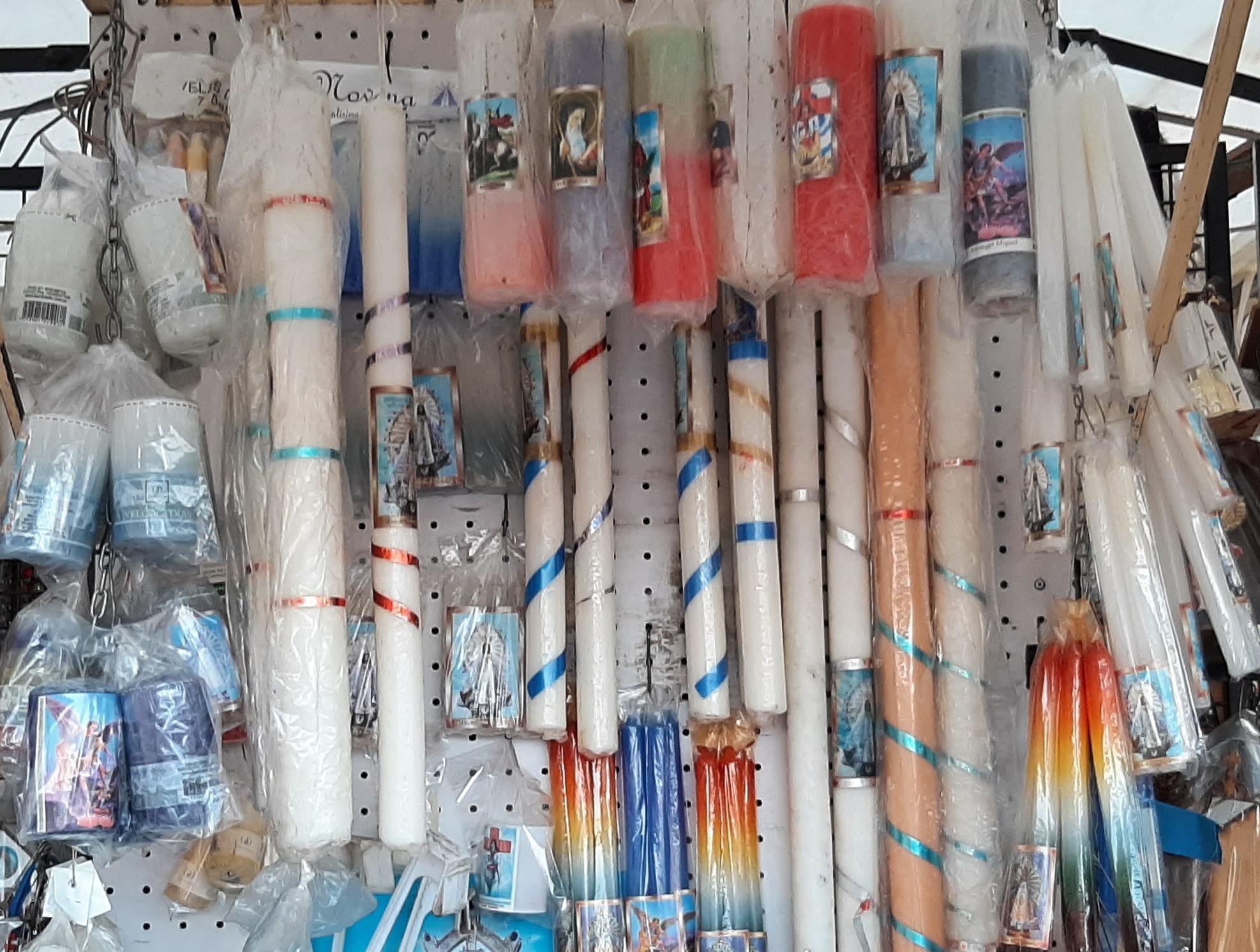
These types of candles and taper candles (the ones with little pictures and decorated with “gift ribbons,” made of white or orange wax) are similar to the ones Marcelo and I used to make in the late 1980s. We also made candles that were about as tall as I was, and it was very difficult to remove them from the tube without breaking them. The photo was taken from one of the mobile sales carts located right on the sidewalk (almost at the entrance to the atrium) of the BNL, in Plaza Belgrano.
Some of the information was obtained through structured interviews using a written questionnaire, with responses recorded on audio, unstructured oral interviews conducted in the field, observation of images and objects displayed in the surrounding religious market, as well as the examination of certain material aspects of the church and the attitudes of the faithful and visitors. Undoubtedly, the images collected during fieldwork in Luján, the audio recordings received in response to my interviews, and the examination of websites related to the Basilica of Luján and other Marian shrines are documentary sources that provide information complementary to the consultation of historical archives.
I will share some aspects of my fieldwork during that visit and a series of photographs, accompanied by audio excerpts from the four people interviewed in April and May 2025, which, taken together, allow us to reflect on the unique character of local and regional religiosity in Luján, interwoven synchronically with a brief narrative that alludes to a longer historical span and concisely recounts the colonial origins of a religious practice that weathered the storms of Church-State tensions at the end of the century xix, right up to the present day.
Below, I present this very brief history of the colonial devotion to Our Lady of Luján and of the Neogothic church that, centuries later, became Argentina’s national Marian shrine.
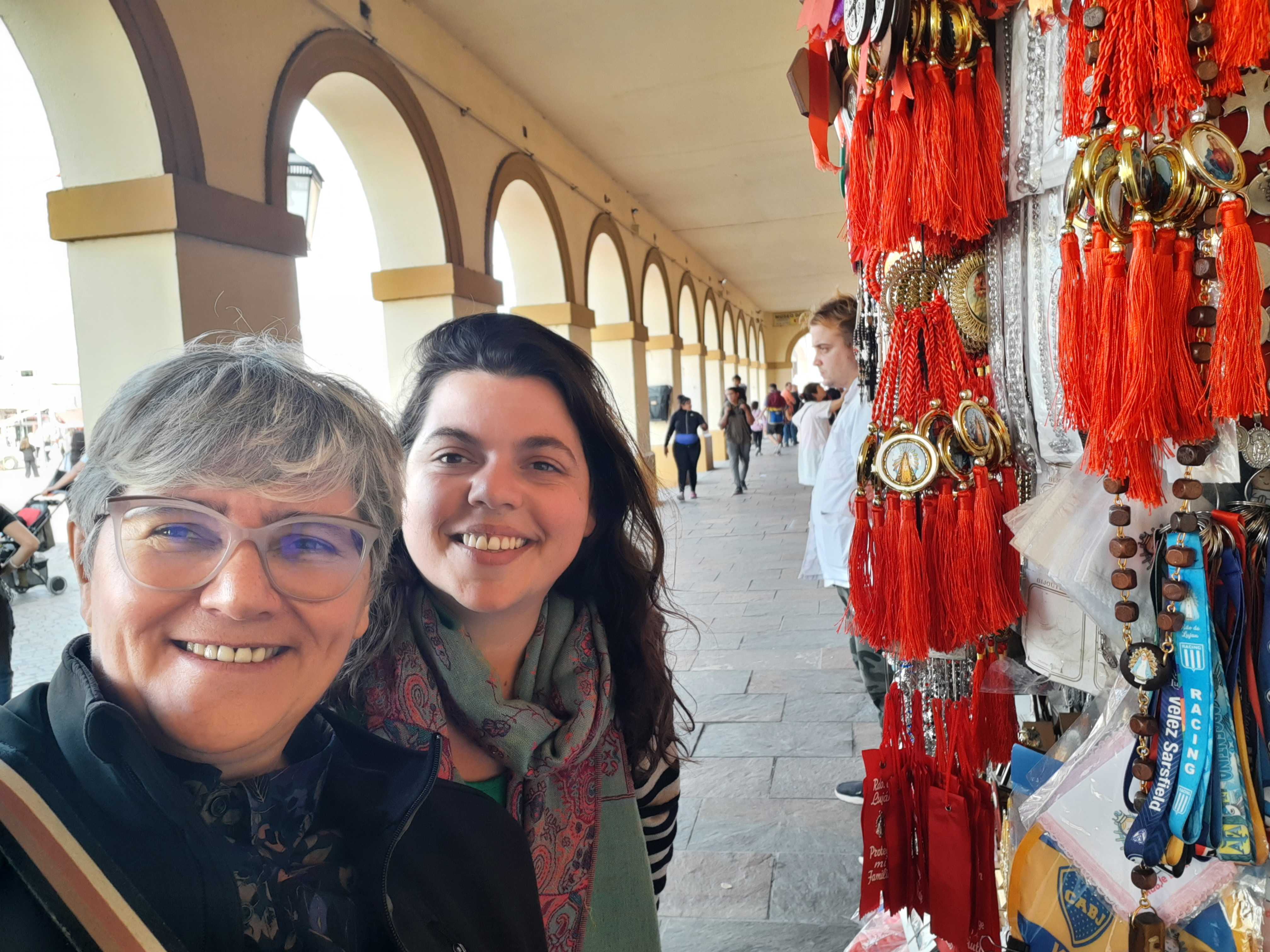
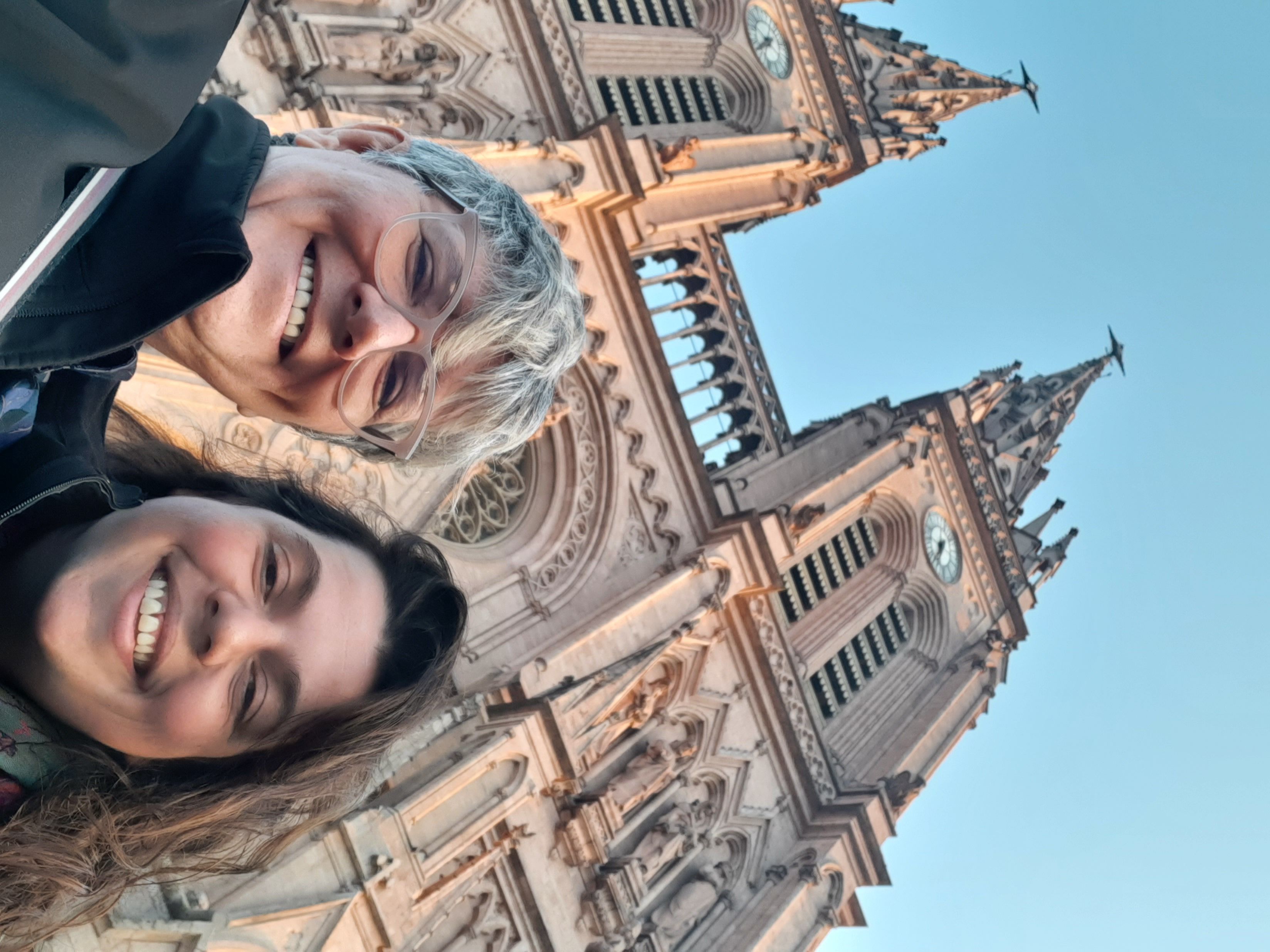
Church of Our Lady of Luján, an architectural votive offering
The Virgin of Luján is the most important Marian devotion in Argentina, and her worship began around 1630, when an ox-drawn cart coming from the Port of Buenos Aires and carrying various goods2 It arrived on the banks of the Luján River, carrying in its cargo an image of the Immaculate Mary from Brazil (Fogelman, 2003, 2006). The oxen mysteriously stopped at that river in the countryside surrounding the still-small port city of Buenos Aires. This mysterious halt—which witnesses attributed to the will of the image—led to the image being placed in a wayside shrine on the estate of some Portuguese landowners living there, who were also merchants.
The image of the Virgin Mary gradually gained a reputation for performing miracles. By the end of the century xvii, it was moved to another location on the Luján River: It was purchased by Doña Ana de Matos, a widow and owner of the estate, who for a time was in charge of supplying meat to the city of Buenos Aires and was a woman connected to the commercial and credit networks of the Portuguese community in Buenos Aires. Ana de Matos purchased the image of the Virgin Mary from Manuel, an enslaved Black man who had been dedicated to its care since childhood, and moved them to a cattle ranch she had donated specifically for the image of the Virgin. Her donation of land and the inclusion of a clause prohibiting the removal of the image of Mary from that location (under penalty of revocation of the donation) laid the foundation for the wealth and fame of the Luján shrine.
Later, on the site donated by Ana de Matos (mid-century xviii) a new phase of growth began for the church and the temple: A Basque merchant, Don Juan de Lezica y Torrezuri, began overseeing the construction of a colonial-style church. He had traveled down from Callao, passing through the Yungas Valley and Córdoba, until he reached Buenos Aires, conducting business that involved transatlantic networks. Lezica y Torrezuri fell ill near Luján and vowed to build a church for the Virgin if he were cured (Fogelman, 2003, 2006). He did just that, serving as trustee for the construction of a new church, a colonial-style building, thereby enriching his estate, building a bridge in the shadow of the sanctuary (which granted him 12 years of toll revenue for the construction), and securing recognition for the fledgling settlement of Luján as a town worthy of a town council. This mid-century colonial church xviii It was the first explicit architectural votive offering dedicated to the Virgin of Luján. This offering of thanksgiving for the Basque merchant’s restored health also injected tremendous vitality into the shrine, thereby expanding its influence into the interior of the Río de la Plata region and leading to the organization of a fundraising campaign for the new sanctuary of the Virgin of Luján.
Votive offerings were often overlooked as subjects of study because they were viewed as rustic objects, remnants of superstition, or items of poor taste (Didi-Huberman, 2016). However, in recent decades they have managed to spark interest, first among anthropologists, and later among historians and art historians. Recent contributions on the subject, stemming from long-standing exchanges between Mexico and France, can be found in the bilingual book edited by Caroline Perrée, in which she, Pierre-Antoine Fabre, and Renée de la Torre (2021) write a remarkable introduction.
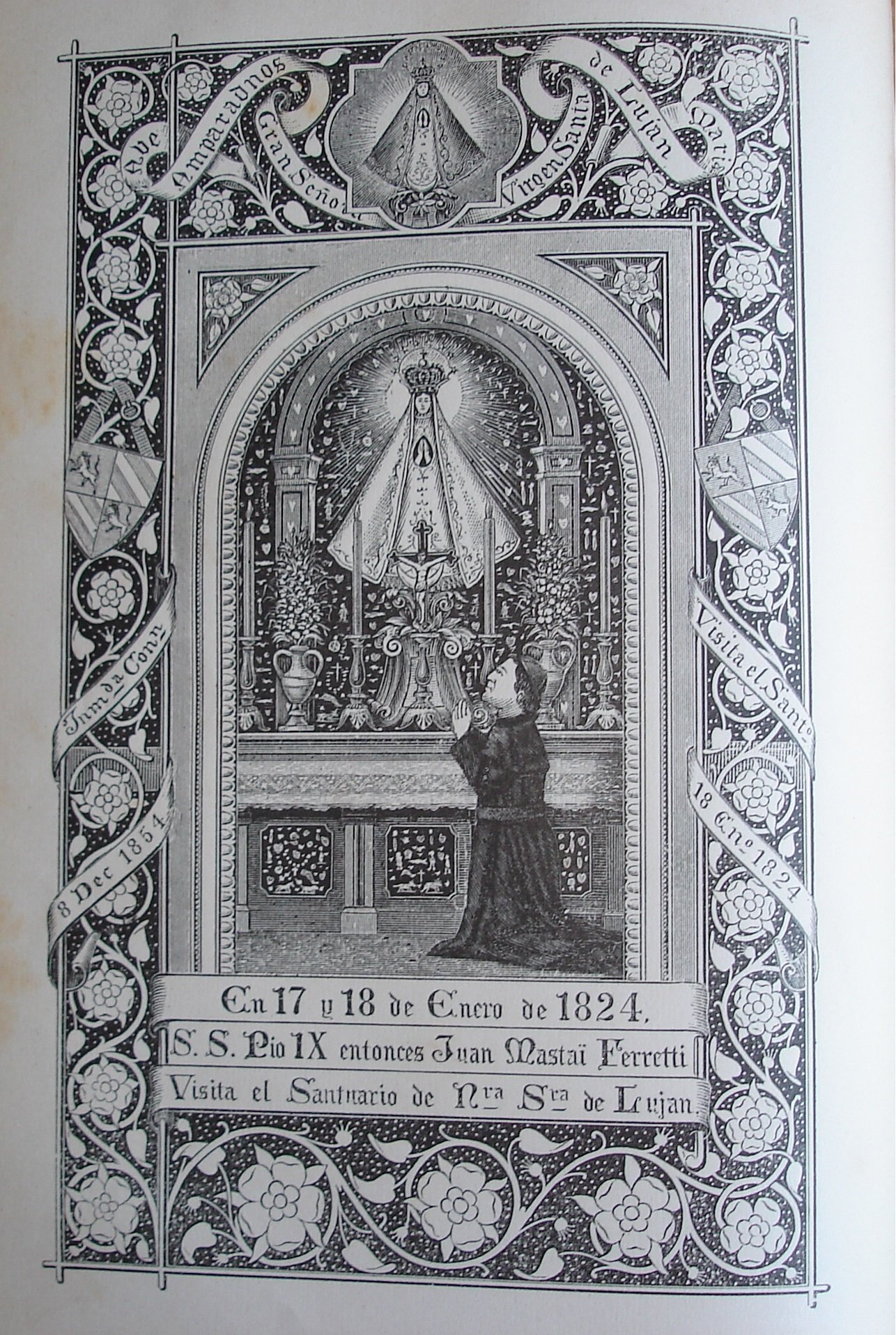
In the case of the Río de la Plata, the clues for understanding these issues were right there in the sources, although they had not been explored. Some time ago (Fogelman, 2018), I unearthed this excerpt from the travel journal of William McCann, an English traveler of the Protestant faith who passed through Luján in 1847. His text Viaje a caballo por las provincias argentinas It is known as the diary of “An Englishman” and provides an interesting description of the devotion to the Virgin, particularly of her niche in the church built by Lezica and Torrezuri, where offerings were prominently displayed around the Virgin (even in the middle of the century xix), and this is how they appear in the later engraving in Jorge M. Salvaire's book (1885).
This church houses the venerated image, about which the following tradition is told: On one occasion, two carved images of the Virgin were being transported from Buenos Aires to Chile along the road through the country when suddenly, the wagon carrying one of them began to encounter obstacles along the way and eventually broke down near the Luján River. This incident was considered miraculous, as it was believed that the Virgin refused to cross the river. They then decided to build a church on the banks of the stream. Later, a magnificent building was erected, dedicated to the same devotion, which cost seventy thousand silver pesos, and offerings began to arrive from all over the country. These offerings consist of gold and silver objects shaped like arms, hands, and other body parts—symbols of the blessings that the believers believe they have attained through their vows. The image is located in the center of the main altar, facing the nave of the church, but When it comes time to present an offering to him, the priest turns him toward the side chapel. That's the name given to a small chapel located behind the altar, where the Virgin can see the donors and their offerings. The votive offerings of the poor generally consist of candles that are lit in honor of the image. In addition, forty to fifty chaplaincies are affiliated with the Shrine, and the income from charitable donations exceeds that of the Cathedral of Buenos Aires (McCann, 1939 [1847]: 162–163, cited in Fogelman, 2018. The italicized text is mine).
The temple built by Lezica and Torrezuri was replaced at the end of the century xix by the current Neo-Gothic basilica—a building of immense prominence on the Buenos Aires plain—which creates a sort of “sacred zone” within the urban landscape (Flores, 2025: 5), where believers and tourists gather regularly and from which presidential campaigns are even launched (Fogelman, 2013: 143–144). Construction began in 1885, fervently spearheaded by the Lazarist priest Jorge María Salvaire, a French native and missionary in the Pampas of the Río de la Plata.
The current church, with its medieval-style ribbed vaults and tall towers designed by Salvaire, replaces the old colonial church built by Lezica and Torrezuri, but it shares one feature with that earlier structure: it, too, is a votive offering—a gift made in fulfillment of a promise—because it was built to honor a vow made to Our Lady of Luján. When the French priest was captured by the Pampas Indians, he found himself at their mercy and on the verge of being attacked with spears. After invoking the Virgin, whom he had seen while passing through the nearest village, he was saved by an indigenous horseman who galloped up and threw a poncho over him. That protective gesture, along with an exchange between the horseman and the other Indians, managed to stop the attack. Salvaire promised to build a worthy shrine for the Virgin and to spread the word about her miraculous deeds.
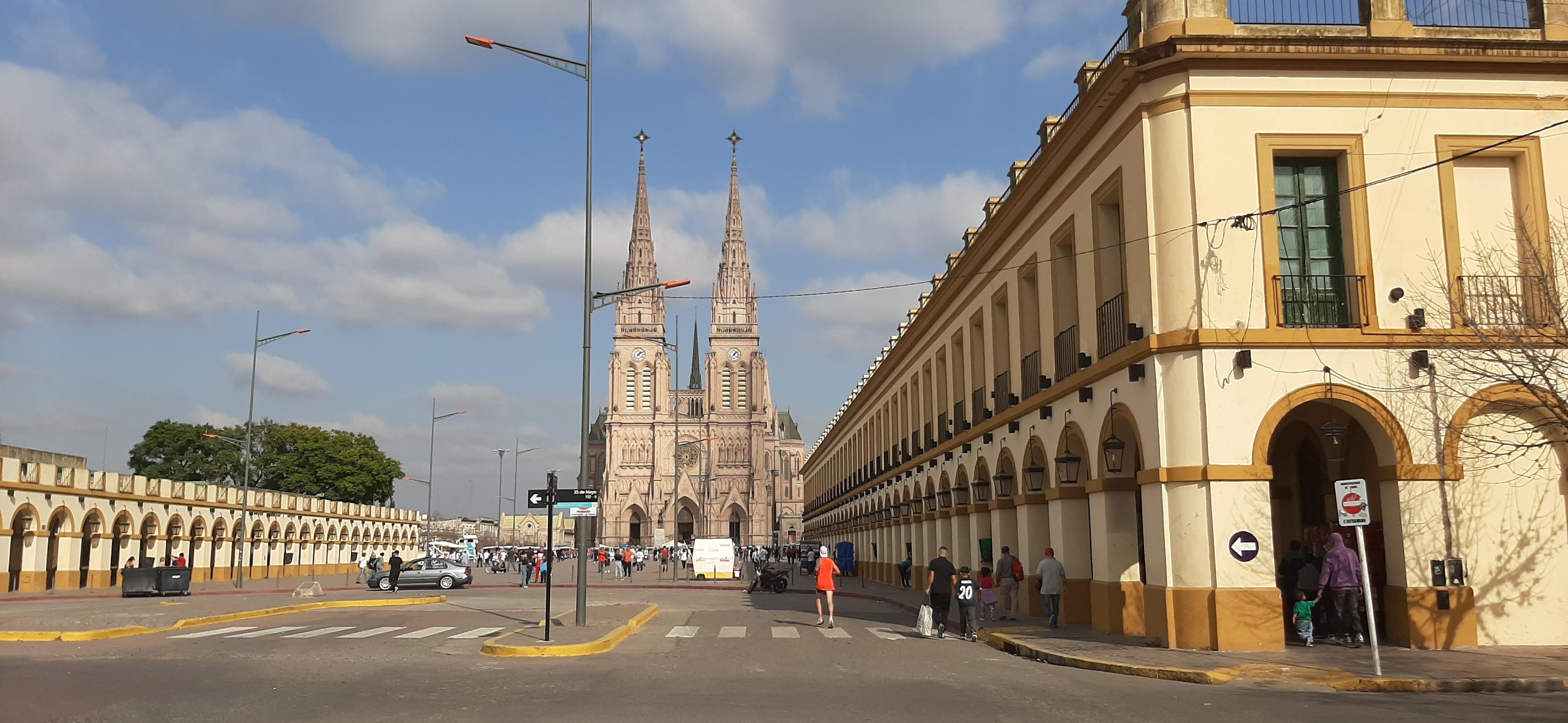
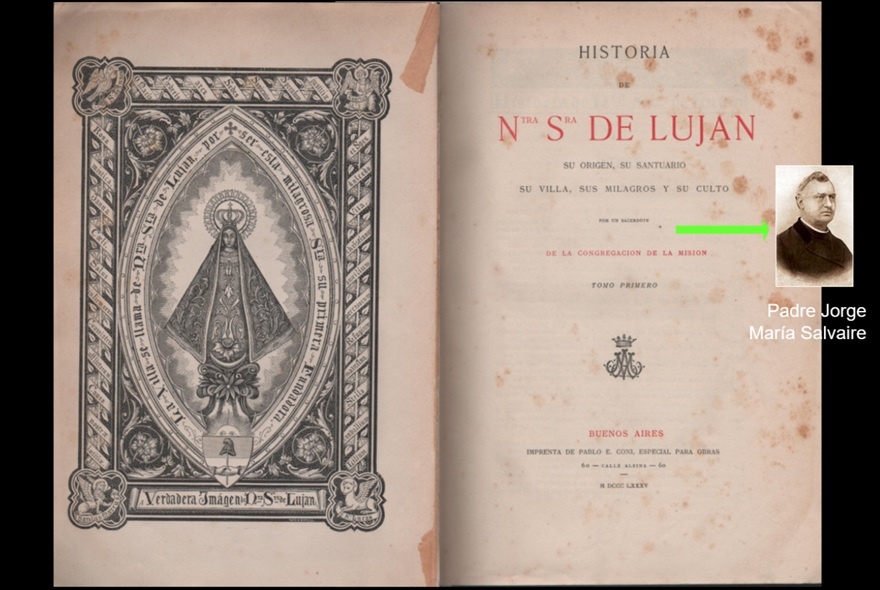
A Neo-Gothic church designed by Father Salvaire in the late 19th century. The arcades facing Plaza Belgrano are colonial-style structures, but they were built in 1938. On the right, you can see the arcade of the Enrique Udaondo Museum Complex and its Zeballos Historical Archive; in that arcade, there is a row of mobile stalls selling souvenirs and candles. On the left, the other arcade leads to the building housing the Fernán Félix de Amador Municipal Museum of Fine Arts.
Book Cover The History of Our Lady of Luján: Her Origin, Her Shrine, Her Town, Her Miracles, and Her Worship. By a priest of the Congregation of the Mission. Buenos Aires: Pablo E. Coni Press, Special Edition for Books, 1885. With engravings by Woodwell. Photography and image editing: Patricia Fogelman.
The Shrine of the Virgin: A Refuge and Bastion Against the Indigenous People, the State, and Modernity
Baluarte
From Old French. balouart, and this one from Middle Neerl. bolwerc ‘defensive palisade.’.
- m. A fortification that projects outward at the junction of two curtain walls or wall sections, consisting of two faces that form a projecting angle, two flanks that connect them to the wall, and an entrance niche.
Syn.: bastion, fortification.- m. Protection and defense. A bastion of religion. Syn.: Shelter, defense, protection.
Synonyms or related terms for «baluarte»: bastion, fortification.
Source: Article taken from the Royal Spanish Academy. https://dle.rae.es/baluarte
The National Basilica of Luján occupies a pivotal location marked by the expression of national, regional, and local Catholic piety; but it is also the heart of a tourist hub that comes alive on weekends and is overflowing on certain dates in the Marian calendar. The ceremonies and rituals held there attract massive pilgrimages from other Argentine provinces, consisting of locals—including traditionalist gaucho communities—which were examined by Cristina Teresa Carballo in her doctoral dissertation defended in 2008, as well as by Silvina Olaechea (2013: 99–118), who, in addition to the gauchos, discusses the pilgrimages of Bolivians to Luján.
Indeed, the presence of immigrants from neighboring countries is just as notable as that of European immigrants: pilgrimages by Italians have been analyzed by Mariela Ceva (2013: 51–66) and by Miranda Lida (2010: 809–836), among other ethnic groups. The pilgrimages constitute a very important center of religious tourism—a hieropolis—with a main axis running between the basilica and Plaza Belgrano (a concept applied by Flores, 2012: 137–158, who draws on Rosendahl’s notion of a hieropolis), giving rise to a specific religious geography and a local market for religious objects.
On the other hand, a specific way of analyzing political tensions within the religious context was highlighted by Claudia Touris (2013), who studied the significance of pilgrimages by residents of the shantytowns3 organized by the Movement of Priests for the Third World and the Peronist Shantytown Movement in the 1970s, a time when the military leaders of the dictatorial government staged events that blended politics and religion in the shadow of the sanctuary.
But let's go back in time to better understand how Luján became the city that is home to a temple/fortress housing an image considered miraculous and emblematic of the nation.
Relations between the fledgling state and the Church in Argentina became strained around the 1880s, following the implementation of two radical measures: the Law on Free, Compulsory, and Secular Primary Education (1884) and the legalization of civil marriage—measures that stripped the Roman Catholic Church of two of its major prerogatives. The growing liberal secularism of the ruling elites provoked the fury of the Apostolic Nuncio, Monsignor Luis Mattera, and led to an attempt to join forces with the bishops of the interior, which triggered a fifteen-year break in relations with the Vatican. During this crisis, existing tensions were kept in check by the constitutional protection afforded to the Catholic faith, so that, for example, the construction of churches could still proceed without major problems. To this end, the Church was able to employ Italian and French architects (as noted by José Burucúa and Isaura Molina, 2001) and use imported building materials, which meant that its revenues were not actually being targeted by the government; on the contrary, during the century xix About a thousand churches were built throughout the country… And there were not only Catholic churches, but also those of other religions that had taken root throughout that century and that the state was very willing to accept in a more inclusive and liberal gesture, albeit with certain limits (Terán, 2008: 109–189).
The cultural diversity brought about by the influx of European immigrants, the expansion of the railroad networks, the availability of credit and the commercial system, industry, and the organization of the justice system (the enactment of codes, regulations governing elections, the tax system, and the monetary system, etc.), and the creation of the national secondary schools and the University of Buenos Aires—all of which together imbued the country with an atmosphere of impressive dynamism, at least until the crisis of 1889 (Romero, 1986: 174).
However, the rivalry between the State and the Roman Catholic Church cannot be overlooked, and many of these churches built at the end of the century served as bastions for reorganizing anti-liberal Catholics, producing emblems and visual narratives, and galvanizing solidarity against the increasingly secular State. It is in this metaphorical sense that these architectural structures—especially the neo-Gothic ones—can be seen as bastions defending ecclesiastical representation, as fortresses that emulate the medieval style in the face of growing secularization and the loss of their prerogatives in society; and the Basilica of Luján is the prime example in Argentina, followed by the cathedrals of La Plata and Mar del Plata, two other major cities in the province of Buenos Aires.
It is worth noting that there were two proposals for the design of the Luján shrine. The one chosen was that of Lazarist Father Jorge Salvaire, who proposed building a Neo-Gothic church on the site of the old shrine to the Virgin near the Luján River; his proposal prevailed in the debate over the plan put forward by Father Emilio George, who proposed building a Roman--Byzantine-style church in the city center to protect it from flooding. It is possible that the (more conservative) Neo-Gothic design was part of a strategy that drew on “militant architecture,” which reinforces my view of the basilica as a bastion of the Church during times of conflict with liberalism.
Undoubtedly, subsequent ecclesiastical and political exploitations of the image of Luján and her shrine have revived this interest in using them as a means of generating legitimacy and consensus for specific purposes, including the consolidation of a Catholic national identity (Martín, 1997), operating even at the level of beliefs—much as the machinery of representation would—in a convergence where religion, national sentiment, and the sphere of political ambitions intersect. This instrumentalization of the architectural ex-voto—which has become the Luján sanctuary—within its social and political context leads me to conceive of it as a cultural object and, in its great complexity, as a cultural device (reappropriating this notion based on the contributions of Michel Foucault, 2016; Giorgio Agamben, 2011; Gilles Deleuze, 1990). In the shrine as a cultural device, solidarities, legitimacies, and refuges are forged against the siege of the new state policy; while Salvaire’s book, with its account of the Virgin and her miracles, served to lend an aura of historical sacredness to the National Church’s anti-liberal project.
Why, then, claim that the temple of Luján was a bulwark against the Indians? Because in the creation of the engravings commissioned by Salvaire at the end of the century xix, there is one that weaves together the colonial past and the present, highlighting the importance of the church that houses the image of Mary in defense of her faithful and against the infidels. I am referring to the engraving that depicts the escape from the great Indian raid that ravaged the outskirts of the town of Luján in 1780 and which, according to Salvaire’s account in his 1885 book, did not reach the town center or the sanctuary because the Virgin used a dense fog to blind the attacking infidel Indians. The “blindness” of the infidels echoes a critique of the enemies of religion—represented by modernity—in Salvaire’s time. The siege by the enemies at the end of the century xix It has changed, but they will remain “blind” to the truths of the faith. Thus, the sanctuary we see in the engraving depicts the colonial building erected by Juan de Lezica y Torrezuri—the very same one that Salvaire encountered along with the image of Mary (which stands out in the upper left corner of the engraving), the very same image that saved him from death at the hands of the indigenous people. That colonial sanctuary will be replaced by the project Salverian of the neo-Gothic temple, but the sense of strength—of a bulwark on the frontier against enemies—will remain intact.
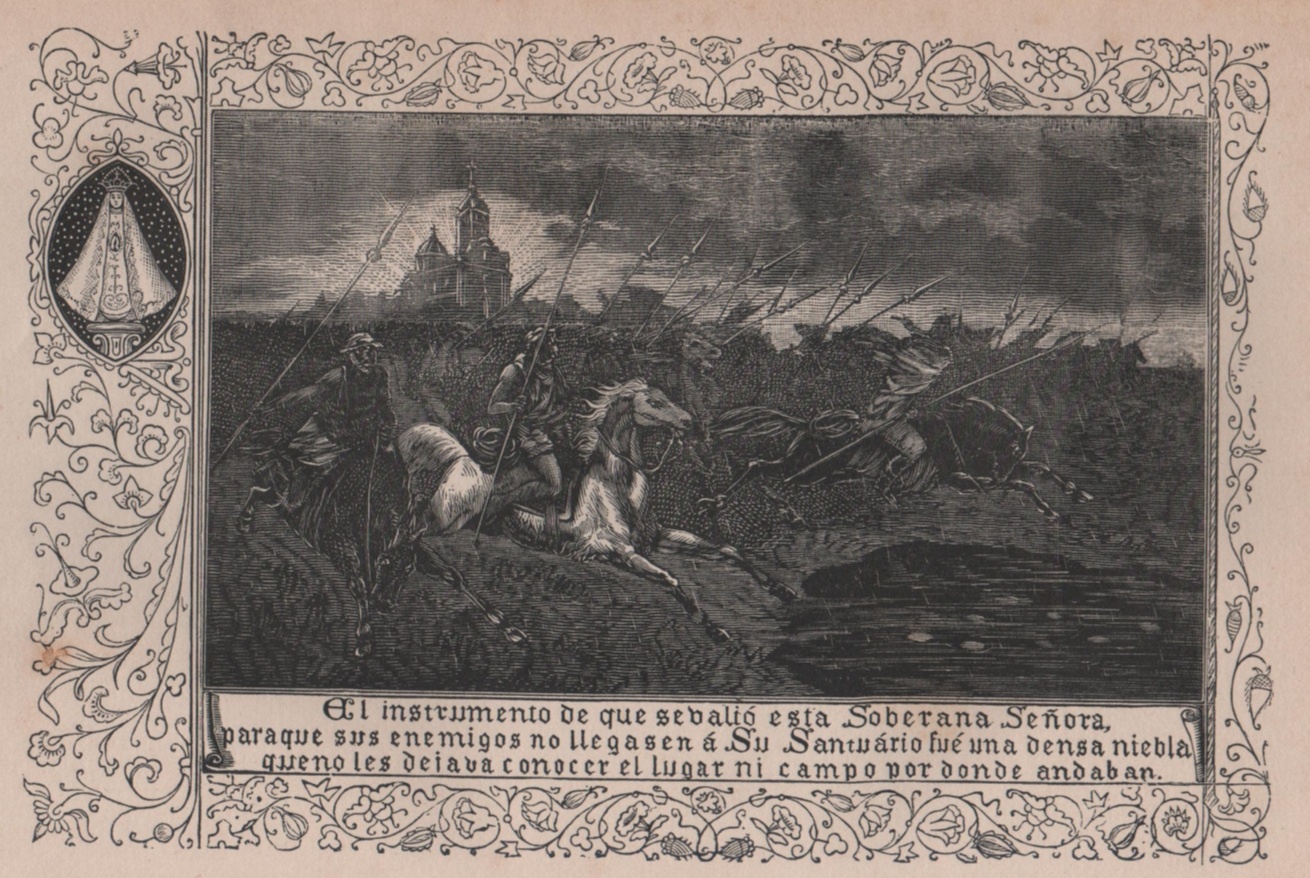
Engraving by E. Woodwell. “The means this Sovereign Lady employed to prevent her enemies from reaching her sanctuary was a thick fog that prevented them from seeing the place or the countryside through which they were traveling.”. The History of Our Lady of Luján: Her Origins, Her Shrine, Her Town, Her Miracles, and Her Worship, vols. I and II. Buenos Aires, 1885. By Jorge Salvaire, a priest of the Congregation of the Mission.
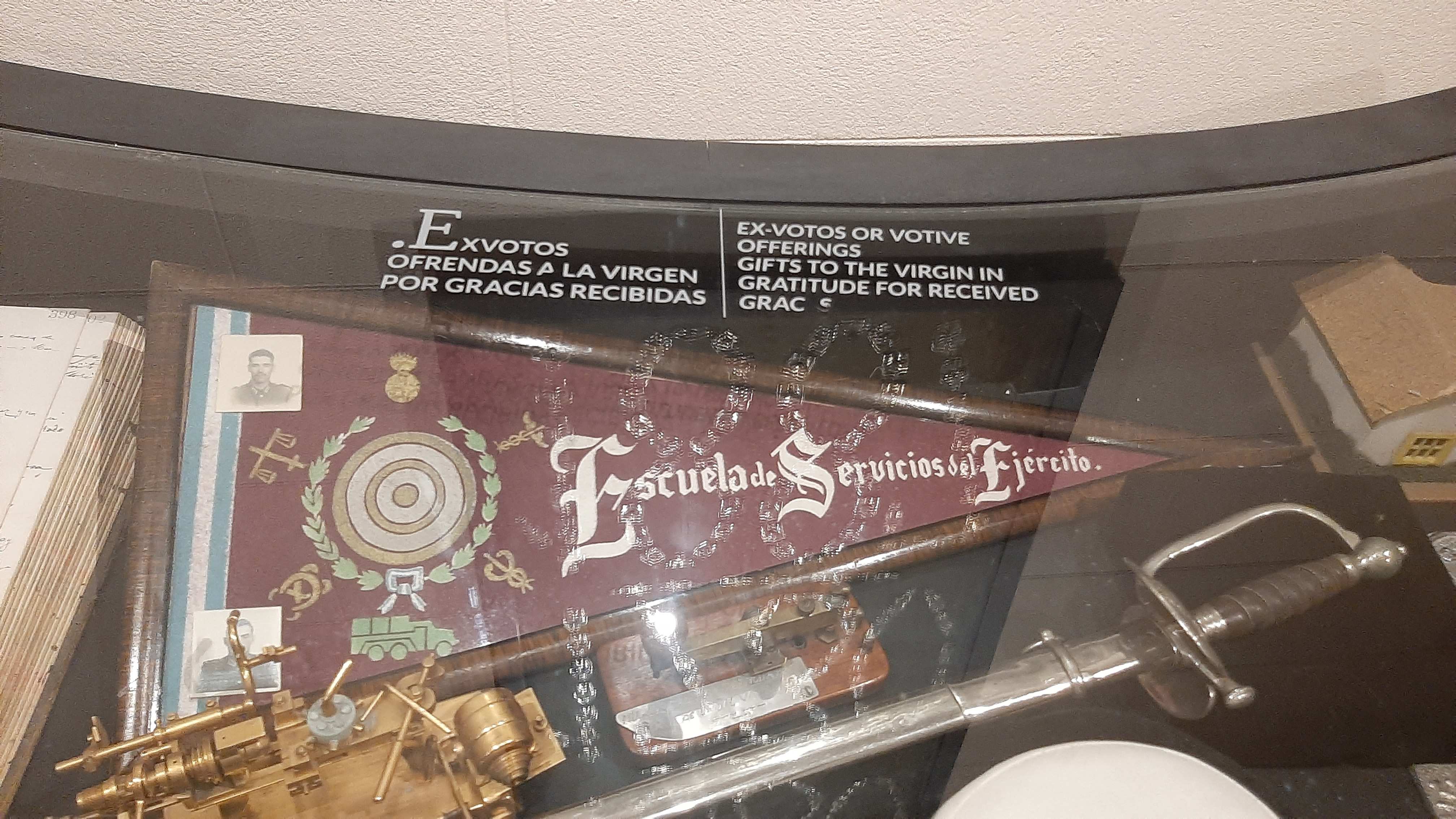
Beneath the Basilica of Luján lies a huge crypt that houses a large collection of images of patron Marian deities from other countries, but it currently lacks a specific space for votive offerings. These votive offerings, which were once displayed on the sanctuary’s walls in the form of tapestries and framed pictures featuring assembled figurines, have been removed from view. During my visits to the shrine in the late 1980s and early 1990s, I saw some of those tapestries featuring small metal figurines and military decorations arranged to form words, hearts, and dates. I was only able to locate one of them in the Basilica’s Hall of Treasures, featuring dates significant to the sanctuary’s history, which I will present later.
By asking questions of the staff at the Hall of Treasures and the sanctuary’s tour guides—whom I was able to speak with at the desk where offerings are received—as well as an employee at the Udaondo Museum, which is very close to the sanctuary, I learned that there is a storage facility near the basilica that is not open to the public and where, it is said, the bulk of the offerings to the Virgin are kept. There is also word that there are plans (though it is unclear when) to open a museum gallery featuring votive offerings. At present, there are only a few—I estimate fewer than ten—on display in that room, where other objects related to the history of the shrine or notable visitors (Pope John Paul II, politicians, former presidents, former governors, etc.) are more prominently featured.
However, it is still possible to bring votive offerings to Luján and leave them on a reception desk to the right of the sanctuary’s main entrance, where staff from the National Basilica of Luján’s Heritage Department are stationed.
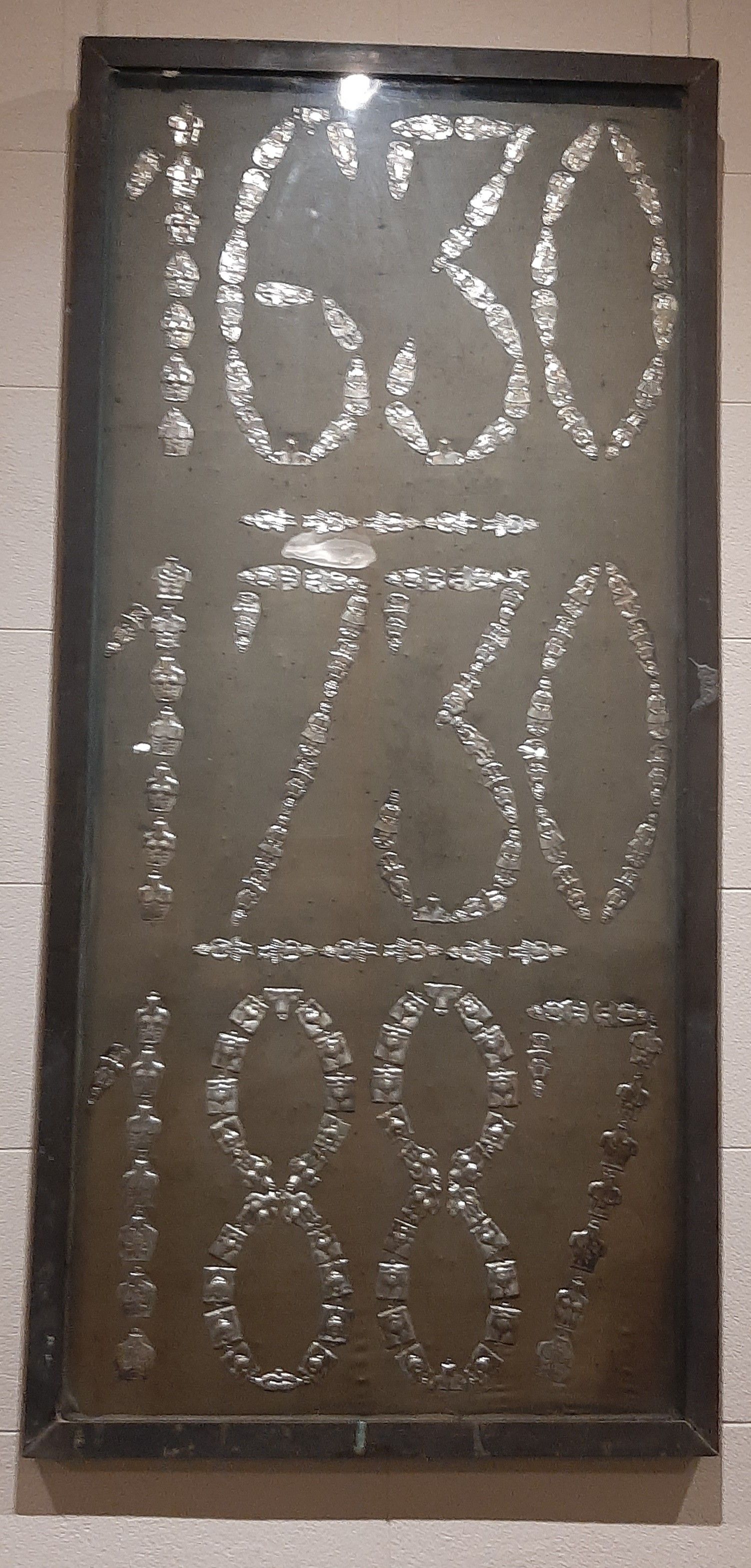
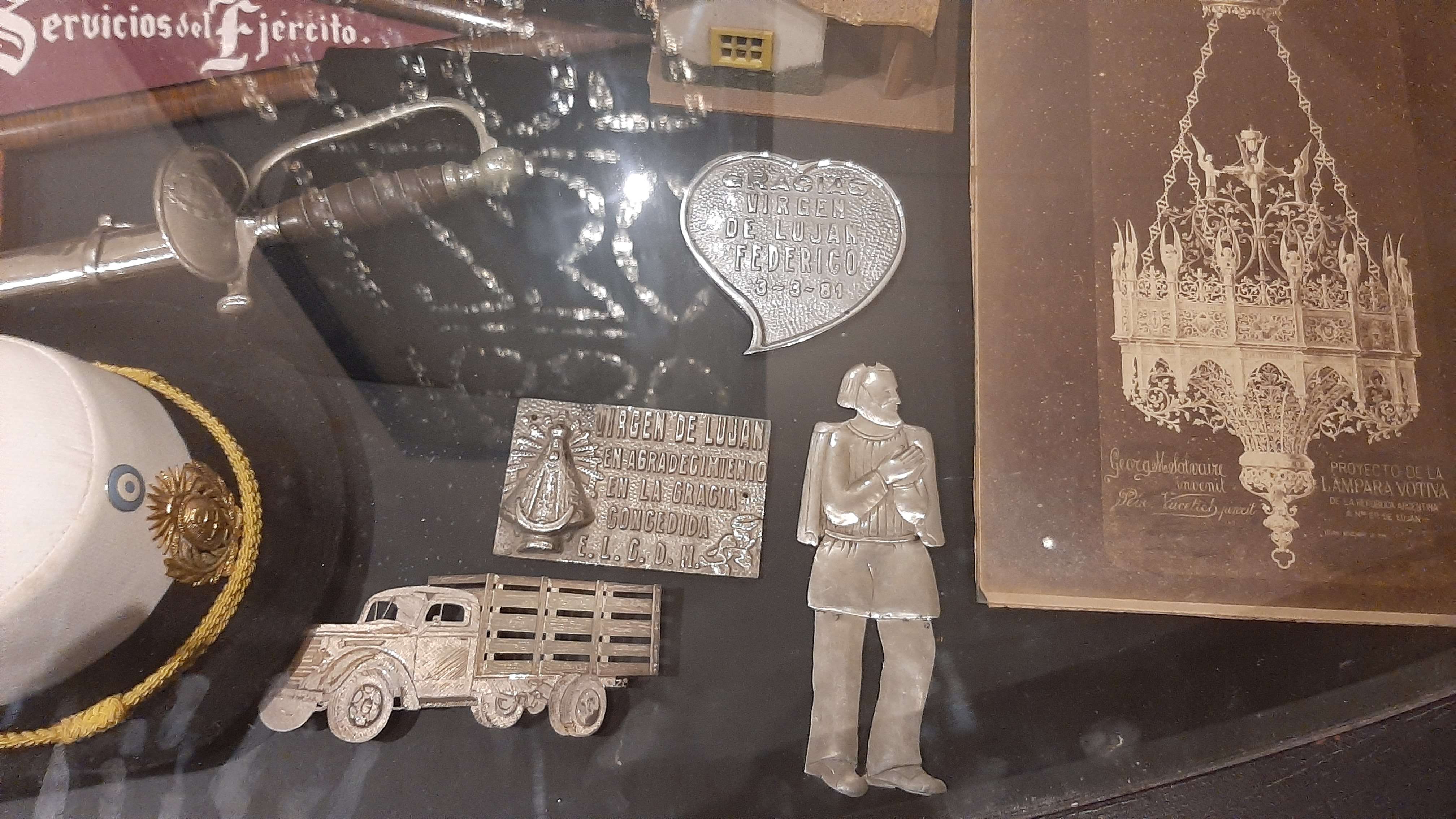
“Just so you can’t say I didn’t mention the flowers”
I’ve seen people leaving flowers inside the basilica as close to the altar as they can. There’s usually a basket at the foot of the altar, on the right as you face it, where offerings and donations are collected (some of which go to charity). In any case, I wouldn’t say their presence is as noticeable as in other churches. Generally speaking, it’s a small gesture of bringing a single flower, not a bouquet. In this regard, the accounts of my four interviewees coincide: Silvana Lemes made a pilgrimage with a friend who left a flower as a token of gratitude to the Virgin; Natalia Calvo, accompanied by a friend, said the same thing; and even her students from school brought flowers. Celia Burgos recalls seeing many flowers outside, on the steps, along with melted candles.
I suppose that laying floral offerings is more common among visitors who arrive at the shrine by bus, train, or private car than among pilgrims traveling on foot. But that’s just a guess. On the other hand, I haven’t seen many stalls selling fresh flowers around the shrine—just a few plastic flowers on a handful of carts, which are shown in the audio-video clip I made featuring Celia Burgos’s voice.
Many candles that won't light
In my observations, neither flowers nor lit candles outside the temple have the same significant presence that I saw at other shrines. On the subject of candles, I write in greater depth about the properties of wax as a material and the symbolic meaning of its recycling in a text that I hope to publish soon. Nevertheless, I would like to share a few points on this topic. Although one of my interviewees (Natalia Calvo) speculated about the recycling of candles, as is done at other shrines, I cannot confirm that the priests collect the scattered wax remnants from the atrium and staircases. However, candles that are handed in whole (and remain intact) may be sold at some of the carts in the plaza associated with the basilica. The basilica itself has, within the atrium and on the ground floor of the sanctuary, two official shops selling religious items (two santerías), where candles occupy a very prominent place alongside high-quality images depicting the Virgin of Luján in first place, followed by other figures of saints. The items for sale in these official religious goods shops stand out for their refinement and, as my interviewee Claudia Touris noted, their prices are higher than at the street stalls.
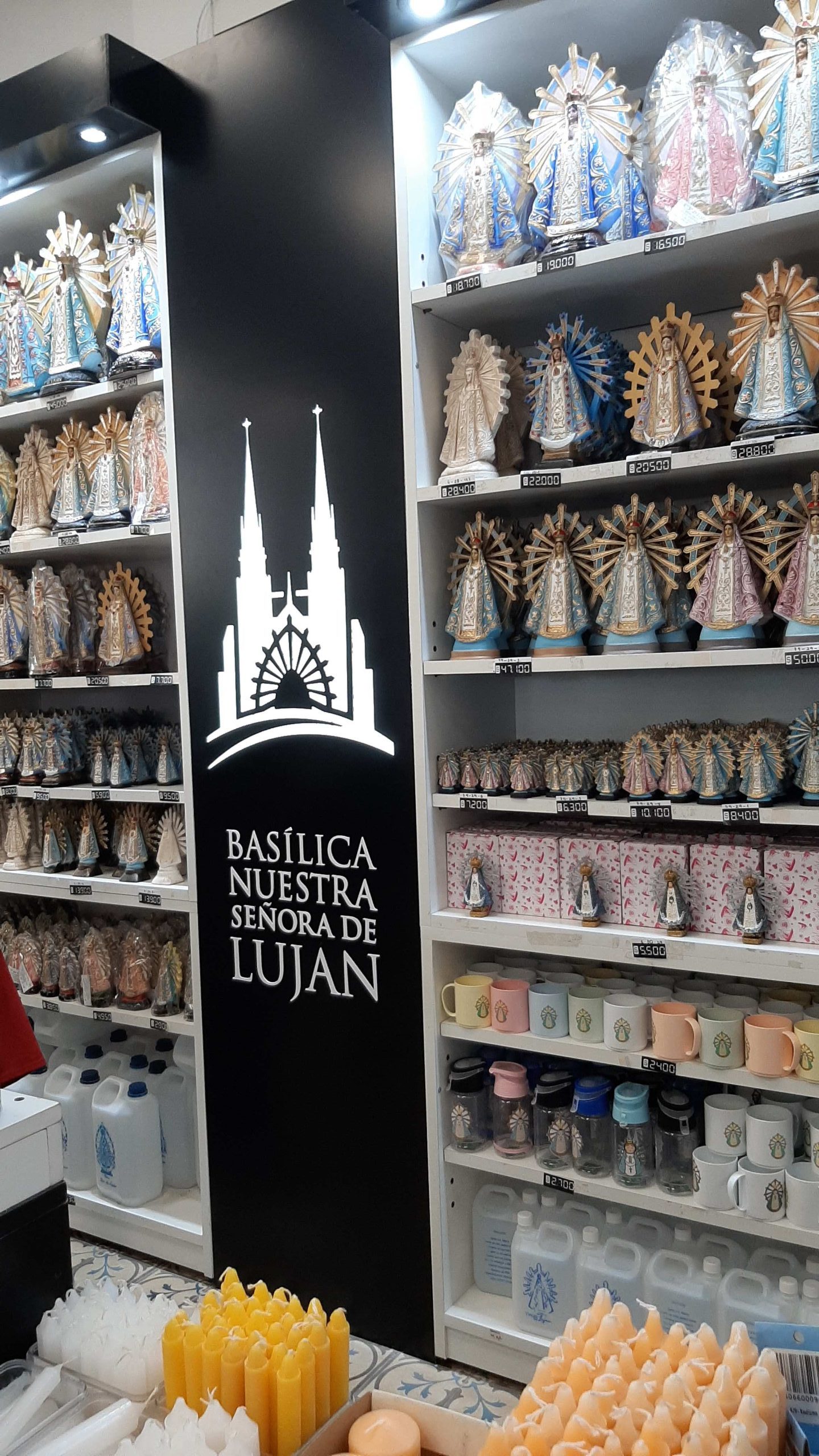
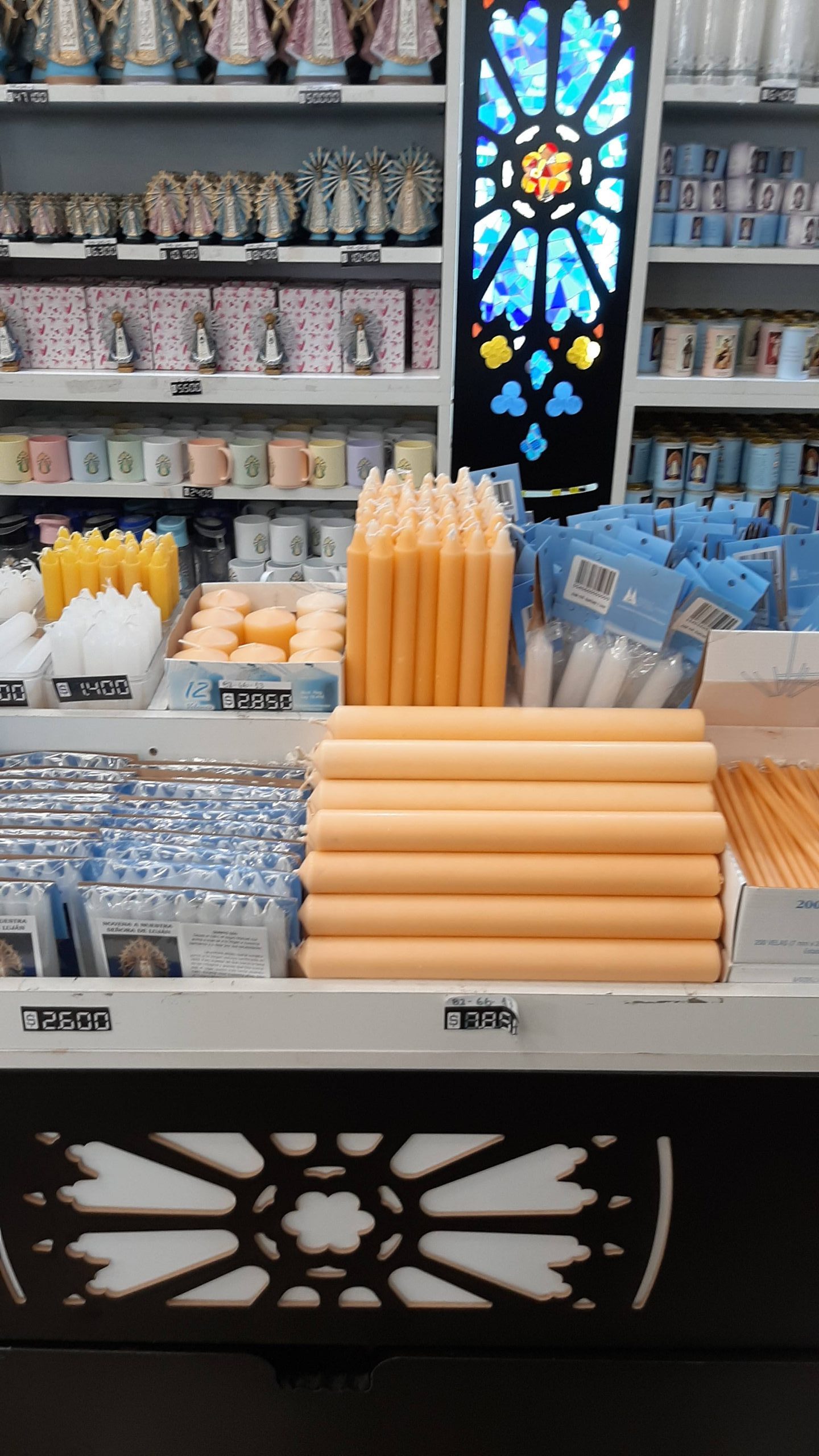
However, I want to emphasize that the presence of candles in the shrines and at the vendor carts in Plaza Belgrano across from the basilica is striking; this reflects the popular custom of offering candles as a token of gratitude to the Virgin, without lighting them—as stipulated by the sanctuary authorities—but also to take them home for private religious ceremonies. Candles are cultural objects rich in meaning, rooted in very ancient traditions of Catholic, Jewish, and also ancestral Indigenous American practices.
Lighting candles is a gesture steeped in symbolic significance when expressing gratitude, but above all, when asking for help for oneself or for the souls of the deceased: that is why people buy them and take them home. Often, the promise is fulfilled by presenting the candle as a complete offering (ex-voto) without lighting it, although at other times the promise is made through prayer in front of a candle, which requires lighting it (on the steps or at home). This practice, which I observed during my visit on June 9, 2024, aligns with the accounts provided by the women I interviewed on this topic.
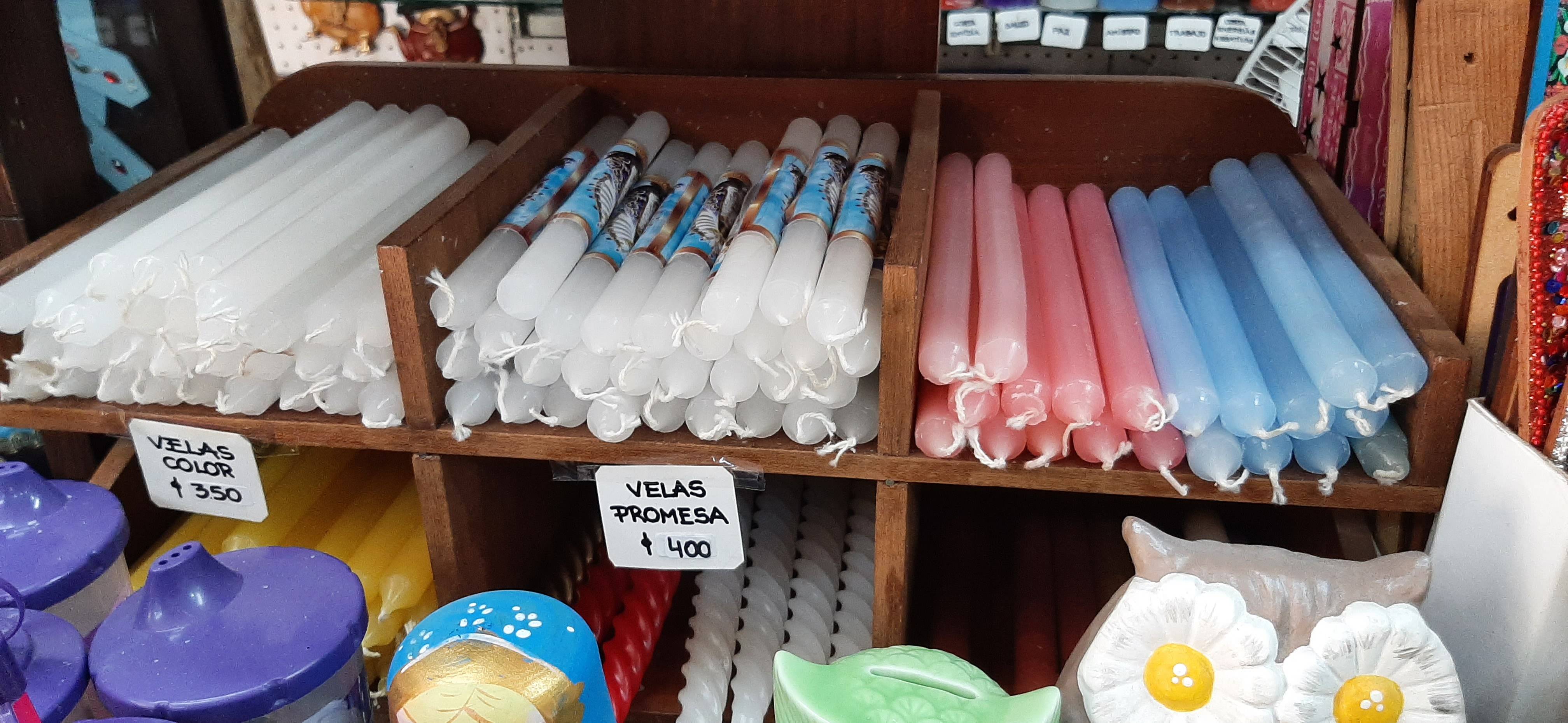
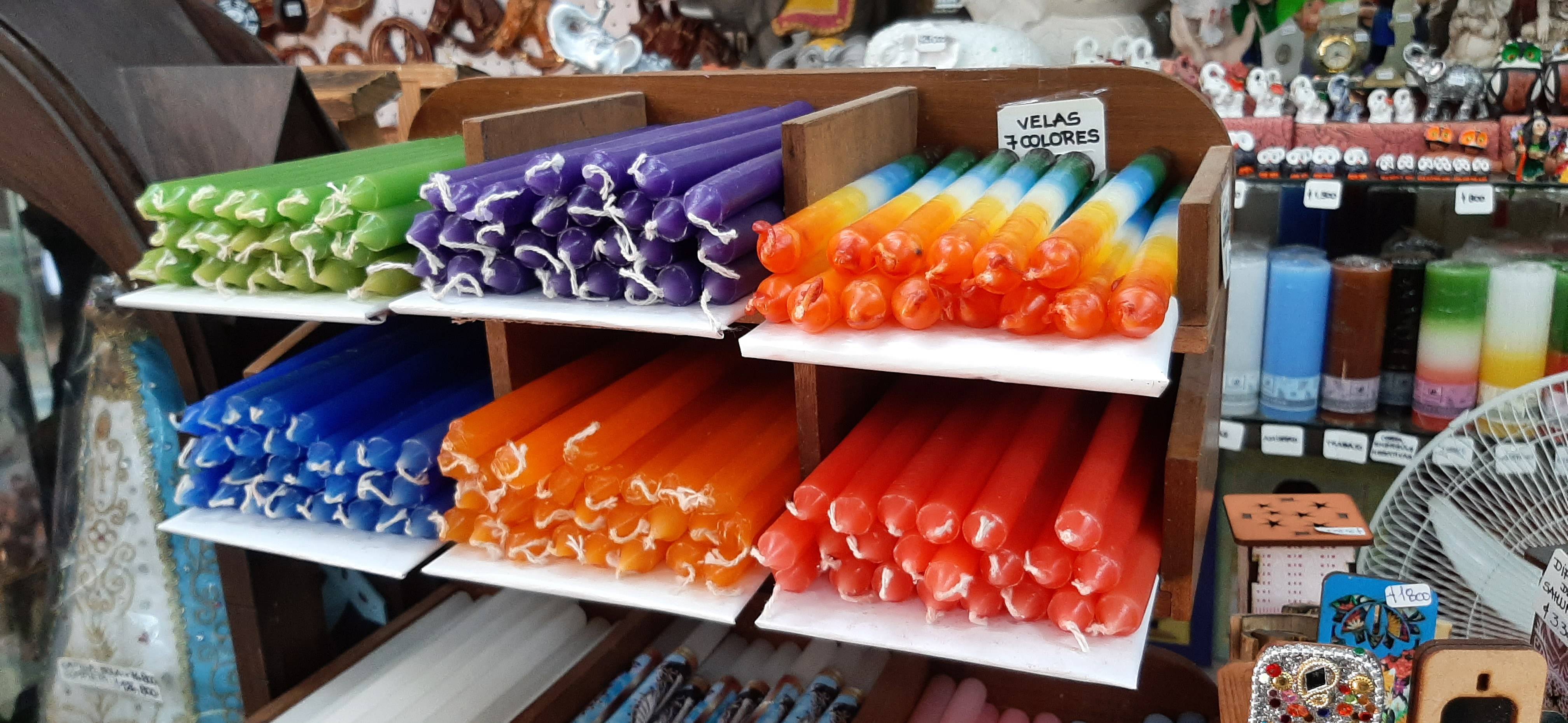
One aspect related to candles that my interviewees did not mention, but which I observed during my survey of stalls and shrines while accompanied by Jula, is the presence—albeit in smaller quantities—of colorful candles. These candles appear mainly in some older religious shops scattered around the basilica, rather than at the small stalls or mobile carts in the plaza, where they are also found, though in small numbers. They are multicolored candles, likely associated with magical practices (for the ritual of the Seven Powers, to open paths, etc.). Back when I made candles, I don’t recall multicolored candles being common. I understand that angelic worship and its rituals have gained followers in recent years, but I think they could also be used for other rituals.
The modernity From Luján. A shrine dedicated to the deity, but devoid of votive offerings
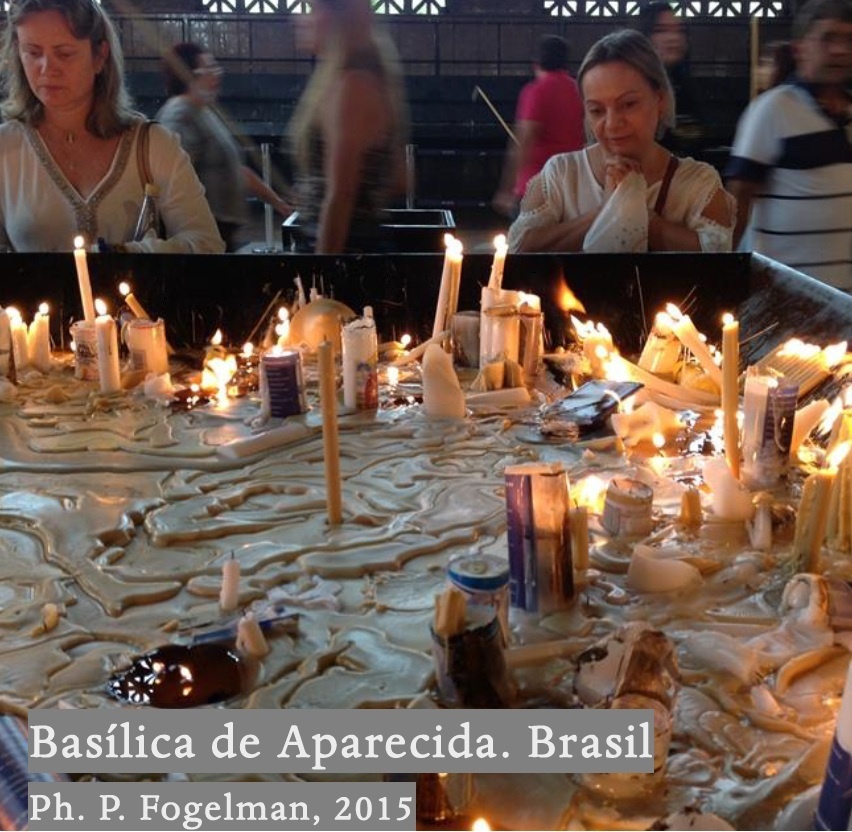
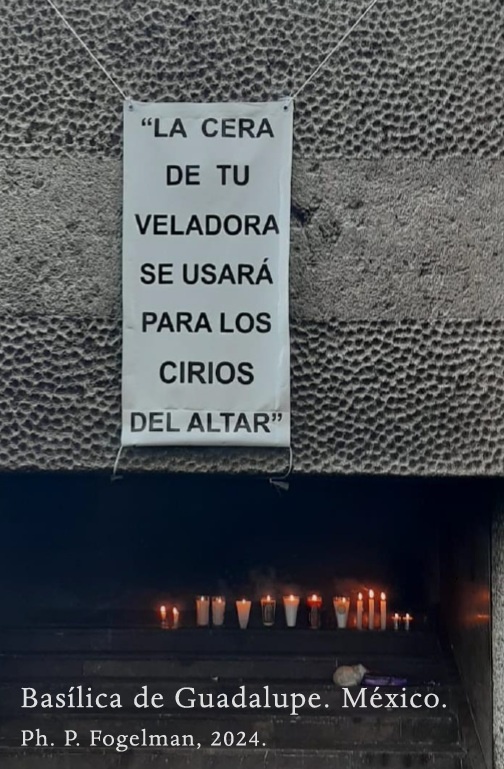
In the section discussed above, I noted—referring to work I had previously conducted and that has been published—that I interpret the sanctuary as having been erected as a counterweight to the liberal state, being part of the revival of the Neo-Gothic movement against the secularizing modernity of Salvaire’s era (Fogelman, 2013; 2018). Now I would like to turn my attention to another aspect, which is not contradictory, but which seems to be a torsion. I think that, over time, Luján has taken on a character quite different from the other two major Marian basilicas I have used as points of reference: Our Lady of Guadalupe,4 located north of Mexico City, in the Gustavo A. Madero borough, visited in January 2024; and Our Lady of Aparecida,5 located in the city of Aparecida, in the Paraíba River Valley, in the eastern part of the state of São Paulo (Brazil), which I visited in September 2015. What I mean is that, in both cases, the votive offerings representing the body are highly visible, prominent, and central to the construction of the narrative of the Virgin’s miraculous power. The sale and offering of wax votive offerings that mimic parts of the body—both diseased and miraculously healed—in the Basilica of Aparecida, and the stories depicted in the Guadalupe collection of “milagritos” (an entire Mexican votive genre) in which lives are saved, people are rescued, and illnesses are cured—that is, in which the body is central—have no parallel in Luján. In Luján, I see nothing that brings the body represented of the faithful to the scene. These are the figures of Christ, Mary, the female saints, the male saints, and the witnesses to the founding miracle (especially the enslaved Black man named Manuel, the Virgin’s first sacristan), who, through statues, take on a tangible presence in the space. I asked many vendors at the mobile stalls in the plaza and at the Udaondo Museum in Luján about the sale of wax or metal votive offerings: regarding the latter, they told me that they are no longer used, that they are expensive, and that the priests at the basilica would not like them—much less accept the wax ones. They said the wax ones are ugly and “ordinary” (in Argentina, this means “of poor quality” or “crude”), and that the priests would not allow items that “look out of place” in the church.
This aesthetic sensibility, which stands in contrast to the trends at the other two national shrines, has long led me to reflect on the different forms of religiosity, the impact of modernity, and the various manifestations of secularization. At the Aparecida shrine, the Sala das Promessas is a vast symphony of material elements where we can almost hear the stories of the Virgin’s miracles—miracles involving the body, as well as success in personal endeavors, professional and romantic achievements, but above all, health.
I have explored these issues in a book chapter in which I compared the exhibitions in Aparecida and Luján (Fogelman, 2024a). In that text, drawing on some central concepts for thinking about exhibition spaces (Bennett, 2005; Duncan, 2007; icom, 2022), I have noted how the Sala das Promessas in Aparecida—with its numerous, brightly lit display cases containing objects organized by theme—reminds me of a hybrid between a museum and a shopping mall, albeit with a religious theme. The exhibition (whose collection is largely temporary) is housed in a modern building with functional architecture, surrounded by shops selling votive offerings, where candles and wax representations of body parts are abundant. In that text, I referred to this hall and its exhibition as a cultural device (Fogelman, 2024a).
We see something similar in Guadalupe—in its visual narratives, in the objects people carry, and in the collection on display. Furthermore, both Guadalupe and Aparecida have designated areas for lighting candles of supplication or thanksgiving. And those candles melt, are melted down, and are reused to bring the faithful and their religious experiences closer to the altar of Jesus“ sacrifice, especially in the form of Paschal candles. Thus, the candles (which represent body and spirit) can return. A similar process applies to the effigies of body parts that are offered as gifts. If the pieces are made of wax, they can be melted down and reappear. In this way, the fantasy of physical return or the persistence of the spirit after ”going out” is metaphorically evoked.
In Luján, however, this does not happen explicitly. It struck me that every time I asked my interviewees about the use of candles in the bnl, none of them had noticed anything strange about the fact that there was no specific place to light candles. None of them—who have visited the shrine (two of them even made a pilgrimage there)—bring candles; some have bought them to take home.
One of the women I interviewed, Natalia Calvo, told me that she assumed the priests did the same thing as at other shrines: “With the melted candles […] they make new candles.” Another interviewee, Celia Burgos, thinks they throw away the remains of the melted candles and that most of the candles people buy are to have them blessed and then take them home. It strikes me that they do not find it excessive that so many candles are offered when none of them will be lit anywhere in the basilica.
Holy cards in the wallet and other objects for protection and remembrance

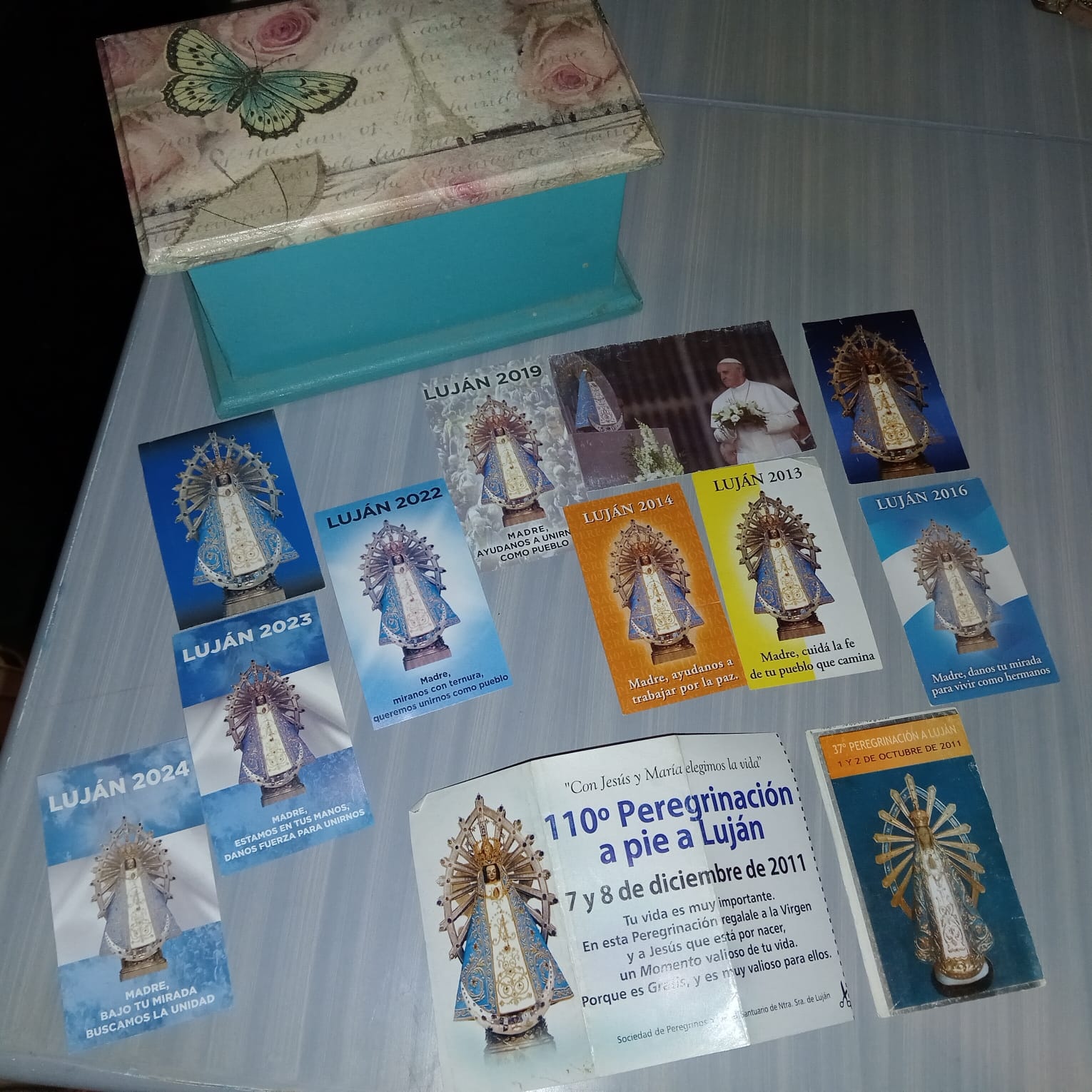
The four women interviewed emphasized the sale of items intended to be “souvenirs,”, souvenirs from their visit to Luján and small gifts for their loved ones. These items—key chains, rosaries, small medallions of the Virgin, holy cards, and small bottles of water—often serve as amulets, offering protection due to their connection to the image of Luján and her shrine. Hypothetically, the key chains protect the home and the car; the holy cards are usually carried in wallets (in this regard, I’ve included an audio-visual clip from my interview with Silvana Lemes, who, in addition to telling me about her experience on a pilgrimage to Luján, provided me with photos of her wallet and her collection of holy cards). Silvana Lemes explains—among other experiences—why she carries them, how and where she got them, and also shares her experience making a pilgrimage to Luján.
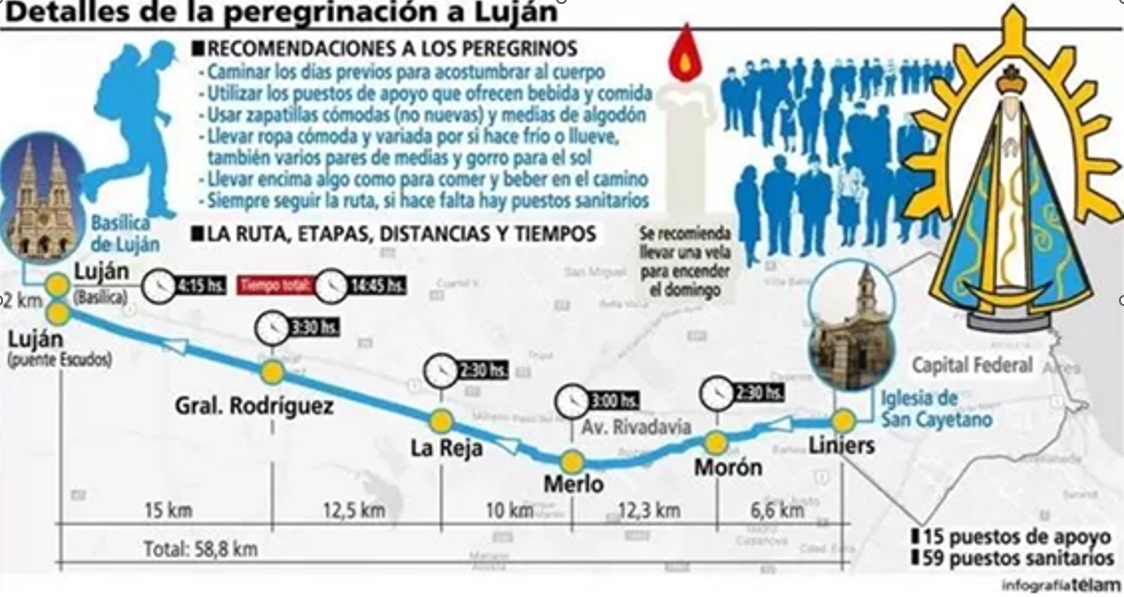
The women I interviewed are Catholic, but they hold differing views on the use of objects and votive traditions. One of them, despite her Catholic affiliation, was very reluctant to embrace forms of popular Marian devotion. However, in the other three interviews, I could sense their empathy and connection to the figure of Luján and how their beliefs are intertwined with childhood experiences and family ties woven into their way of expressing gratitude. The story of the Virgin takes them back to their childhood—to teachers, mothers, and grandmothers—and the long pilgrimage represents a communal form of participation in the ritual. None of them carried flowers; however, their friends and students did. Now adults, they walk with friends or coworkers. All four are teachers.
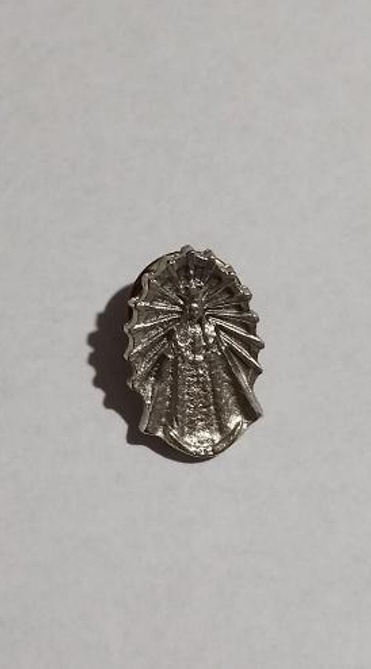
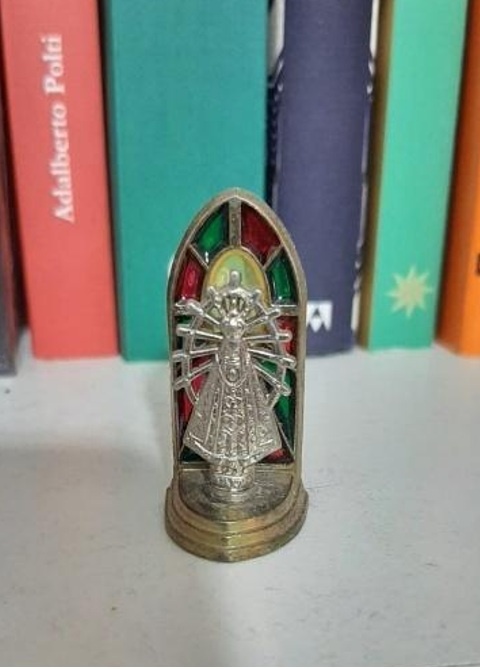
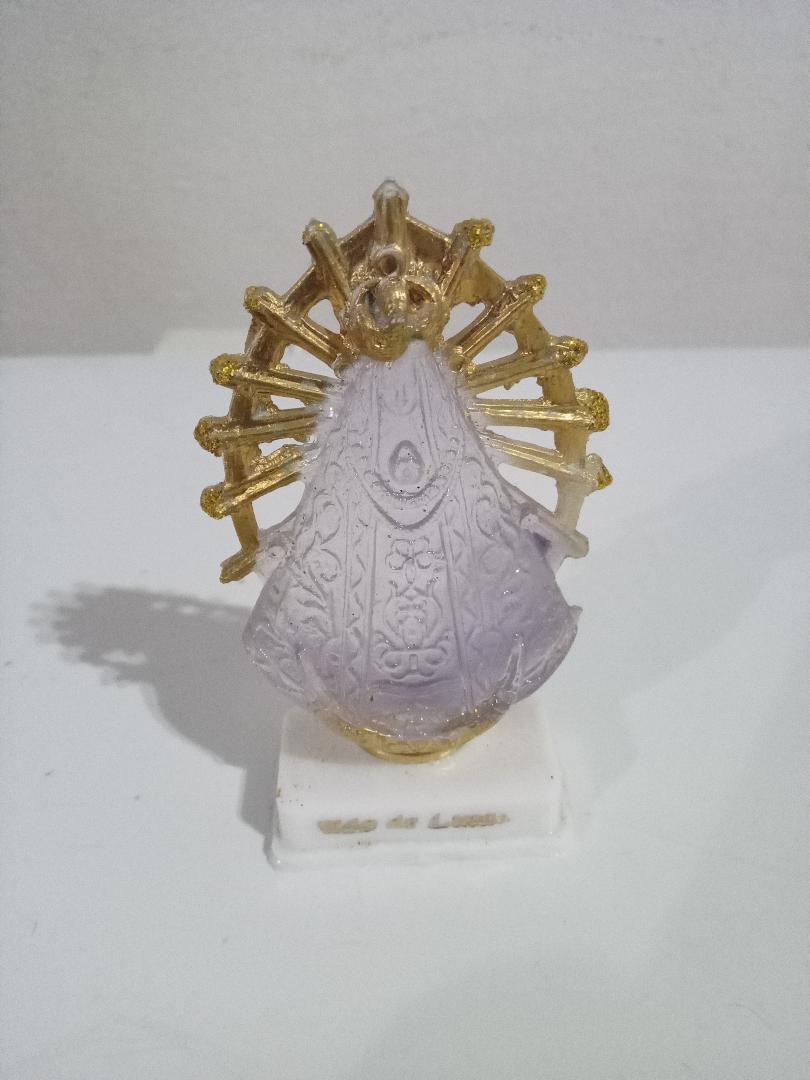
At the stalls and shrines, small statues of María de Luján stand out. Three of the women I interviewed shared photos of “little Virgin statues” with me: Natalia Calvo wears a pin featuring Our Lady of Luján on the lapel of her suit jacket, somewhat like a coat of arms, and has a statuette of Our Lady of Luján in her collection of nativity scenes; Claudia Touris, a professor at the National University of Luján—who is Catholic but not particularly devoted to Our Lady of Luján—gives a small image of Our Lady of Luján a prominent place on her bookshelf; and Celia Burgos emphasizes the practical aspect of her appreciation for her “Little Virgin of the Weather,” made of plastic and coated with a dye that changes color depending on the humidity in the air. Before heading out, Celia checks the image to see whether or not she should bring an umbrella.
Bringing the Body to the Virgin. Pilgrimages and Representations of the Body
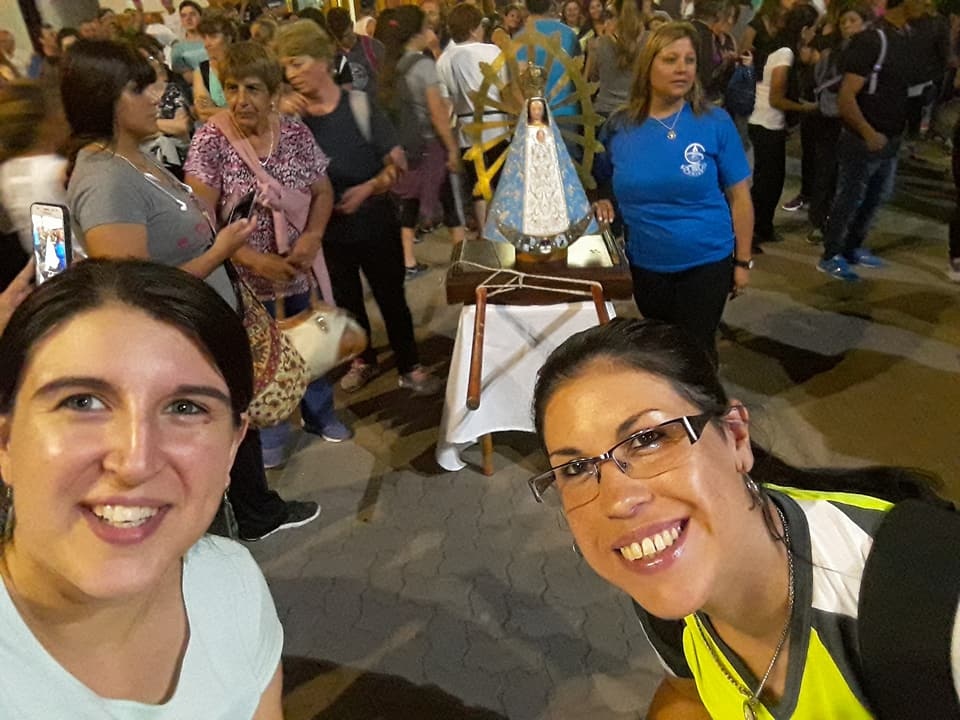
As can be seen in the audio and video clips I’ve attached, Silvana Lemes and Celia Burgos have a tradition of praying to the Virgin and fulfilling their promises by “walking the pilgrimage” to her shrine. Silvana Lemes used to go every year with her mother, asking the Virgin that her grandmother not lose her sight completely. When her mother passed away, Silvana—angry at the world and at religion—stopped going to Luján for a year. As her grandmother’s eyesight deteriorated, she resumed the pilgrimage, reviving her late mother’s tradition. It is interesting how a physical sacrifice (the walk is long) serves, in the pilgrims’ view, to protect the health of a loved one who is often a member of the family. In this regard, Silvana recounted in her testimony that her mother had given her and her sisters small medals of the Virgin Mary, and that this symbolized a kind of bond between the four of them. Their mother’s death and the loss of one of the little medals some time later would lead them to try to fill those voids by resuming the pilgrimage for their grandmother’s health and searching the plaza for another replacement medal. Silvana also resumed her pilgrimages to give thanks for her son Max, who was born with serious health problems and spent months in the hospital. She continues to walk to Luján with her friends.
I find this idea of “bringing one’s body to the Virgin” very interesting: a traditional practice dating back to ancient times that remains alive in Luján, even as the offering of effigies of the body is gradually disappearing. It involves carrying it on a long walk that doesn’t necessarily mean entering the shrine at the end of the procession or going to the basilica by public or private transportation, but rather going to “visit” the Virgin.
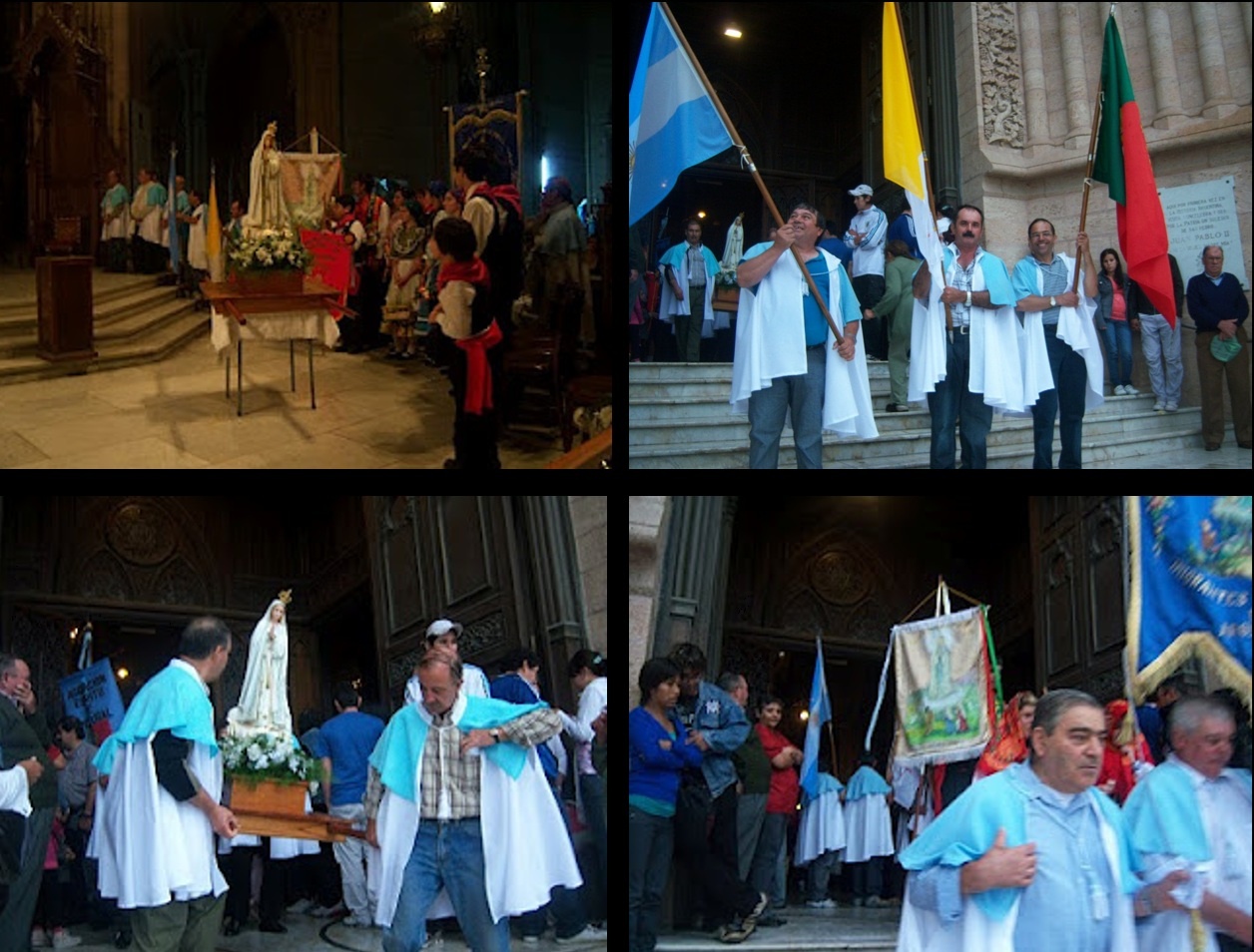
In 1981, I myself walked from the town of Moreno to Luján (about 30 kilometers), but I did so for non-religious reasons: I was in the middle of high school and simply tagged along with some friends from school who wanted to take part in that year’s Youth Pilgrimage, which took place at night. There were two girls (Graciela and me) and two boys (Fabián and Álvaro). I remember it was very cold. It was probably the month of May. We stopped along the way to have coffee or rest; some people carried bags with food or drinks, and many sang or prayed. I remember some people carrying large boomboxes on their shoulders (a hallmark of the lower social class in the 1980s) and playing their music very loudly. People of all ages, from different social groups, but I’d venture to say that—as far as I can recall—we were mainly from the middle class, lower-middle class, and lower class. The walk took more than five (maybe six) hours, and for the last few kilometers we had to walk in the rain. When we arrived at the basilica, my feet were sore: the blisters that had formed during the walk had even burst. There were a lot of people there despite the bad weather. Only the two men in our group went inside the basilica. My friend and I stayed outside to rest, sitting on the steps, a little surprised by our companions’ devotion. But I had been even more amazed by the way other people prayed along the way, in the rain, and how some crawled on their knees up sections of the steps. I don’t remember buying anything, but I do remember that we had breakfast at a café at the terminal station. It was still raining, and we took the bus back home. I never imagined, at that moment, that I would later study history at the National University of Luján, much less that I would conduct research on the cult of the Virgin.
Returning to the politics of religiosity in Luján, I believe that the approaches that were gradually adopted over time draw on the Vatican Council ii Austerity, the eradication of popular forms of devotion because they are seen as bordering on superstition: I understand that this is the case Modernity from a Lujan Perspective. A modernity which removes the depicted body from the scene, except to carry it as an offering on a long walk and to kneel before the image placed high in the niche behind the altar. And this distance from the depicted body—which, on the one hand, blocks the entry of votive offerings—also prevents any possible nudity within the temple.
The alleged miracle of healing allows some churches to display depictions of body parts that could never be shown uncovered, without clothing. Thus, in some churches, cathedrals, and basilicas where votive offerings are permitted, breasts, prostates, and vaginas may be displayed (alongside representations of legs, heads, and arms) (Fogelman, 2024a). The criteria of austerity, neatness, hygienic distance from the body, and superstition ultimately create a stony realm in which only the word and its abstractions are inscribed on the stone as proof of the miracle—without bodies and without photographs.
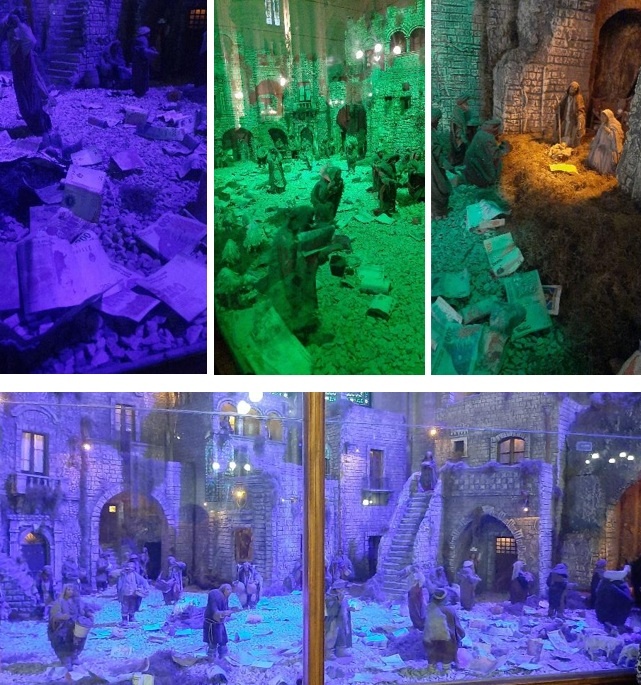
Is it possible to imagine that a certain kind of modernity—colder, more hygienic, and more impersonal—is taking hold? In the architectural votive offering—a bastion of carved stone dedicated to the Virgin of Luján—the word is sanctified, while the body is stripped of its centrality. There is, however, one feature that has really caught my attention: a large nativity scene, filled with small pieces, displayed in a spacious glass case and bathed in lights that change color. This nativity scene—donated by a school in Luján—has a collection box underneath to receive alms for the basilica, but people tend to toss bills over the glass, resulting in a strange scene (rather cold, for my taste, perhaps a bit eerie), which shifts from blue to green to yellow, and where Joseph, Mary, and the baby Jesus are surrounded by money. The main scene depicts the reception of the Three Wise Men, but in the rest of the display, a series of figures (peasants, shepherds, beggars, soldiers) appear covered in bills.
In the attached video, filmed during my visit in 2024, you can see these scenes in detail, hear—in the background—singing and music during a ceremony at the main altar, and watch as adults bring their children to see the nativity scene and leave alms. Without a doubt, it is a way of expressing religious devotion among other things. An old concept in a new format, where belief, superstition, and spectacle—intertwined with child’s play and the pursuit of money—interact.
Bringing flowers or candles is still customary, though less common; on the other hand, since the candles aren’t lit, few of them break. They can be brought in through one door and taken out, intact, through the other. Wear and tear will cause them to break and eventually melt or be discarded, but this is not a policy explicitly linked to the discourse on transcendence as stated by the basilica’s priests. These objects are taken directly to rooms outside the church, and we know they circulate among the stalls surrounding the basilica. The policy followed in Luján regarding votive offerings seems to align more closely with the provisions of the Second Vatican Council ii and a concern with containing or limiting “excess” in the realm of popular religiosity, but it also seems to accept the arrival of offerings and their commercial recirculation (Fogelman, 2024a: 265).
For this ritual of bringing body and spirit closer to the prayer, the faithful buy candles bearing the image of the Virgin or other saints in the plaza and take them home or, to a lesser extent, light them on the steps. The body does, indeed, appear at the shrine in Luján through the great sacrificial offering of the walks—the regular pilgrimages organized by the Church. One of these is the traditional Youth Pilgrimage to Luján.
Beyond the visual impact of the stained-glass windows and neo-Gothic arches, which create an atmosphere of revival medieval, right in the middle of the century xxi, the management of popular devotion seems—as I have described earlier—much more restrained or limited than at other national shrines where there is an enormous number of votive offerings (promises and “little miracles”) and where there are specific areas for lighting the candles that have been offered.
About fifteen years ago, I led a group project on religion and regional history, the results of which were published in a book that I edited together with two colleagues from the unlu (Fogelman, Ceva, and Touris, 2013). In that research, we observed the presence of gaucho communities and immigrant groups (Bolivians, Paraguayans, Portuguese, etc.) that bring great vibrancy and color to the plaza and the atrium on their commemorative dates. However, we also noted that the basilica complex incorporated almost no objects into the space during these celebrations, aside from the garments of some of the images in the crypt, which were made by their ethnic or national communities of origin; for example, the mantles of the Virgin of Copacabana and the Virgin of Urkupiña, which were made and donated by their Bolivian devotees who had immigrated to Argentina and their communities.
In Luján, we find a significant votive structure that serves, among other things, as a home for the image of the Virgin and a bastion of religion. It is characterized by its stone structure, which exudes a sense of strength, marked by countless stones bearing the names of individuals or families who have expressed their gratitude to the Virgin.
In the interview conducted at the donation desk (June 2024), the staff members working there (official sanctuary guides) explained to me that, since its creation, the basilica had featured perforated bricks in its walls where people could place small rolled-up pieces of paper bearing a name and a note of thanks for a favor granted; the donors’ names were then carved into the stone above them. I don’t know if all the carved stones we see—bearing the names of individuals or families, whether clearly defined or worn down by time—contain those little pieces of paper or capsules inside.
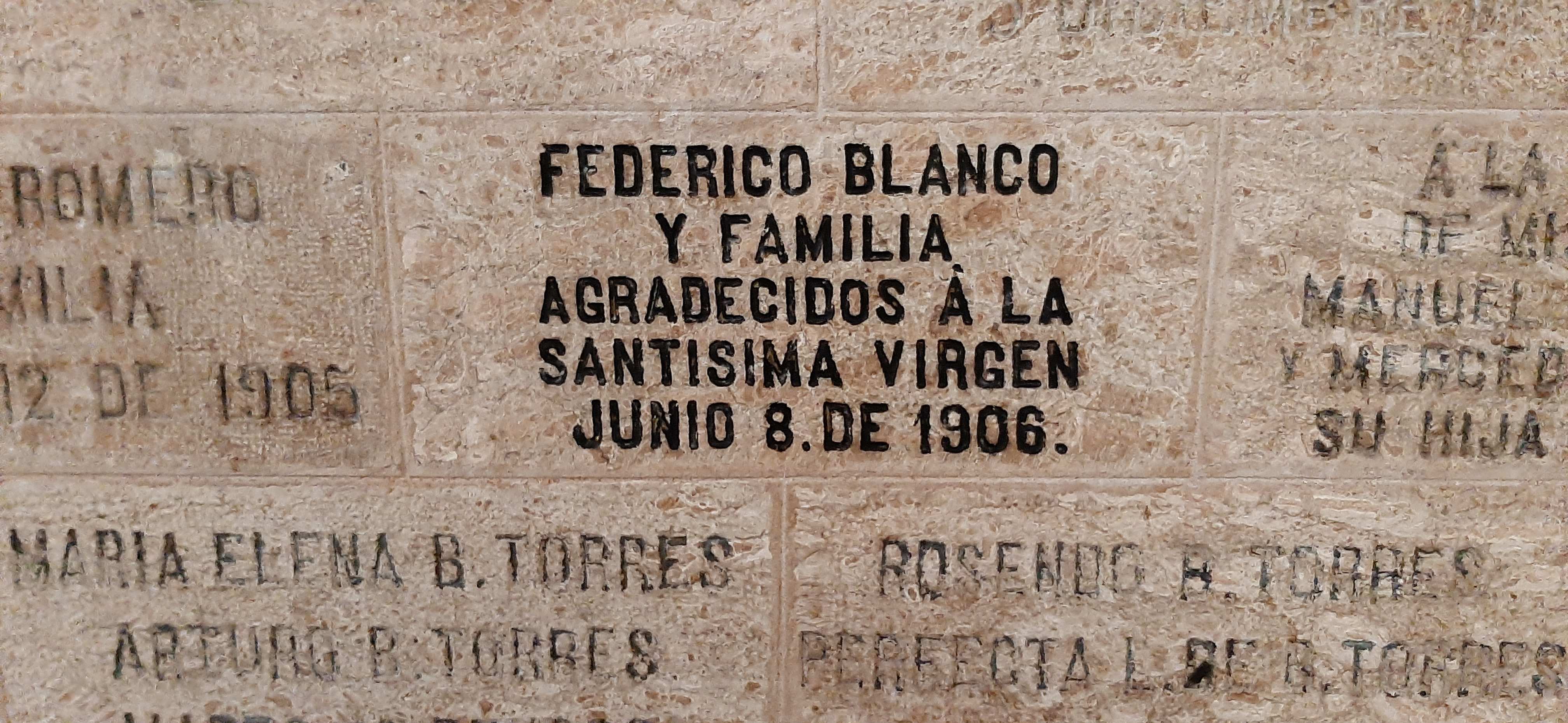
Nevertheless, I understand that the practice of carving the names of donors and votive offerings into the walls, columns, and staircases—a practice already envisioned by Salvaire—indicates a mechanism designed to immortalize the granted miracle in stone in a sober manner that is, at the same time, profitable for the church: not everyone was able—or would be able—to pay the contribution necessary to fulfill that promise and have their name carved forever into the walls of the basilica. In his 1885 design, Salvaire envisioned a votive system marked by words carved in stone, reserving the walls, columns, and staircases for this form of written expression of gratitude. Each name inscribed in gratitude on the stone instills in visitors a deep trust in the power of the Virgin Mary. I have attached a video clip showing images of the carved stones on the walls of the basilica.
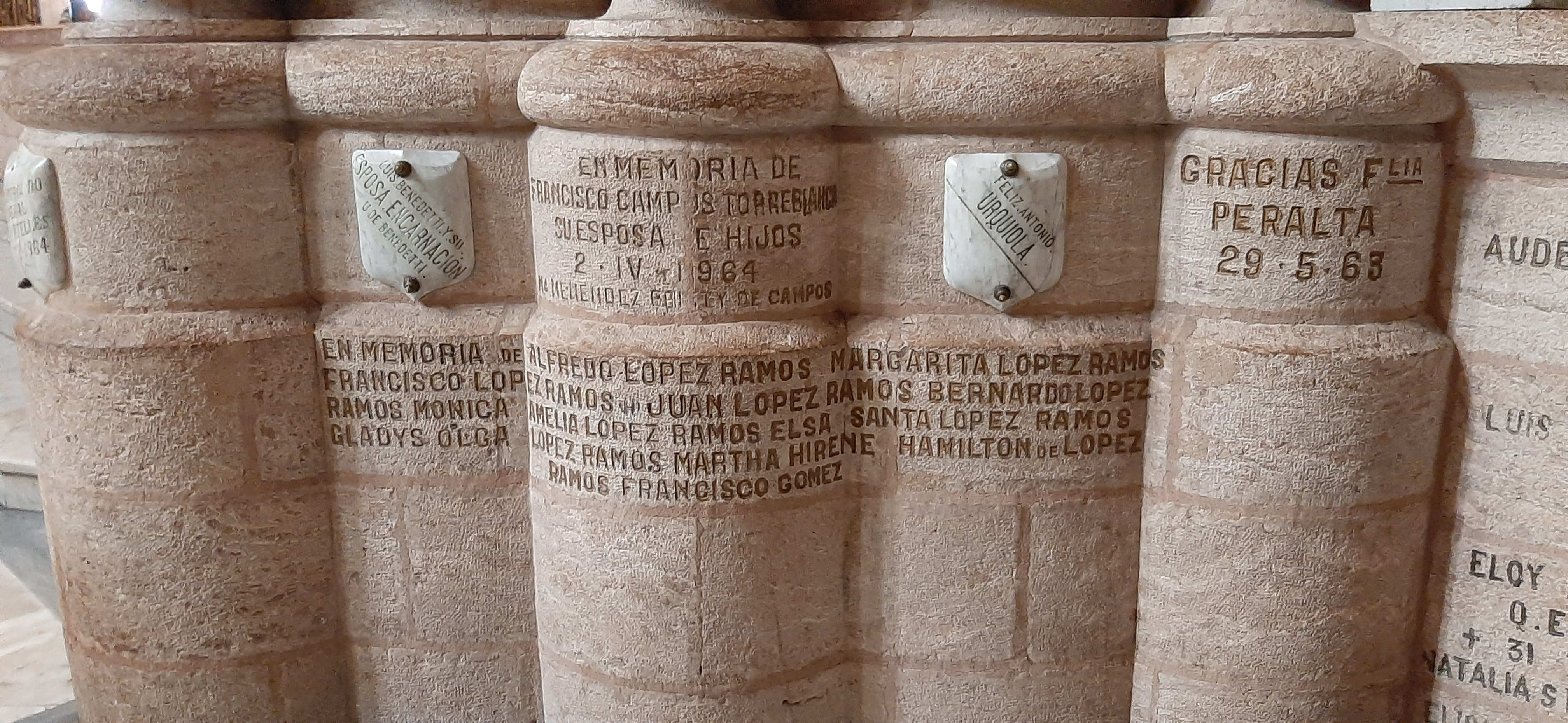
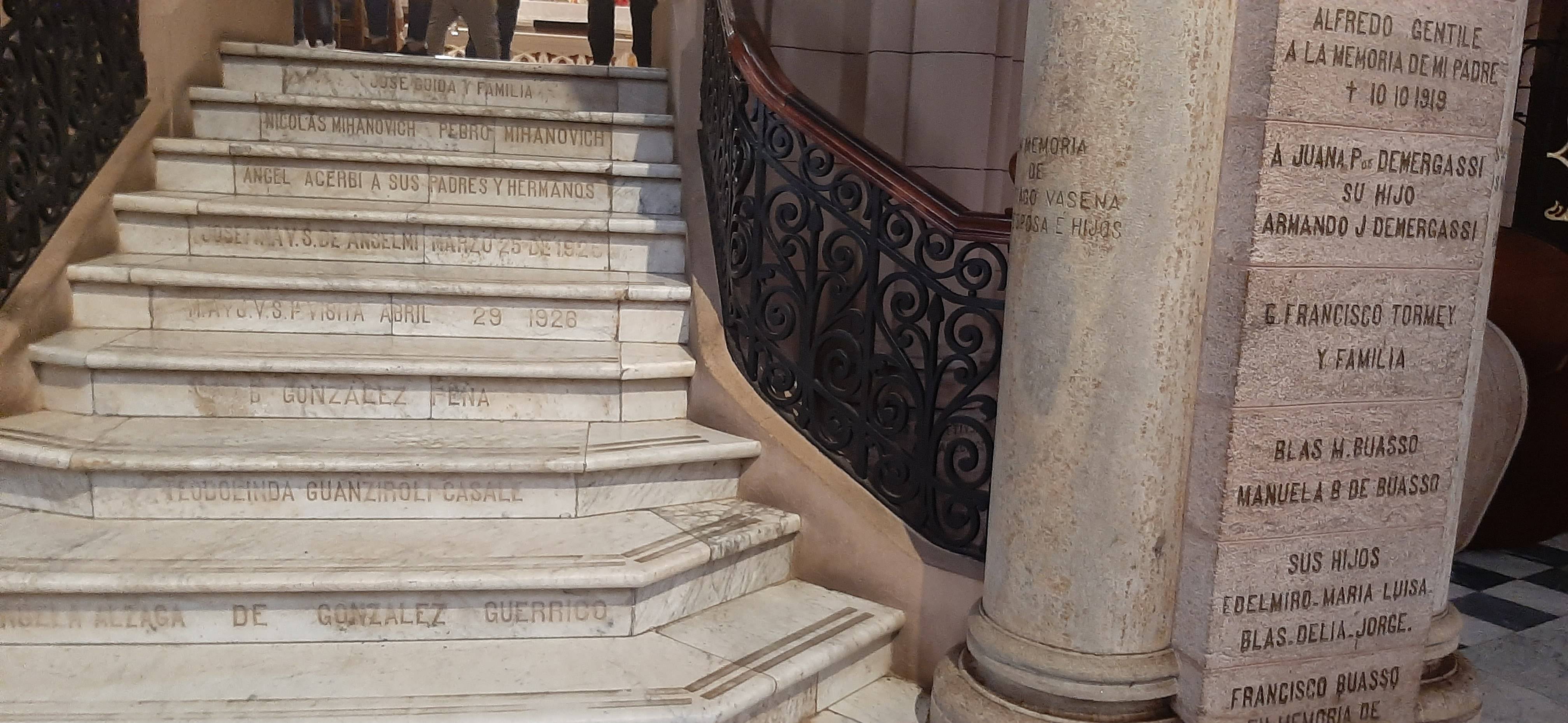
The temple, as a device inscribed in this way, impresses its visitors and establishes hierarchies and figures of prominence: the names carved in stone belong to prominent local and regional families, nationally renowned businesspeople (the Mihanovichs, for example, shipping magnates), Catholic politicians, and so on. Such expressions of gratitude reinforce the effect of the structure, much as a collection of votive offerings would, evoking surprise and emotion in visitors: the sheer magnitude of its presence speaks to the great efficacy of the miraculous image. This temple, which is a sanctuary, also serves as a refuge and a bastion because its solid and prominent presence on the Pampas plain projects itself into the landscape as a temple-fortress representing the Church within the sociocultural landscape of Buenos Aires. As the most important house of the Virgin in Argentina, the basilica—a refuge for the faithful and a bastion of the Church—transcends the national level, amplifying the power of its Marian image and legitimizing the Church that channels that power.
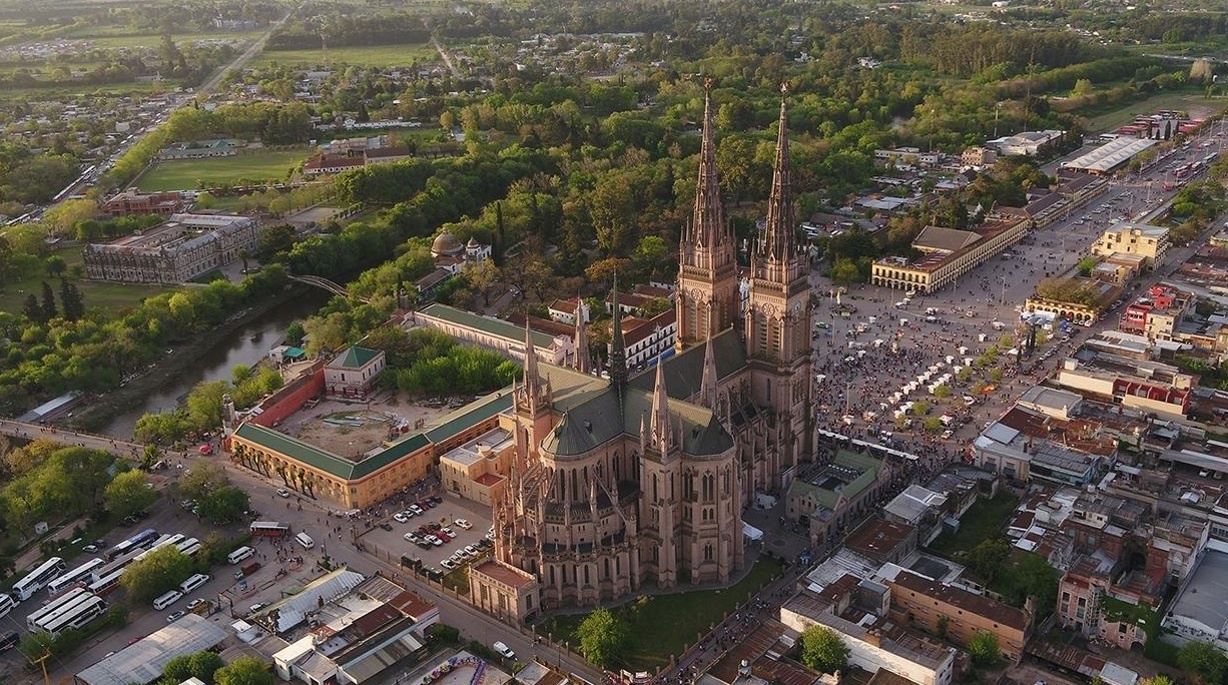
In turn, at least since 1944, the image of the Virgin of Luján—with her golden halo, crown, and sky-blue and white triangular mantle (the national colors)—became widely known through her designation as the patron saint of Argentina’s highways and, even more so, in 1948, when she was declared the patron saint of the Argentine Railroads. It is still possible to see enthroned images of the Virgin of Luján in train stations and on the Buenos Aires subway. The small image from Luján has become a symbol of national significance, and it is housed in a building that casts its shadow—or its power—like a landmark within the country itself.
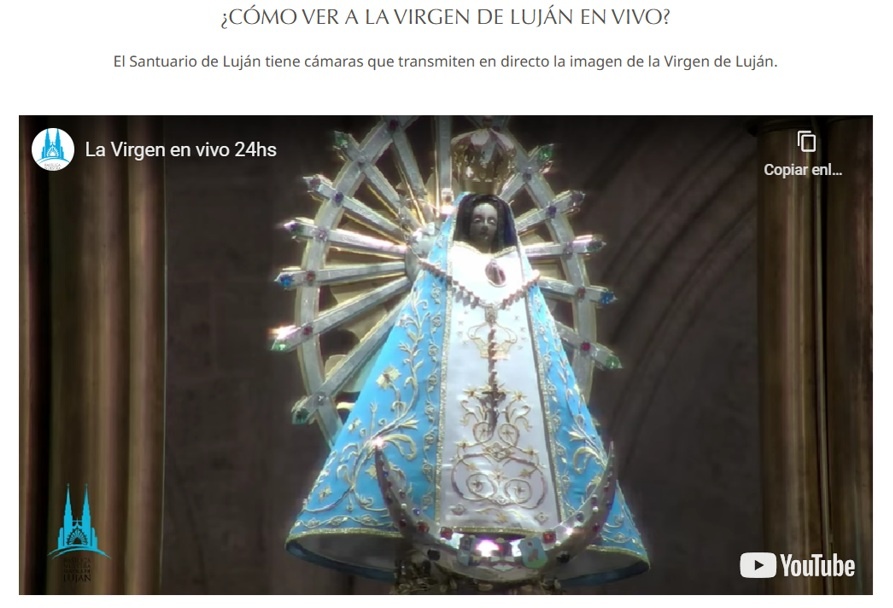
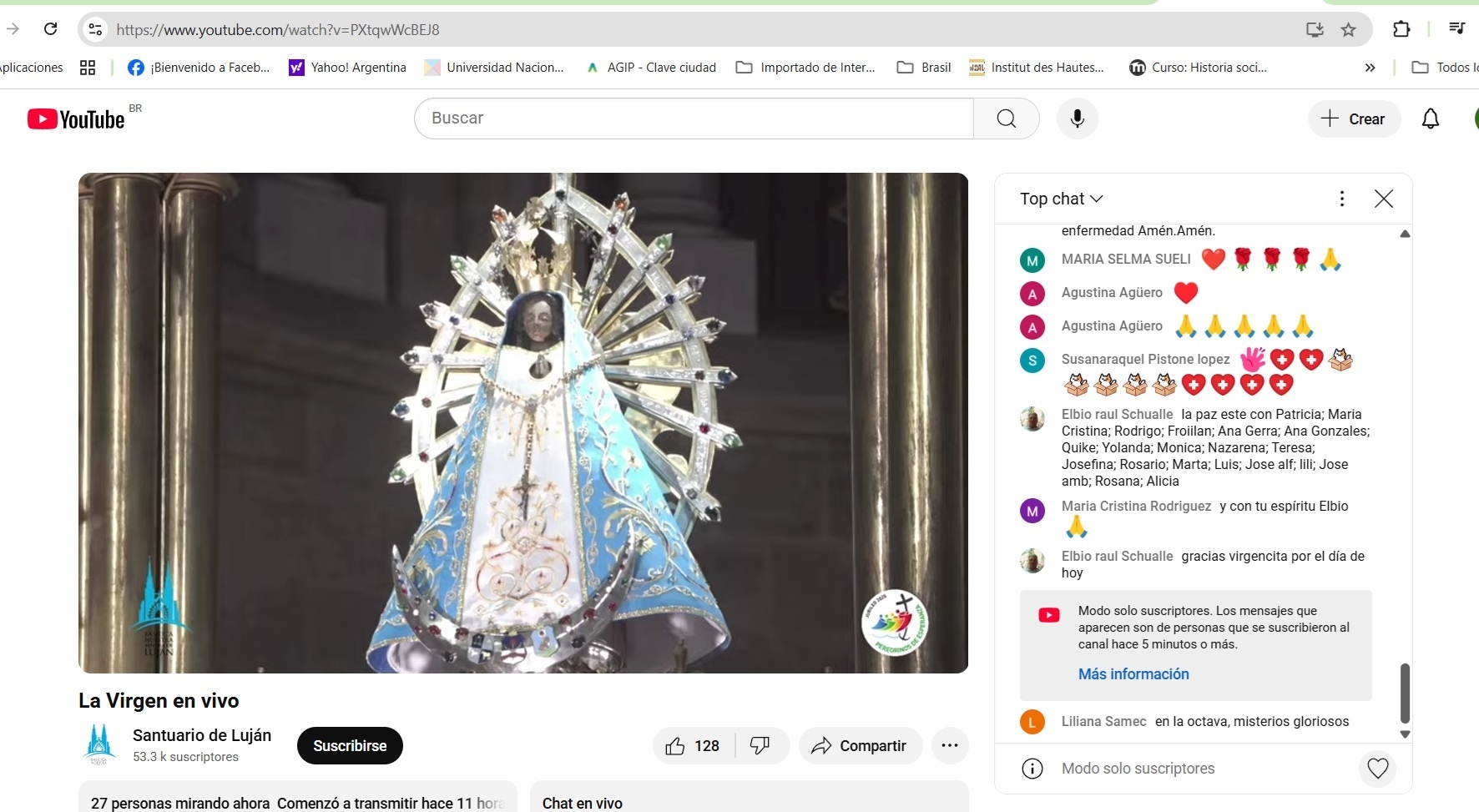
You can view the Mass schedule on the website. A religious-themed music video is shown, featuring people in the church, as well as excellent shots of the sanctuary and the original image of Our Lady of Luján.
Final thoughts
At the shrine of the Virgin of Luján, votive offerings other than candles gradually disappeared over time, and this trend accelerated during the second half of the century xx. I would argue that Luján is undergoing a very unique process of secularization. Religious beliefs and practices remain very much alive in the area, but the administration, management, and ties to the political scene, in general, point to a context of major changes. In Luján, with the phasing out of the display of votive offerings and the absence of new images inside the basilica (except in the crypt), the practice appears to conform to the post-conciliar desire for “decency and modesty” in worship, while incorporating modern elements into their spatial organization and the management of offerings (Fogelman, 2018).
In this Marian tradition, politics has always been closely linked to the legitimacy of worship, whether through alliances between the two spheres or through competition between them (Fogelman, 2010; and Touris, 2013). Devotion grew intensely amid these tensions between religion and politics. In these spaces of tension (along with the transformations taking place within the shrines themselves), the cards of a certain secularization are being played; yet I observe that this process is ambiguous because in the Basilica of Luján—with its lack of offerings and objects of popular piety— one walks and breathes “within” a votive offering filled with stones carved with words of thanks, where the ancient votive practice survives oblivion; even as its former centrality has shifted, it persists before the eyes of visitors.
In the ways in which offerings exist, endure, are displayed, and are even relatively overlooked (ergo, in an effort to give tangible form to the efficacy of supposed miracles, but without doing so in a way that encroaches on the space and detracts from the centrality of the stone sanctuary), the sanctuary complex and the shops surrounding the basilica function, as a whole, as a religious-cultural mechanism embedded in a process of secularization, yet driven by the ebbs and flows of the disenchantment and re-enchantment of the world (Weber, 2014 [1922]; Maffessoli, 2002; Schluchter, 2017; Fogelman, 2024b).
Beyond these historical considerations, I believe that my curiosity to understand the rationales and emotions intertwined in the practices of Marian devotion, to learn about and comprehend representations of the Virgin, and to explore how social power relations are woven around the meaning or symbolism of the image, may have arisen from that initial contact with the material aspects of worship, in which candle-making played a part. It may be that this anecdotal personal experience is inseparable from my professional interest: an interest, a curiosity that has existed for many years now and that leads me, as a cultural historian, to review documentary material, devise new approaches to sources, and take the liberty of delving into my own memories alongside the testimonies of my interviewees.
Throughout this article, I was able to explore—even in a playful way—the intersection between history and autobiography. I feel that I have navigated it from start to finish with sincerity and even a certain fondness, thanks to a subject (the focus of my study) that allows me to move from archives to temples; from memory and voice to photographs and, finally, to certain material objects, as I attempt to trace the nonlinear path of the cultural history of religion.
Bibliography
Agamben, Giorgio (2011). “¿Qué es un dispositivo?”, Sociológica, vol. 26, núm. 73, mayo-agosto, pp. 249-264.
Bennett, Tony (2005). “The Exhibitionary Complex”, en Reesa Greenberg, Bruce Ferguson y Sandy Nairne (eds.). Thinking About Exhibitions. Londres: Routledge, pp. 58-80.
Burucúa, José e Isaura Molina (2001). “Religión, arte y civilización europea en América del Sur (1779-1920). El caso del Río de la Plata”, separata, núm. 2, p. 5.
Carballo, Cristina Teresa (2008). “El camino del peregrino: hacia una reconstrucción territorial de las creencias religiosas (Argentina): el caso de la peregrinación gaucha a la ciudad de Luján”. Tesis doctoral digitalizada. Le Mans: Université de Le Mans.
Ceva, Mariela (2013). “Las peregrinaciones extranjeras a Luján hacia el Centenario”, en Patricia Fogelman, Mariela Ceva y Claudia Touris (eds.). El culto mariano en Luján y San Nicolás. Religiosidad e historia regional. Buenos Aires: Biblos, pp. 51-66.
Deleuze, Gilles (1990). “¿Qué es un dispositivo?”, en Etienne Balbier et al. Michel Foucault, filósofo. Barcelona: Gedisa, pp. 155-165.
Didi-Huberman, Georges (2016). Exvoto: imagen, órgano, tiempo. Barcelona: Sans Soleil.
Duncan, Carol (2007). Rituales de civilización. Murcia: Nausicaä.
Fabre, Pierre-Antoine, Caroline Perrée y Renée de la Torre (2021). “De la confection à l’exposition: quand l’exvoto fait système. Desde la confección hasta la exhibición: cuando el exvoto se establece como sistema”, en Caroline Perrée. L’exvoto ou les métamorphoses du don. El exvoto o las metamorfosis del don. Ciudad de México: Centro de Estudios Mexicanos y Centroamericanos/Centro Nacional de la Investigación Científica, pp. 7-49.
Flores, Fabián (2012). “Luján como hierópolis: del relato espacial al lugar religioso”, Revista Universitaria de Geografía. Bahía Blanca: Universidad Nacional del Sur, núm. 21, pp. 137-158.
— (2025). “Patrimonios disonantes en el centro histórico basilical de Luján”. Anuario de la División Geografía. Luján: unlu Ediciones, pp. 1-19.
Fogelman, Patricia (2003). “Reconsideraciones sobre los orígenes del culto a la Virgen de Luján”, Entrepasados. Revista de Historia. Buenos Aires, núm. 23, pp. 123-148.
— (2006). “Simulacros de la Virgen y refracciones del culto mariano en el Río de la Plata colonial”. Eadem Utraque Europa. Revista de Historia Cultural e Intelectual, Buenos Aires, año 2, núm. 3, pp. 11-34.
— (2010). “La religiosidad y el poder desde la perspectiva de los estudios culturales”, en Patricia Fogelman (comp.). Religiosidad, cultura y poder: temas y problemas de la historiografía reciente. Buenos Aires: Lumiere, pp. 9-18.
— (2013). “Dos exvotos contra el Estado liberal: la Basílica y el libro de Salvaire sobre la historia del culto de Luján”, en Patricia Fogelman, Mariela Ceva y Claudia Touris (eds.). El culto mariano en Luján y San Nicolás. Religiosidad e historia regional. Buenos Aires: Biblos, pp. 25-49.
— (2018). “Exvotos y secularización: libro y santuario de la Virgen de Luján, fines del s. xix”, Revista Brasileira de História das Religiões, Maringá, núm. 31, pp. 167-202.
— (2024a). “Exvotos y dispositivos culturales en los santuarios nacionales de Nuestra Señora de Luján y Nossa Senhora Aparecida”, en Ana Paula Barcelos Ribeiro da Silva, Patricia Fogelman, Rafael Vaz da Motta Brandão y Leda Agnes Simões de Melo. Conexões Brasil-Argentina: Pontes e intercâmbios a partir da História. Río de Janeiro: Ed. Mauad x, pp. 253-278.
— (2024b). “El reencantamiento travesti. Arte y religiosidad en Buenos Aires”, en Carlos Prado, Cleverson Rodrigues da Silva, Fábio da Silva Sousa e Jorge Christian Fernández (orgs.). Nuestra América: pesquisas e trajetórias em história das Américas. Paranavaí: EduFatecie, pp. 225-250.
Foucault, Michel (ed.) (2016). Historia de la sexualidad: la voluntad de saber, t. i. Buenos Aires: Siglo xxi.
International Council of Museums (icom) (2022). Definición de museo. Praga, 24 de agosto. https://icom.museum/es/recursos/normas-y-directrices/definicion-del-museo/.
Lida, Miranda (2010). “¡A Luján! Las comunidades de inmigrantes y el naciente catolicismo de masas, 1910-1934”, Revista de Indias, 70. Madrid: csic, pp. 809-836.
Maffesoli, Michel (2002). “El reencantamiento del mundo”, Sociológica. México, vol. 17, núm. 48, pp. 213-241.
Martín, Eloísa (1997). “La Virgen de Luján: el milagro de una identidad nacional católica”, ponencia presentada en II Jornadas sobre Alternativas Religiosas en Latinoamérica, 27 al 29 de noviembre. Buenos Aires: disponible en naya. https://www.equiponaya.com.ar/congresos/contenido/religion/24.htm
McCann, William (1939 [1847]). Viaje a caballo por las provincias argentinas. Buenos Aires: Ferrari.
Olaechea, Silvina (2013). “Etnicidad y tradición. Peregrinaciones y fiestas de bolivianos y gauchos en Luján”, en Patricia Fogelman, Mariela Ceva y Claudia Touris (eds.). El culto mariano en Luján y San Nicolás. Religiosidad e historia regional. Buenos Aires: Biblos, pp. 99-118.
Real Academia Española. “Baluarte”. Diccionario de la Lengua Española. https://dle.rae.es/baluarte
Romero, José Luis (1986 [1956]). Las ideas políticas en Argentina. Buenos Aires: fce.
Salvaire, Jorge M. (1885) Historia de Nuestra Señora de Luján, su origen, su santuario, su villa, sus milagros y su culto. Por un sacerdote de la congregación de la Misión. Buenos Aires: Imprenta de Pablo E. Coni. Especial para Obras [con grabados de E. Woodwell].
Schluchter, Wolfgang (2017). El desencantamiento del mundo: seis estudios sobre Max Weber. Ciudad de México: fce.
Terán, Oscar (2008). Historia de las ideas en la Argentina. Diez lecciones iniciales, 1810-1980. Buenos Aires: Siglo xxi.
Touris, Claudia (2013). “Catolicismo popular e imaginario liberacionista en los años 70. El caso de las peregrinaciones villeras a Luján y del Movimiento Villero Peronista”, en Patricia Fogelman, Mariela Ceva y Claudia Touris (eds.). El culto mariano en Luján y San Nicolás. Religiosidad e historia regional. Buenos Aires: Biblos, pp. 67-97.
Weber, Max (ed.) (2014 [1922]). Economía y sociedad. Ciudad de México: fce.
Patricia Alejandra Fogelman He is a historian and researcher at the National Council for Scientific and Technical Research (conicet), Argentina. Ph.D. in History and Civilizations from the School of Advanced Studies in the Social Sciences (ehess) in Paris and holds a Ph.D. in History from the School of Philosophy and Letters at the University of Buenos Aires (ffyl-uba). Master's degree in Latin American History from the International University of Andalusia (unia-Spain). He completed four postdoctoral fellowships in Brazil and France. He is a faculty member in the Ph.D. program in History and Comparative Theory of the Arts at the National University of Tres de Febrero (untref). At the Ravignani Institute of the uba has led the Study Group on Religiosity and Evangelization for more than 20 years (generate). She currently directs the Transversal Program on Gender, Religion, Art, and Materialities (Transversal-gram(a), filed with the Materia Center of the untref and also directs the Center for Brazilian Studies (ceb) of the untref. This paper is a partial result of his undergraduate research in conicet and a group project carried out as part of the Transversal Program—GRAMa, approved by the Secretariat of Research and Development of the untref, titled: “Thread/Voice/Earth/Fire. An Approach to the performance ”Artistic and artivist practice based on materiality, sound, and visuality in Buenos Aires from a gender perspective" (2025–2026). Email: pafogelman@gmail.com
Institutions



 EN
EN  ES
ES  FR
FR  PT
PT