
Votive Offerings as Objects and Active Memory: Contributions by Halbwachs and Latour
- José Cláudio Alves Oliveira
- - see biodata
Votive Offerings as Objects and Active Memory: Contributions by Halbwachs and Latour
Received: May 26, 2025
Acceptance: September 16, 2025
Abstract
This topic, which is based on excerpts from the author's doctoral dissertation, was defended this year at the "Memoria: Language and Society" program at the State University of Southwest Bahia (uesb), discusses the votive offering as an object of collective memory and half which operates within a process of networked agency that, in our view, expands collective memory. The ex-voto is the object that the believer places in shrines, cemeteries, or wayside crosses in praise of a blessing received and which, therefore, brings individual and collective information closer to the public. The objective is to present the ex-voto as a source of collective memory, since it is a rich testament to local, regional, and national histories, while also noting its displacement and dissemination into spheres that do not typically engage with religiosity, such as museums, stores, brands, clothing, and advertisements. Throughout the text, several examples will illustrate the potential of the ex-voto as an active object. As a theoretical foundation, we highlight the contributions of Maurice Halbwachs and Bruno Latour, who present, respectively, the following operational concepts: networks and agency; individual and collective memory.
Keywords: votive offer, collective memory, actor-network theory
Ex-votos as Objects and Active Memory: Contributions from Halbwachs and Latour
Abstract: Based on sections of the doctoral dissertation the author defended this year in the Memory and Language Program at the Universidade Estadual do Sudoeste da Bahia in Brazil, this article examines the ex-voto, an object that believers leave in miracle rooms, at cemeteries, or at roadside shrines to express gratitude for a divine favor received. As both an object and a medium within networked processes of agency, it brings visibility to individual and collective experiences. At the same time, the ex-voto is a source of collective memory, as it constitutes a rich record of local, regional, and national histories. The article traces its circulation and proliferation in spaces not traditionally associated with religion, such as museums, shops, commercial brands, clothing, and advertising. Throughout the text, examples illustrate the ex-voto’s potential as an active object. The theoretical framework draws on Maurice Halbwachs and Bruno Latour, highlighting their respective contributions through the core analytical concepts of networks and agency, and individual and collective memory.
Keywords: ex-voto, collective memory, actor-network theory.
Collective memory
The term collective memory It is widely used but poorly understood in contemporary academic discourse. It has been part of this discourse at least since the 1920s, when the French sociologist Maurice Halbwachs (1887–1945) presented his work at a number of seminars. Since then, it has been used as a vaguely defined concept that various scholars draw upon when examining issues related to global conflicts. However, the concept of collective memory is rarely treated as a construct worthy of attention in its own right.
Thus, over the past few decades, collective memory has become a topic of renewed interest in the humanities and social sciences and is now a fundamental part of emerging interdisciplinary activities in “memory studies,” particularly in fields such as communication, the arts, information science, social and art history, museology, and anthropology. Contemporary authors such as Elin Luque Agraz (2012), Caroline Perrée (2013), Oliveira and Pretre (2018), and Jorge González (2017), among others, have contextualized ex-votos within various contemporary frameworks during the first two decades of the century xxi. However, this topic continues to be plagued by the fact that it has almost as many definitions as there are researchers writing about it. Perhaps the only accepted characteristic is that collective memory is a form of memory that transcends individuals and is shared by a group.
One of the problems that arises when we seek to define collective memory is that it is not a subject that fits neatly within the boundaries of a single academic discipline. The concept (or concepts) is (or are) explored by sociologists, psychologists, historians, literary scholars, communication scholars, information scientists, and others, creating a broad interdisciplinary network that, as we will see below, has some differences among its members.
Collective memories are memories shared by groups that shape their social identities. Some authors use the metaphor of the hourglass, which provides a useful tool for explaining the formation of the collective in relation to memories of time and the interactions between the macro, meso, and micro levels. To this end, we suggest three challenges along this path, which involves the issue of votive offerings: objects dedicated to graces received, placed in a “hall of miracles,” and which have also taken on other, non-religious dimensions: multiple perspectives, the role of generations, and the bridging of discussion across disciplines.
According to Halbwachs (1990, 2004), human memory seeks to preserve, encode, transform, and restore what has been lived—experiences—and, from there, to transmit knowledge. Based on this approach, we can identify and define the psychological functions through which human beings can recall past impressions or information. From the perspective of the humanities and social sciences, memory is a subject of analysis applied to sociology, history, anthropology, philosophy, and communication and information science studies. These fields investigate a “loose memory,” as most specialists in these fields emphasize that memory cannot be an exact and perfect reflection of the past; that is, it is not restricted to mere traces or recollections. Nevertheless, the links between biological and social memory persist and cannot be denied.
The study of collective memory lies at the intersection of these two worlds, where individuals and the social context in which they live come together to form a set of representations, information, and memories shared by a group. Throughout this analysis, we can see that both perspectives need to be considered together within a coherent framework in order to gain insight into how memories involving the collective are formed, transformed, and transmitted: how we retain them, how we encounter them, and what their individual significance and collective impact are. There are no other approaches that problematize this notion. For this reason, this paper adopts Halbwachs’s perspective because it provides a conceptual framework for memory that is more strongly applicable across all cultures in terms of its theoretical foundation.
Memories are not preserved literally, but are reconstructed in relation to the present, based on specific conditions and the social context. It is from this premise that Halbwachs (1990, 2004) developed the concept of collective memory. The French sociologist rejects the idea that memory can function solely in isolation and emphasizes, above all, the influence of social factors on the content of individual memories. In The Social Frames of Memory (1990), Halbwachs argues that, over the course of an era, it is the beliefs linked to collective experiences that undoubtedly shape the meaning of individual memories.
When the concept of collective memory reemerged in the late 1970s, it was situated within the field of history rather than sociology. According to Pierre Nora (1993), collective memory is “what remains of the past in the experiences of groups, or rather, what these groups do with the past.” Since then, the concept has gradually spread throughout the humanities and social sciences.
Conceptual contrasts set collective memory—understood as a static foundation of knowledge—against collective memory that involves the repeated reconstruction of representations of the past, a process that is sometimes highly controversial. These contrasts are found primarily in the work of Henry Bergson (1999), who departs from the scope formulated for the concept of collective memory by distancing himself from history. In academia, particularly in the information sciences, these are positions that diverge from the conceptual application proposed by Halbwachs (1990, 2004).
For the French sociologist, the notion of collective memory is presented as a body of knowledge shared by a “culture of individuals”; conversely, focusing on collective memory would place greater emphasis on the social and political resistance that is part of many narratives of the past. Such a challenge is more akin to a process. One example is the endless dialectic between “official culture” and “vernacular culture.” Can you explain why it is endless and what it consists of? From this perspective, collective memory is more a space of contestation than a body of knowledge—a space in which local groups engage in an ongoing struggle against elites and authorities to control the understanding of the past (Halbwachs, 1990). Contestation over collective memory encompasses family discussions, museums, monuments and memorials, history textbooks, and national holidays. For example, the portrayal of Indigenous peoples in national museums has undergone a fundamental shift as new, empowered perspectives have emerged in what is often called the “politics of memory.”.
Halbwachs, who was a student of Bergson (1859–1941), allows us to conceive of the subject of memory from a social perspective, since he argues that the process of remembering does not occur through the prism of individuality—as his teacher maintained—but rather, when we recall something, memories emerge anchored in the recollections of the other individuals who make up the group, regardless of whether they are physically present or not: “Our memories remain collective and are recalled for us by others, even when they concern events that only we witnessed. This happens because we are never alone” [“Our memories remain collective and are not recalled by others, even if they are events that only we witnessed. This happens because we are never alone”] (Halbwachs, 2004: 30). For this author, memory is present in the collective, in groups, and individual memory is a part of this whole that helps to nourish it.
To ANT – Actor-Network Theory
Bruno Latour—a French sociologist, anthropologist, and philosopher—who is considered one of the greatest contemporary intellectuals, recently passed away in Paris at the age of 75. Latour was a full professor at the Paris Institute of Political Studies and at the London School of Economics and Political Science. He was one of the founders of the field known as the Social Studies of Science and Technology (esct). His main theoretical contribution was the development of Actor-Network Theory (ant) (Actor-Network Theory, tar), according to which, when analyzing scientific activity, it is posited that both human and non-human actors—the latter due to their connection to the principle of generalized symmetry—develop within society (Muniesa, 2015).
Regarding Actor-Network Theory, Bruno Latour reveals in his dissertation that exploring its properties was a task the Parisian group for the study of science and technology set out to tackle in the early 1980s; this group consisted of Latour, Michel Callon, and John Law. However, this theory has often been misunderstood and, consequently, severely misinterpreted in superficial studies, particularly in the fields of sociology and cyberculture. Pierre Lévy is another contemporary French theorist who engages with Latour’s theory in relation to digital cooperation networks.
Our analysis is consistent with the best-known work by the aforementioned author, who presents the main milestone of his theory in Reassembling the Social: An Introduction to Actor-Network Theory. This work is considered a major contribution, as it offers new perspectives for understanding individuals, their groups, and their networks. For Latour, “In a way, this book resembles a travel guide through a landscape that is at once entirely banal—the social world we are accustomed to—and completely exotic: we need to learn how to slow down with every step” [“In a certain sense, this book resembles a travel guide through a landscape that is at once entirely banal—the social world to which we are accustomed—and completely exotic: we need to learn how to slow down with every step (Latour, 2012)”].
In the first part of the book, Latour analyzes the etymology of the word “social.” He also argues that a changing society functions this way precisely because it is composed of different individuals; therefore, the term “social” should not be tied to a fixed definition. In his view, the way the “social” is approached—especially by sociologists—conveys the false notion that a given phenomenon can be explained in its entirety. This thesis appears to be false, according to the author, because it fails to take into account the complexity of social phenomena, which goes beyond a superficial analysis—that is, one conducted outside the scientific framework and, consequently, a simplistic analysis carried out by traditional researchers tied to positivist sociology.
Latour (2012) refers to standard sociology as “sociology of the social” and to critical sociology as “sociology of associations” or “associology.” It appears that the author’s intention is regroop the concept of “the social” in sociology, proposing a “new path” through which social phenomena could be better understood and linked to a multifaceted need in the world. Thus, he proposes Actor-Network Theory, originally known as Actor-Network Theory.
An Approach Based on Memory
Our main focus is to concentrate on a memory and a object actors in the face of the ant, freeing us from an analysis that reduces the object to a thing, to show the actor as essentially intentionalist: the actor shaped by the network itself, who does not need to divide or “distribute” the votive offering, but who, in the face of mutual practices, stands in solidarity within a continuous process of decoding. The actor is the network of the votive offering, an active object in a relationship that currently exists between tradition, religion, communication, and cyberspace. In fact, the ex-voto today, as an almost infinite object, forms a network—whether religious, museological, fashion-related, or tied to the media. This is because Latour’s (2012) aim, in his main theory, is “to show why the social cannot be constructed as a kind of material or domain and to take on the task of providing a ‘social explanation’ of some other state of affairs” [to show why the social cannot be constructed as a kind of material or domain and take on the task of providing a ‘social explanation’ of some other state of affairs] (Latour, 2012: 17–18).
As a first approximation, the ant asserts that modern societies cannot be described without recognizing them as having a fibrous structure—filiform, tangled, and capillary in nature—that is never captured by notions of levels, layers, territories, spheres, categories, structures, or systems. The ant It was developed by science and technology students, and their argument is that it is utterly impossible to understand what holds society together without reintroducing into its fabric the facts produced by the natural and social sciences and the artifacts designed by engineers.
As a second approach, the ant It is, therefore, the assertion that the only way to achieve this reintegration of things into our understanding of social fabrics is through an ontology and a social theory similar to that of a network. To remain at this highly intuitive level, the ant It is a simple argument about material resistance. Strength does not come from concentration, purity, and unity, but from dispersion, heterogeneity, and the careful interweaving of weak ties.
This sense that resilience, tenacity, and robustness are more easily achieved through networks, weaves, twists, and bonds that are weak in and of themselves—and that every bond, no matter how strong, is woven from even weaker threads—permeates, for example, the analysis of micropowers developed by the theorist Michel Foucault (1926–1984), as well as a recent sociology of technology contributed by Pierre Lévy (1999), Nicholas Negroponte (1996), and Paul Virilio (1999), which complement Latour’s work.
Universality and order are not the rule, but rather exceptions that must be taken into account. Therefore, contingencies or groupings are more like archipelagos in a sea than lakes dotting a mainland. To put it less metaphorically, while universalists must fill the entire surface with either order or contingencies, the ant It does not attempt to fill the gaps between local order books or between the threads that connect these contingencies. This is the most counterintuitive aspect of the ant. Literally, there is nothing but networks; there is nothing between them. In this sense, the ant It is a theory linked to a certain form of relativism, but, as we will attempt to show, this is the first necessary step toward a reductionist and relational ontology, especially when we combine the ant to analyses of votive offerings that focus solely on their primary aspect: religion.
Instead of having to choose between a local and a global perspective, the concept of a network allows us to think of a global—highly connected—entity that, nevertheless, remains continuously local, which aligns with Halbwachs’s (1990) concept of collective memory and also allows us to draw a connection to the notion of tactical subject by Michel de Certeau (1982); thus, rather than pitting the individual against the masses, or agency against structure, we simply observe how a given element becomes strategic due to the number of connections it commands and how its importance diminishes as it loses those connections. A network is an entire boundary with no interior or exterior. The only question that can be asked is whether or not a connection exists between two elements. The surface “between” networks is either connected—but then the network is expanding—or it does not exist. Literally, a network has no exterior. It is not a foreground against a background, nor a crack in solid ground; it is like a lightning rod, which creates both the background and the foreground at the same time (Deleuze and Guattari, 1972).
The concept of a network, in its simplest topological form, already allows us to reorganize the spatial metaphors that have hindered the study of society and nature: near and far, up and down, local and global, inside and outside. These are replaced by associations and connections (which the ant it does not need to be classified as social, natural, or technical, as we will show later). This does not mean that there is nothing resembling a “macro” society or a “external” nature, as argued by those who often accuse it, but rather that, in order to achieve the effects of distance, proximity, hierarchies, connectivity, exteriority, and surfaces, a tremendous amount of additional work must be done (Latour, 2012).
An “actor” in ant is a semiotic definition—a actant–, that is, something that acts or to which activity is attributed by others. It does not imply any special motivation on the part of individual human actors, nor of humans in general. A actant It can be literally anything, as long as it is the source of an action. Although this point has been reiterated, anthropocentrism and sociocentrism are so deeply entrenched in the social sciences (as well as in critiques of social explanations) that every use of the ant It has been interpreted as referring to certain superhumans who yearn even for the very study of Pasteur’s network (Latour, 2012).
The connection between Halbwachs and Latour lies in the issues that link tradition, networks, and, above all, the synergy between the aesthetics that reveal the emergence of votive offerings. All of this involves maintaining the connection between art, the media, and religiosity, where they coexist, even if, at a given moment, the focus is not on faith. This includes social media and its platforms.
The Votive Offering and the ANT
We are not the first to examine the interaction between different levels of memory, addressing the issues of votive offerings and their impact on family, work, health, and education. Among those who have conducted similar research—albeit focused on history—are the studies by Michel Vovelle (1987) in France and Luque Agraz (2012) in Mexico, which allows us to suggest an interwoven approach to studying memory, one that takes experience as its starting point, prior to diachronic analysis.
How can we assess the “effects” and “aftermath” of an event that is significant to a community? How can we measure the transformation of votive representations? How can we identify the emotional and communicative processes surrounding collective memory?
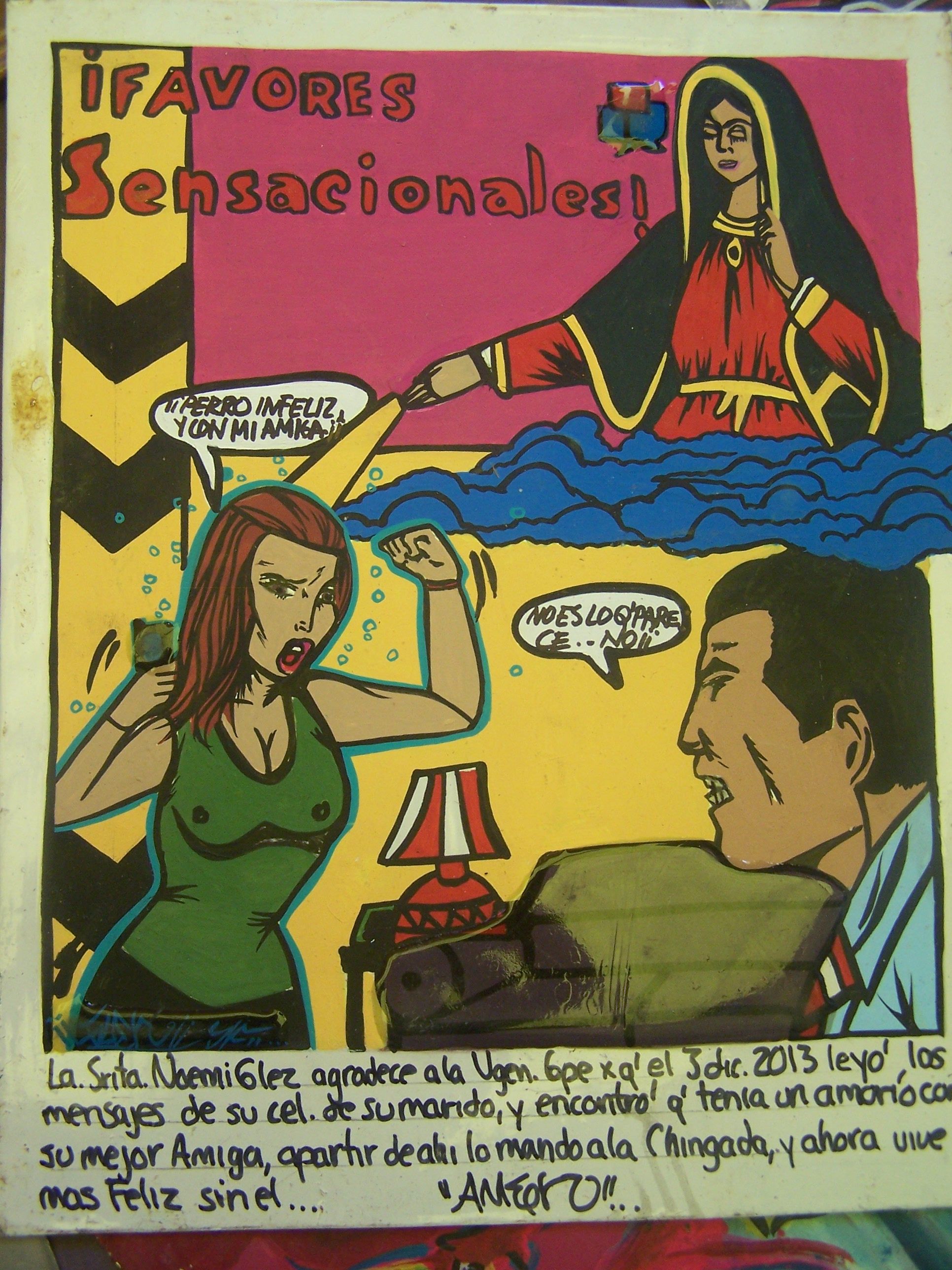
These issues highlight the need for interdisciplinary work, so that collective memory can be studied from different angles, since, beginning in the 1950s, various types and media of ex-votos, as well as ex-voto representations, underwent changes and stood out primarily for their new and transgressive approaches (Images 1 and 2). Image 1 shows the traditional ex-voto, with its more formalist aesthetic; it is not a drawing, but a message, in a word; Image 2 takes the form of a comic strip, with an aesthetic featuring elements that reflect a media-mediated contemporary world.
The two previous examples are pictorial ex-votos. The ex-voto in Image 2 is not ritually displayed in a church. It is merely an aesthetic potential brought to life that reflects contemporary elements, created by Donovan in Mexico. Image 1 shows a traditional ex-voto that was placed in a church. Neither of these circulates on social media. They are found in collections. Image 1 is a traditional ex-voto, while Image 2 is a transgressive ex-voto that reinforces a critique of society.
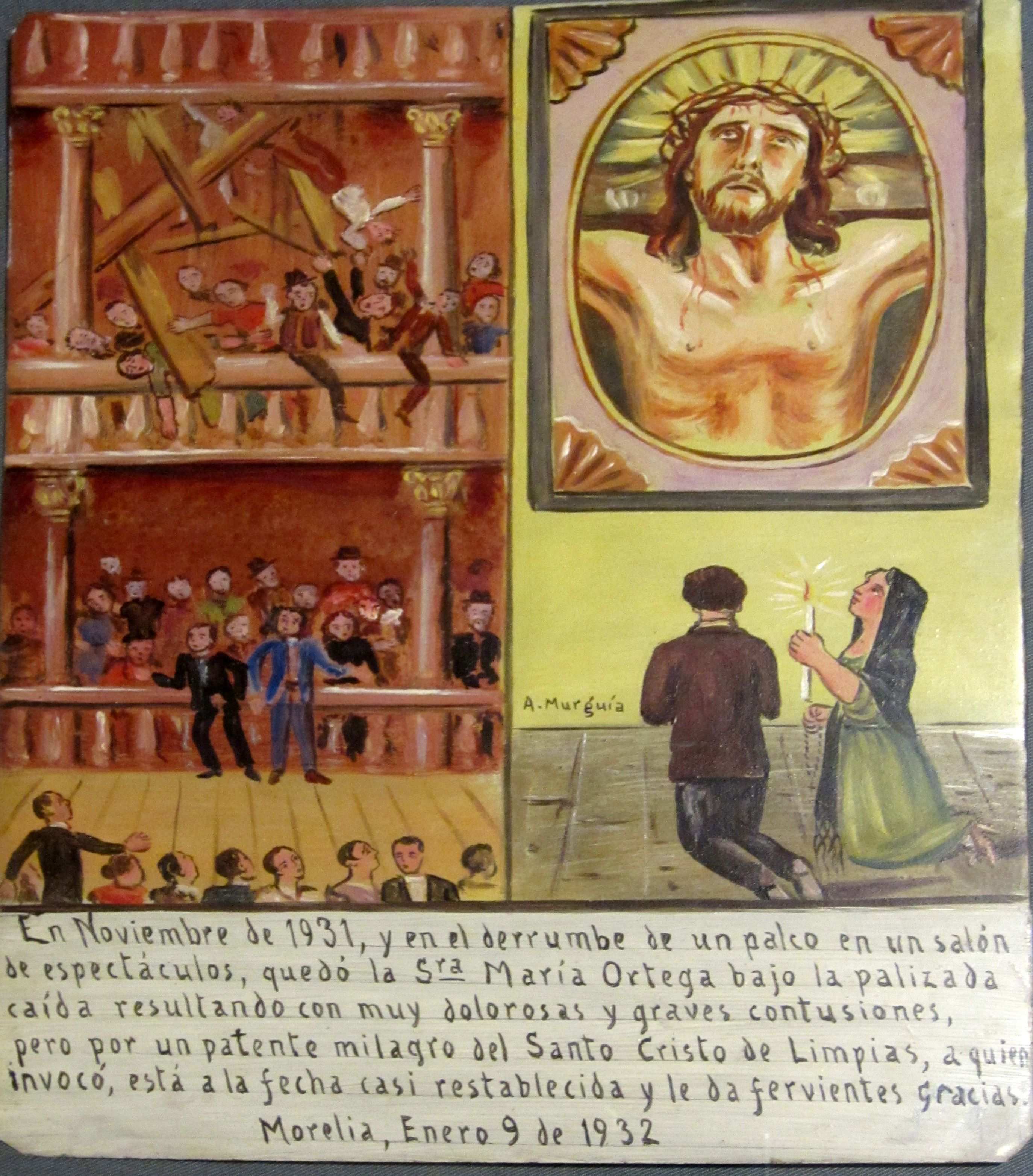
“In November 1931, when a stage collapsed at a performance hall, Mrs. Maria Ortega was trapped under the fallen railing and suffered very painful and serious bruises, but by a clear miracle of the Holy Christ of Limpias, whom she invoked, she has now almost fully recovered and offers him her fervent thanks. Morelia, January 9, 1932”
“Ms. Naomi Glez thanks Vgen. Gpe because on Dec. 3, 2013, she read the messages on her cell phone from her husband and found out that he was having an […] affair with her best friend. From that point on, she told him to go to hell, and now she’s happier without him…’
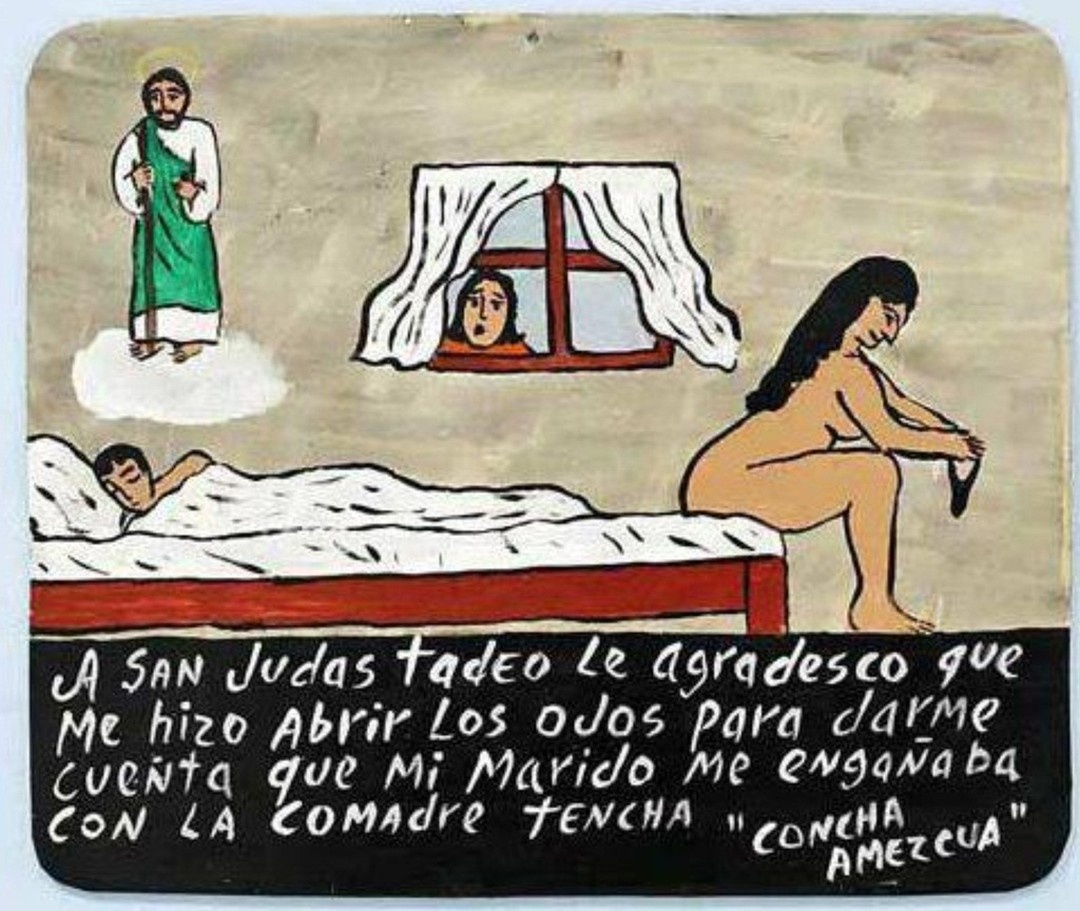
The exvotive transformation—from its various forms to its transgression and its immersion in cyberspace—is rooted in chronological time and in the contemporary possibilities of engaging with places, discourses, and issues that were long suppressed, as seen in images 3 and 4, in which the themes would not be accepted by a traditional Catholic Church, because they raise questions of sexuality and intersexuality.
This transformation, linked to representation, resides in a network (Latour, 2012) that allows us to view traditional or “reconditioned” ex-votos in non-sacred places. Such as in museums, exhibitions, film adaptations, or in works by artists who use the aesthetics of ex-votos as a source of art and messages of protest. Places representative of art, exhibition design, fashion, and cyberspace. A network that provides us with greater clarity regarding the expansion of ex-votos through other channels—based on them—in preserving the memory of what an ex-voto is.
Images 3 and 4 were indeed created artistically to circulate solely as satirical or humorous depictions on social media. These two examples are not votive offerings placed in churches, but rather an aesthetic that caricatures everyday life and other social factors. They are two examples of the votive offering as an active object, because the votive aesthetic is present, but not the intention to place the offering in a hall of miracles or a church. There is a purely pictorial aesthetic. This lies outside the religious sphere.
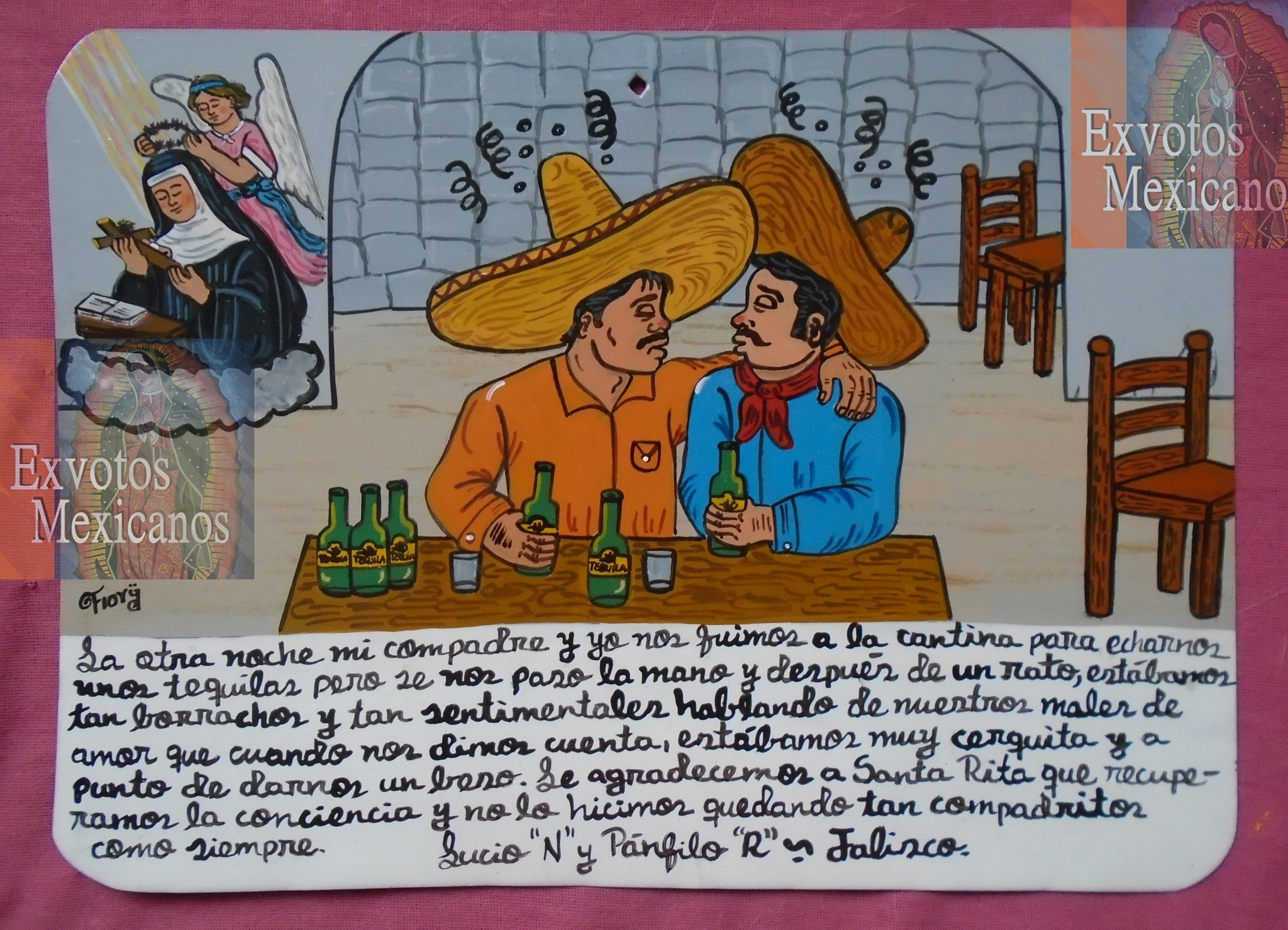
“The other night, my buddy and I went to the bar to have a few tequilas, but we got a little carried away, and after a while, we were so drunk and so sentimental, talking about our heartbreaks, that before we knew it, we were very close and about to kiss. We thank Santa Rita that we came to our senses and didn’t go through with it, remaining as close friends as ever. Lucio "N" and Pánfilo "R." Jalisco.”
I am grateful to Saint Jude Thaddeus for opening my eyes so I could realize that my husband was cheating on me with our neighbor Tencha “Concha Amezcua.”
From the perspective of popular communication, the votive offering itself serves various mediums, sharing individual and collective stories, discourses, messages, and information—what takes place on cruises, in “miracle rooms,” museums, and cemeteries. However, when the object functions more actively, we see the sale of the ex-voto, now with an aesthetic significance, since the value of the work is reflected in its aesthetics, and from this reflection arises the possibility of testimony, which manifests itself both in the art itself and, for example, in the decoration of a room. In this case, we refer both to physical fairs and galleries in Mexico and to the sale of ex-votos on major online marketplaces, such as Mercado Libre and apps for Android and iOS systems (Figure 5).
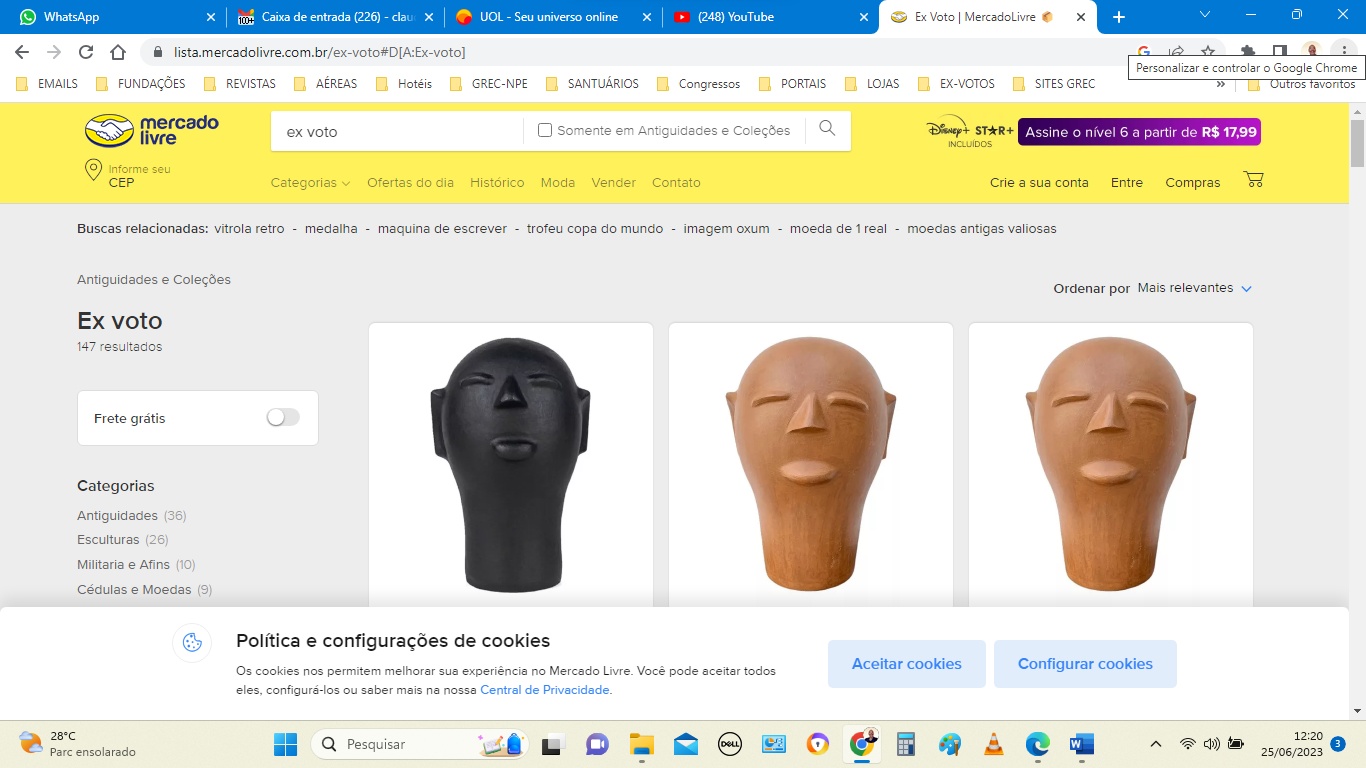
From the perspective of cyberspace, we can discuss the rituals of placing votive offerings in digital shrines, as well as—in addition to the sale of votive offerings on websites (Image 5)—the votive offerings that convey various forms of social protest and are posted on Facebook and Instagram. They are also transgressive, as they highlight causes that diverge from religious issues and relate to contemporary topics. In addition to this, many are digital natives, that is, they are votive offerings created in digital format—such as a document created in Microsoft Word, a photo taken with a digital camera, and many others created in digital format.
It is on these paths that we grapple with a memory acting, which moves between faith and the market, between shrines and fairs, between online storefronts and social media. Facing a performance, in a movement that generates effects that are no longer local but far-reaching, and which, through the various forms it takes, assumes multi- and hyper-dimensional proportions.
In this regard, when Latour reflects on objects and their roles in the course of action, the theorist of the ant states that social action “is not only undertaken by strangers but is also transferred or delegated to different types of actors capable of carrying it out through other modes of action, other types of force” [“it is not only undertaken by strangers, but is transferred or delegated to different types of actors capable of carrying it out thanks to other modes of action, to other types of force”] (Latour, 2012). For the French theorist, this portrays the basic, humble, prosaic, and common activities that objects perform in society. Such activities, in addition to constituting the process of ant, expand and diversify the ways of doing things, the actions, and the possibilities in every corner of culture, and it is with this purpose in mind that we see the leaps that the ex-voto provides: from the traditional to the transgressive, from the traditional to decoration, from everyday use to a hall of miracles, and from there to a museum. In addition to these leaps, there are many others, in different spheres, that multiply the object’s potential. In this sense, we can glimpse the “agents,” which take into account the behavior of others and are guided by them in order to steer possibilities along their own course or along various courses. Votive offerings are agents within these networks.
Still following Latour’s line of thought, we note that objects act in ways that depend on themselves and on other parts. They are complements to an almost infinite number of human actions or acts. In the case of votive offerings, because they are connected to human actions, they express power relations; symbolize social hierarchies; exacerbate social inequalities; convey social power; aspire to equality; and embody gender relations (Latour, 2012).
The power of votive offerings, when we talk about the ant, lies not only in the demonstration or testimony of the miracle itself, but also in the differences in the media used to convey the information, in the formats displayed in the miracle halls, in the “ostentation” based on educational attainment—including one’s profession—or the diplomas held by high-ranking officials, to the material displayed in the halls and museums: small gold and silver miracle images instead of brass ones. And we can even consider the altarpieces: when they are produced at low cost by a little-known altarpiece maker and, on the other hand, when the altarpiece, placed in a “miracle hall,” comes, for example, from the great altarpiece by Alfredo Vilchis.
As for the social hierarchies, votive offerings—in their various media, types, and formats—allow for class distinctions within the democratic space of a church’s “hall of miracles,” but through yet another act, they reinforce this aspect. Diplomas belonging to ministers, university presidents, mayors, legislators, and colonels—which pass through a “hall of miracles”—ultimately end up in the church’s museum. School diplomas, on the other hand, remain in the “hall of miracles” until they are burned and discarded by the church’s own priests. And among these diplomas, the hierarchy of the objects continues: elementary school diplomas alongside university degrees, master’s degrees, and doctorates.
The hierarchies themselves—as reflected in the votive offerings and their respective ranks or positions in society—reveal the social inequality. But other votive offerings are capable of revealing such inequality: letters and notes recounting a family’s experience of overcoming hunger; the achievement of a simple first job; evidence—through photos, paintings, drawings, or letters—of recovery from an illness or accident after the patient had been treated in a public hospital with limited resources; or release from prison after a court ruled that the charges brought against the individual were unfounded.
Latour’s assertion—which complements what he argues when discussing the “object” in society and in interconnections—reveals the “life” of each: that of the object and that of the human. They are different, primarily in terms of material/immaterial. But there is a society—and within it, uses, connections, and activities—where each becomes an actor, or even, collectively, creates an actor, revealing itself in its multiple possibilities and faces—a multimodality, so to speak. In relation to the object in question—the votive offering, whether in the form of a house key, a coin, a lock of hair, a tooth, drawings, letters, or paintings—it will no longer be what it once demonstrated to be a particular aspect of social life. It becomes, now, in the hall of miracles, a testimony to a home won back, to restored health, to a toothache that no longer exists, to the calligraphy that sketches a story of triumphs and joys, to an imaginative act that, through aesthetics, offers salvation.
It will reuse materials to make candles from paraffin votive offerings; from cans, including industrial ones; from wigs, made from strands of hair; from orthopedic devices and wheelchairs, which are repurposed by institutions that serve people with mobility challenges; it will become a scientific subject for museum exhibitions and documentation systems. Or it will meet its end, like letters, notes, and photographs of society’s most common figures: in the trash or at the incinerator.
Final thoughts
In this process—from the agency to the votive offering—we find what we might call case file. And in it, we see the “encounter” between two great theorists: Latour (2012) and Halbwachs (1990, 2004). Just like the acting object, Will the ex-voto be recognized throughout society—hence its importance as a stereotype—in the places where it is displayed, even outside the realm of “miracles”? T-shirt prints; in museums as an object that has been turned into a museum piece and displayed to the public for another purpose or restricted to visitors, in a technical collection, and in the documentation system; on social media as an object that deals with humor and social protest.
Through this recognition and its agency, we can perceive how it has fulfilled its role in various historical processes that are not limited to religion. The ex-voto, therefore, breathes life into other cultural objects and, at the same time, positions itself in a place (or various places) where its recognition will highlight significant historical moments, thereby preserving its value as a source of origin for social groups—which means, so to speak, the perpetuation and strengthening of collective memory—now increasingly expansive, consolidated in scope, and with its recognition and imaginary anchoring, so to speak, in the “non-place,” a term coined here by the French theorist Marc Augé (2000).
Bibliography
Auge, Marc (2000). Los no lugares. Espacios del anonimato: una antropología de la sobremodernidad. Barcelona: Gedisa.
Bergson, Henri (1999). Matéria e memória: ensaio sobre a relação do corpo com o espírito. São Paulo: Martins Fontes.
De Certeau, Michel (1982). A escrita da história. Río de Janeiro: Forense Universitária.
Deleuze, Gilles y Félix Guattari (1972). Anti-Œdipe. París: Éditions du Minuit.
González, Jorge A. (2017). Mais(+) cultura(s): estudos sobre telenovela, comunicação, culturas populares e sociedade. João Pessoa: Editora Instituto Federal da Paraíba/Editora da Universidade Estadual da Paraíba.
Halbwachs, Maurice (1990). A memória coletiva. Coimbra: Edições Vértice.
— (2004). Los marcos sociales de la memoria. Concepción: Universidad de Concepción/Universidad Central de Venezuela.
Latour, Bruno (2012). Reagregando o social: uma introdução à teoria do ator-rede. Salvador: Editora Universidade Federal da Bahía/Editora da Universidade do Sagrado Coração.
Lévy, Pierre (1999). Cibercultura. Río de Janeiro: Editora 34.
Luque Agraz, Elin (2012). “Análisis de la evolución de los exvotos pictóricos como documentos visuales para describir ‘la otra Historia’ de México”. Tesis doctoral. México: Universidad Nacional de Educación a Distancia.
Muniesa, Fabian (2015). “Actor-Network Theory”, International Encyclopedia of the Social & Behavioral Sciences, pp. 80-84. https://www.sciencedirect.com/science/article/pii/B9780080970868850011
Negroponte, Nicholas (1996). A vida digital. São Paulo: Schwarcz Ltda.
Nora, Pierre (1993, diciembre). “Entre memória e história: a problemática dos lugares”, Projeto História, vol. 3 pp. 7-28. https://revistas.pucsp.br/revph/article/view/12101
Perrée, Caroline (2013). L’ex-voto peint: la société mexicaine en mots et en couleurs. México: Centro de Estudios Mexicanos y Centroamericanos.
Oliveira, José Cláudio A. (2023). “A memória coletiva e a teoria ator-rede: o caso do ex-voto como objeto atuante”, 23º Encontro Nacional de Pesquisa em Ciência da Informação (enancib), 6 a 10 de noviembre. https://enancib.ancib.org/index.php/enancib/xxxiiienancib/paper/view/1356
— y Clarisse Pretre (2018). Se eu quiser falar com Deus: histórias e lugares dos ex-votos. Curitiba: Editora CVA!
Virilio, Paul (1999). O espaço crítico: e as perspectivas do tempo real. Río de Janeiro: Editora 34.
Vovelle, Michel (1987). Ideologias e mentalidades. São Paulo: Editora Brasiliense.
José Cláudio Alves Oliveira He holds a Ph.D. in Memory: Language and Society from the State University of Southwest Bahia (uesb), Brazil (2023). Ph.D. in Communication and Contemporary Culture from the Federal University of Bahia (ufba), Brazil (2004). Postdoctoral Fellowship pnpd/capes in Information Sciences at the Júlio de Mesquita Filho State University of São Paulo (unesp). Postdoctoral fellowship in Communication and Technology at the University of Miño, Portugal; associate professor iv in the Department of Museology at the ufba. Tenured professor in the graduate programs in Information Sciences (ppgci) and Museology of the ufba (ppgmuseu). Researcher at the cnpq. He served as coordinator of the Graduate Program in Museology at the ufba (2020–2024). He is the coordinator of the Ex-voto Research Center. He is the associate director of the Department of Museology at the ufba. He is a member of the ancib and the soter. He served as a member of the Evaluation Committees for capes and the finep. He was chair of the Social Sciences Committee of the pibic of the ufba between 2024 and 2026.
Institutions



 EN
EN  ES
ES  FR
FR  PT
PT