
Videogames as a Trojan Horse in the teaching of history
- Manuel Almazan
- - see biodata
Videogames as a Trojan Horse in the teaching of history
Receipt: December 8, 2024
Acceptance: April 1, 2025
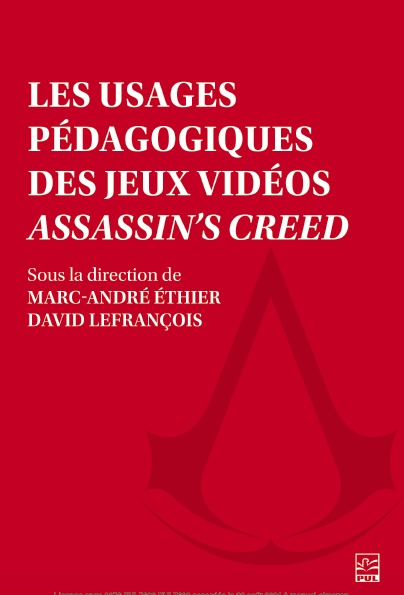
Les usages pédagogiques des jeux vidéo Assassin's Creed
Marc-André Éthier and David Lefrançois (dirs.), 2023 Les Presses de l'Université Laval, Quebec, 187 pp.
Playing is serious
The presence of video games in everyday life is becoming more and more evident; these types of works have been incorporated into workplaces and classrooms with the purpose of attracting the user's attention and facilitating the development of activities through a playful experience.
Educational centers have incorporated video games in some of their courses as a novel way of bringing students closer to certain knowledge. One of the titles that have inaugurated this trend and are currently enjoying a certain degree of popularity is Age of Empires (Ensemble Studios, 1997), a real-time strategy game set in different historical periods. Academics such as Begoña Gros and José Garrido (2008) have reported their experience in designing didactic strategies in elementary schools using the aforementioned game. For his part, Professor Nicolas Trépanier (2014) frequently uses the game in the following way Assassin’s Creed (Ubisoft, 2007) as part of their higher level courses. This is how the professor puts it:
I find that, even more than I expected, the use of video games is a very efficient way to allow undergraduates to engage with historiography and leaves them with a sophisticated, critical perspective that will likely remain alive long after they graduate (s. p.).
The French-Canadian studio that created this video game has decades of experience in the industry, so it is not surprising to see the emergence of Quebec initiatives to study the advantages and challenges that teachers face when bringing this type of product into the classroom. In this regard, we focus on the book Educational uses of Assassin video games’s Creed directed by Marc-André Éthier and David Lefrançois.
The first of these authors holds a doctorate in Didactics and a master's degree in History, both from the University of Montreal;1 Lefrançois holds a PhD in Philosophy from the Université du Québec en Trois-Rivières,2 is a professor of Education Sciences at the Université du Québec en Outaouais and directs the Revue des Sciences de l’Education.3
“History is our playground.”4
The franchise5 Assassin’s Creed an extensive struggle between the Templars and the hashashins; The first ones are looking for the fragments of Eden to control human behavior, while the latter attempt to prevent such acts by means of the animus, a device that relives the experience of ancient assassins, thus moving between different epochs.
The title that starts the saga6 of video games is studied by Romain Vincent and Vincent Boutonnet in “The limits of the critical analysis of Assassin's Creed in class: Damascus at the time of the Crusades”;7 here the authors present the experience of the young Dr. Romain in using Assassin's Creed (ac) in their history-geography classes with their fifth grade students (11 and 12 years old). In this regard, it is worth mentioning the elaboration of video excerpts in such a way that the students are not exposed to the violence that characterizes this title,8 but also to focus their attention on certain architectural elements.
It should be noted that no author of this book focuses on the titles immediately following this one: Assassin's Creed ii, Assassin's Creed: Brotherhood and Assassin's Creed: Revelations. For their part, Mathieu Beauséjour and Virginie Martel wrote “Use of video game kinematics Assassin's Creed iii in a critical stance”, while Alexis Benoît and François Furstenberg wrote “The universe of the Assassin's Creed iii and civil disobedience for the benefit of historical thought”.
In this respect, most of the chapters were written by two hands, either between a scholar and a teacher, a young doctor and a more experienced one, a man and a woman, even one based in Canada and the other in France. The diversity between collaborators is also evident in their approach to the saga; while Beauséjour and Martel make a critical appraisal after using Assassin's Creed For several years in the classroom, Benoît and Furstenberg offer a didactic strategy to be developed in class, including the planning of activities.
The following games in the saga were analyzed by contributors to the book under review; they are “Teaching Atlantic Revolutions and Critical Thinking with Assassin's Creed: Freedom Cry” by Guillaume Barral and “Video game literacy and videoludic representation of the past. Assassin's Creed: Unity in history class” by Hugo Orain and Julien Bazile, which deal with the Haitian and French revolutions, respectively.
Strictly speaking, Assassin's Creed Freedom Cry is a derivative (Downloadable Content)9 of Assassin's Creed iv: Black Flag, The latter expands the content of the latter; on the other hand, Assassin's Creed Unity is a game independent of any other (Stand Alone). The first of these games is used by Barral to raise awareness among students about slavery and the struggles in favor of populations of African origin.
Orain and Bazile approach the second of these titles to teach the origins of the French Revolution in order to promote a critical attitude when their students approach a video game or any other audiovisual medium (television series, Internet platform). Although students do not come into direct contact with the video game, the authors remind that any activity developed in the classroom can be approached in a playful way. Likewise, the authors ask the students not to fall into the dichotomy between “false” and “true”, but to direct their attention to realism (style), accuracy (degree) and authenticity (accreditation).
We find ourselves with a new leap in the saga, because the games Assassin's Creed: Rogue (2014) y Assassin's Creed: Syndicate (2015) are not addressed in this book. This may be due to the curriculum design in Quebec, but also to the ability of teachers/researchers to reconcile such degrees with their school goals.10 In this regard, the Ubisoft studio had already identified the use of its saga within schools, so it created a series that is detached from the main line of Assassin's Creed. This is what the study says on its web page:
The Discovery Tour series is composed of stand-alone games that allow players to freely roam through ancient Greece, ancient Egypt and the Viking Age to learn more about their history and daily life. Students, teachers, non-gamers and regular gamers can discover these eras at their own pace or embark on guided tours and stories supervised by historians and experts (Ubisoft, n.d.).11
In this regard, Kevin Péloquin wrote “Exploring Romanization on the Discovery Tour". OriginsRaphaël Gani and Guillaume Lescaut did the same with ”From identification to verisimilitude: Guillaume's journey through the Discovery Tours”, while Sébastien Quirion and Alexandre Lanoix wrote “The effects of the integration of video games in history classes on teaching practices”.
The first of these three chapters is based on the Discovery Tour: Ancient Egypt (2018); here it is proposed that students identify different architectural elements outside the Roman metropolis.12 Beyond this exercise, the authors point out the problematic nature of the term "the term". romanizationWhat room for action is left to the conquered peoples, and can the adoption of elements of Roman origin be considered a strategy on the part of these peoples?
The second of the above-mentioned chapters deals with three titles of the saga: Discovery Tour: Ancient Egypt (2018), Discovery Tour: Ancient Greece (2019) and Assassin's Creed Valhalla (2020). Gani and Lescaut's experience is characterized by the fact that it was developed among a group of underprivileged students; that is, they are young people who rarely practice any cultural activity and do not have information and communication technologies at home. Perhaps it is due to this situation that the students have difficulties in differentiating the realism with which the scenarios and characters of historical reality are represented. This is how the authors put it: “They assimilate the adjective ‘implausible’ to ‘unreal’. On the other hand, they do not consider as implausible different situations encountered in the game, but the media imaginary itself” (p. 68; quotation marks in the original).
The third of the above-mentioned chapters deals with the following titles Discovery Tour: Ancient Egypt (2018) and Discovery Tour: Ancient Greece (2019). The text focuses on the experience of different teachers: their preparation to use this type of technology in class and the difficulties it brought with it. In this regard, the authors highlight the use of reinforcement that was assigned to the titles; that is, the topics had already been addressed, so their use was a review. In this sense, some teachers consider this experience as an opportunity to get out of the routine and do not plan to repeat it in the near future.13
Finally, we come to the most recent title of the saga, which is addressed by Alexandre Joly-Lavoie in his text “Discovering Vinland with Assassin's Creed ValhallaAn activity to develop critical thinking”. Here the author proposes to deal with the Viking presence in what is known today as the American continent before the arrival of the Europeans (English and French); to do so, he uses written sources that are confronted with the representations included in the video game. Needless to say, the latter does not stand up well in terms of historical accuracy; however, this way of working is one of the deficiencies we find throughout the book.
New game?
After a detailed reading of Educational uses of Assassin's Creed video games, In this book, we can affirm that it is a critical exercise on different titles of the saga. Thus, for example, the various contributors to the book point out the pedagogical limitations of the game and the technological and logistical challenges in bringing it into the classroom. Their conclusions clearly state: “The game [...] does not automatically make students ‘historically’ active, in the sense that playing does not automatically imply the exercise of their critical thinking” (p.182).
In order to achieve the development of critical thinking, a game designed in this sense is required; there must be teachers trained to incorporate this type of material in the classroom, as well as a school system conducive to it: real estate, technology, curriculum, among others. The book's editors are aware of this, which is why they emphasize the planned, cautious and punctual use of the video game. Assassin's Creed is not a magic key to knowledge, but a challenge to the educational process.
While the authors of the book have identified the limitations and challenges involved in such a video game, we consider it useful to add other aspects that seem to have gone unnoticed. Throughout the book we identify different teaching strategies such as meaningful learning that takes students' prior knowledge of the saga into the classroom.
However, the approach that has attracted our attention the most is the so-called “falsificationism”;14 here different teachers have built their classes from the identification of various anachronisms and inaccuracies found throughout the saga, and the idea behind this type of exercise is to point out “this is wrong” or “this is not so” from certain written sources (touchstone).
In the worst case, the video game is used following a kind of behaviorism: “To motivate the students, the teams that helped each other, cooperated and did the requested work respecting the instructions were granted privileges, in particular free play time” (p.14). This type of video game use risks falling into a gamification of learning.
The experience of the Quebec teachers may seem alien to our context, although the development of the industry in Latin America in recent years has been growing and we find games such as Mexico, 1921: deep sleep (Mácula Interactive, 2004) which focuses on the assassination of President-elect Álvaro Obregón and the political instability that followed.
This and other video games are developed by local studios and deal with different episodes in national history; we do not know if they have been taken to schools as part of a learning strategy, so many questions remain in the air: how does the Mexican experience differ from that of other latitudes, how can such a game be approached in the classroom, who and how to assess the success of this exercise, among others.
Bibliography
Gros, Begoña y José Garrido (2008). “‘Con el dedo en la pantalla’: el uso de un videojuego de estrategia en la mediación de aprendizajes curriculares”, Teoría de la Educación. Educación y Cultura en la Sociedad de la Información, vol. 9, núm. 3, pp. 108-129.
Popper, Karl (1980). La lógica de la investigación científica. Madrid: Tecnos.
Trépanier, Nicolas (2014, 1 de mayo). “The Assassin’s Perspective: Teaching History with Video Games”, Perspectives on History. Disponible en: https://bit.ly/41bJanU.
Ubisoft (s.f). Discovery Tour. Disponible en: https://bit.ly/3ZgNr78.
Manuel Almazan is a specialist in International Migration (Colef), PhD in History from the University of Guanajuato and Master in Social Anthropology (COLSAN). He has worked as a teacher at the Faculty of Social Sciences and Humanities (UASLP), as well as an assistant at the Claude Bernard and Jean-Baptiste Say high schools (France). Founding member of the Abya Yala Network (https://www.redabya-yala.org). He is a member of the National System of Researchers (candidate). Currently works as a professor at the Faculty of Social Sciences and Humanities of the Universidad Autónoma de San Luis Potosí. Research interests: graphic history, visual anthropology, migrations.
Institutions



 EN
EN  ES
ES  FR
FR  PT
PT